Tyre Killers
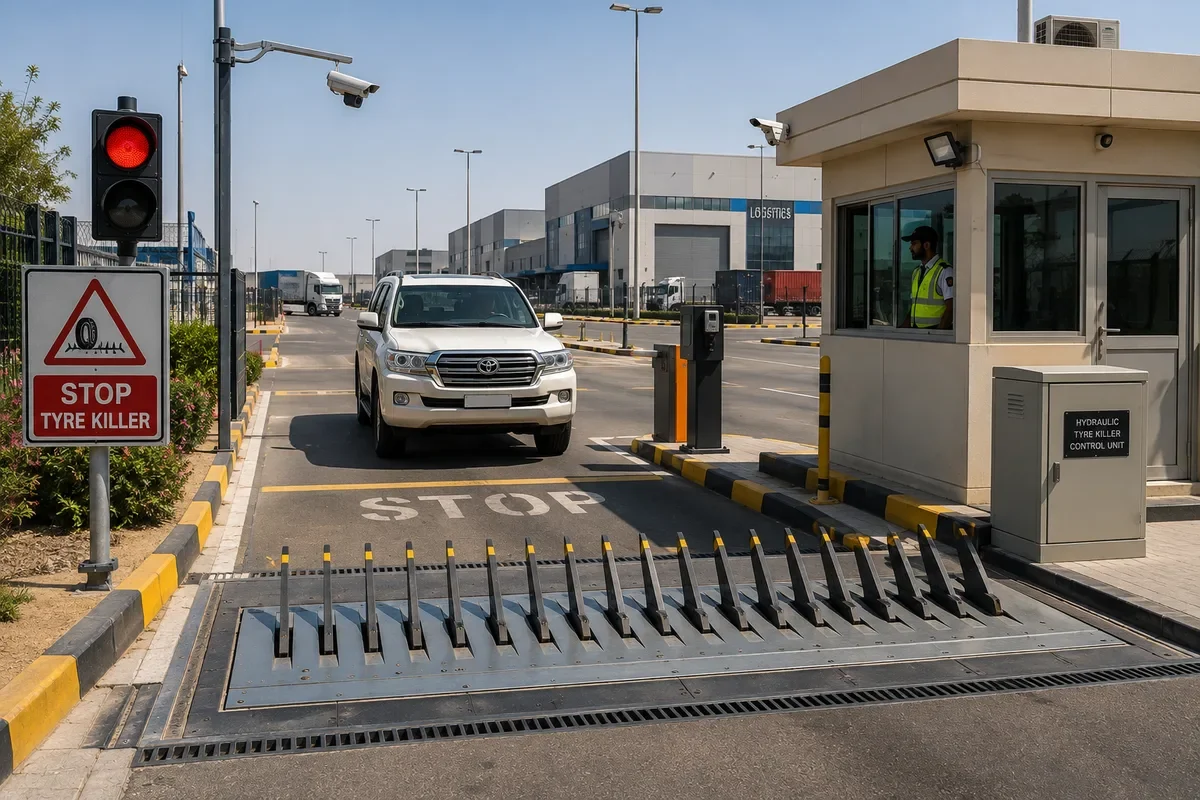
Tyre Killers are vehicle security devices installed across a roadway to restrict unauthorised or wrong-direction vehicle movement using heavy-duty rising spikes.
AZTÖR Automation supplies, installs, integrates, repairs and maintains tyre killer systems for government facilities, industrial compounds, logistics facilities, warehouses, controlled parking areas, security checkpoints and other restricted vehicle entrances across the UAE.
Tyre killers are fundamentally different from Parking Barriers, Automatic Bollards and Road Blockers. A Parking Barrier controls normal vehicle passage using a boom arm, while bollards and road blockers create physical barriers. A tyre killer is specifically designed around directional vehicle control and tyre-deflation deterrence.
A typical tyre killer consists of a reinforced steel body, rotating or retracting spike mechanism, structural frame, roadway fixing or foundation arrangement and, for automatic versions, an actuator and control system.
Tyre killers are available in mechanical and automatic configurations. The appropriate type depends on the traffic flow, security requirement, frequency of authorised movement, road layout and required integration with the wider vehicle access system.
Mechanical tyre killers are commonly configured for one-way traffic. Vehicles travelling in the permitted direction push the spikes down as the tyres pass over them, after which the spikes return to their raised position.
A vehicle attempting to travel against the permitted direction encounters the raised spike orientation and can suffer tyre damage.
The actual operating principle varies by manufacturer, so the traffic direction and product orientation must be confirmed before installation.
Automatic tyre killers use a powered mechanism to lower or raise the spikes according to authorised vehicle access commands.
Hydraulic, electro-mechanical, pneumatic or other manufacturer-specific operating mechanisms may be available depending on the selected system.
Automatic versions are particularly useful where the same lane needs controlled passage in different operating conditions or where the tyre killer must coordinate with security automation.
AZTÖR provides a free site inspection for applicable tyre killer projects. We assess the entrance geometry, traffic direction, lane width, vehicle types, operating frequency, road construction, drainage, underground services, security procedure and required access-control integrations before recommending the system.
Traffic direction is one of the most important design considerations. A tyre killer should never be positioned without clearly establishing the authorised vehicle approach and intended direction of travel.
Clear warning signage and road markings should be incorporated according to the site design so drivers understand the controlled direction before reaching the device.
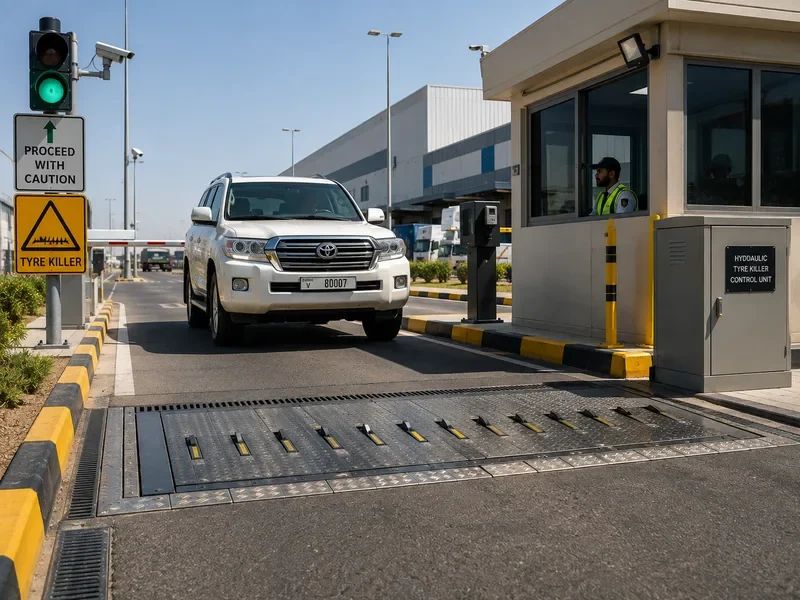
Traffic lights can provide additional visual control at automatic tyre killer entrances.
A red signal can instruct vehicles to stop while the system is not ready for passage, while a green signal can indicate authorised movement according to the configured control sequence.
Warning lights and audible signals may also be integrated where required.
Automatic tyre killers can operate from a guardhouse using authorised push-button, key-switch or control-console commands.
They can also integrate with ANPR vehicle access. An authorised number plate can initiate the required access sequence through a compatible controller.
UHF Vehicle Access can be used for long-range hands-free identification of registered staff, fleet, contractor or other authorised vehicles.
RFID, access cards and other compatible credential technologies can also form part of the wider entrance security system.
Visitor Vehicle Management can be integrated where temporary vehicles require pre-registration, ANPR recognition, intercom verification or security approval before entering.
An intercom can provide an exception workflow for vehicles that do not have automatic access authorisation.
Tyre Killers can also be integrated with Automatic Bollards, Road Blockers, Parking Barriers and automatic gates as part of a layered vehicle access automation system.
For example, a Parking Barrier can provide initial traffic control while a tyre killer provides directional security against unauthorised vehicle movement.
At a higher-security entrance, a tyre killer can operate together with a Road Blocker and security gate according to a defined access sequence.
The sequence between these devices needs careful control. One security device should not create an unsafe vehicle situation because another device has operated at the wrong time.
Suitable control systems can therefore use interlocking logic so the required device positions are confirmed before vehicle passage is authorised.
Induction loops can provide vehicle approach, presence and passage information to an automatic tyre killer control system.
Safety loops can be positioned according to the entrance design to help prevent automatic spikes from rising beneath an authorised vehicle.
Photocells or other suitable presence-detection devices can also be integrated where appropriate.
Access identification and physical vehicle detection remain separate functions. ANPR recognising a number plate does not confirm that the vehicle has completely cleared the tyre killer.
The automation sequence should therefore use suitable passage and safety detection before returning the system to its secure condition.
For automatic systems, position sensors or limit detection can provide feedback that the spikes have reached the required raised or lowered position.
The exact sensing method is manufacturer specific.
Tyre Killers can be installed in surface-mounted or embedded configurations depending on the selected manufacturer and system.
Surface-mounted tyre killers can reduce the depth of civil excavation but normally create a raised roadway profile or ramp arrangement.
The approach and departure ramps should therefore be suitable for the expected vehicles and site operating speeds.
Embedded or flush-mounted tyre killers can provide a lower-profile roadway installation but normally require more substantial excavation and civil coordination.
Neither configuration should be selected solely on appearance. Road construction, underground services, drainage, vehicle clearance and required security performance all need consideration.
Underground utility detection is important before excavation. Electrical cables, water pipes, drainage, telecommunications and other services can affect the available installation position.
Drainage is particularly important for embedded systems containing below-ground mechanical or powered components.
Rainwater, cleaning water, irrigation and groundwater conditions should be considered according to the manufacturer's installation requirements and actual site conditions.
The surrounding roadway and foundation must be suitable for the expected vehicle loads.
Passenger cars, delivery vans, buses and heavy commercial vehicles create different loads, so expected traffic should be identified before the system is selected.
Heavy vehicle applications require equipment and structural arrangements designed for the relevant axle and traffic conditions.
Vehicle speed across a tyre killer should follow the selected manufacturer's requirements and site operating procedure.
Tyre killers should generally form part of a controlled, low-speed security entrance rather than being treated as ordinary unrestricted roadway equipment.
Speed humps, lane geometry, signage, barriers or other traffic-control measures can be used where appropriate to manage approach speed.
Tyre killers are intentionally capable of damaging vehicle tyres when a vehicle attempts prohibited movement. They therefore require particularly clear operational procedures, driver warnings and authorised control.
They should only be used in appropriate controlled-access environments where the security requirement justifies this type of device.
Pedestrian and cyclist routes should be separated appropriately from the tyre killer area. Exposed spikes can create a serious hazard outside their intended vehicle-control function.
The installation layout should therefore prevent normal pedestrian movement across the spike mechanism wherever reasonably practicable.
Motorcycles and other two-wheeled vehicles also require specific consideration. A tyre killer designed around conventional vehicle lanes should not be assumed to provide a safe passage arrangement for every vehicle type.
If motorcycles need to use the entrance, the traffic and access design should specifically address them.
Emergency vehicle access must be considered where the controlled route may be used by fire, ambulance, police or other authorised emergency vehicles.
Automatic systems can provide appropriate emergency lowering or authorised override functions where supported and required by the project.
The required emergency behaviour should be established during design rather than added after installation.
Power-failure behaviour also depends on the selected automatic system.
Manual lowering, emergency release, accumulator arrangements, UPS-supported controls, generator support or other manufacturer-specific solutions may be considered according to the equipment and project requirements.
The required fail-safe or fail-secure condition should match the site's security and emergency-access strategy.
Outdoor UAE installations require suitable materials, coatings, controllers and drive components for heat, direct sunlight, dust, sand, humidity and the actual environmental exposure.
Corrosion protection is particularly important for equipment installed within or close to the roadway.
Regular cleaning is also important because sand, stones and road debris can interfere with moving spike mechanisms.
A tyre killer should not automatically be described as a crash-rated vehicle barrier.
Its primary purpose is normally tyre deflation and directional vehicle deterrence rather than stopping the kinetic energy of an impacting vehicle in the same way as a tested Road Blocker, wedge barrier or crash-rated bollard.
Tyre damage does not guarantee that a moving vehicle will stop immediately.
This distinction is particularly important for high-security projects. If the security requirement is to stop a hostile vehicle within a documented penetration distance, an independently tested hostile-vehicle mitigation barrier should be selected for that requirement.
A tyre killer may still be used as an additional security layer, but it should not replace a crash-rated barrier unless the specific complete product has independently documented performance for the required application.
Likewise, a thicker spike or heavier steel body does not automatically create a certified crash rating.
Where a project requires documented vehicle-impact protection, AZTÖR can integrate suitable tested Road Blockers, Automatic Bollards or other certified vehicle barriers alongside the tyre killer according to the security design.
Tyre killers can be particularly useful at exits where the objective is to discourage vehicles from entering through the outbound lane.
A mechanical one-way tyre killer can allow vehicles to exit in the permitted direction while presenting raised spikes to vehicles attempting to enter from the opposite direction.
However, this arrangement should only be used where the selected product, traffic layout and safety assessment support it.
At guarded industrial entrances, automatic tyre killers can provide more flexible control because security personnel can lower the spikes for authorised movement.
Logistics facilities can integrate the system with guardhouse procedures, ANPR and access control for approved fleet and contractor vehicles.
At sensitive sites, multiple verification stages can be incorporated before the tyre killer is lowered.
Existing tyre killer systems can often be repaired depending on their condition and availability of compatible parts.
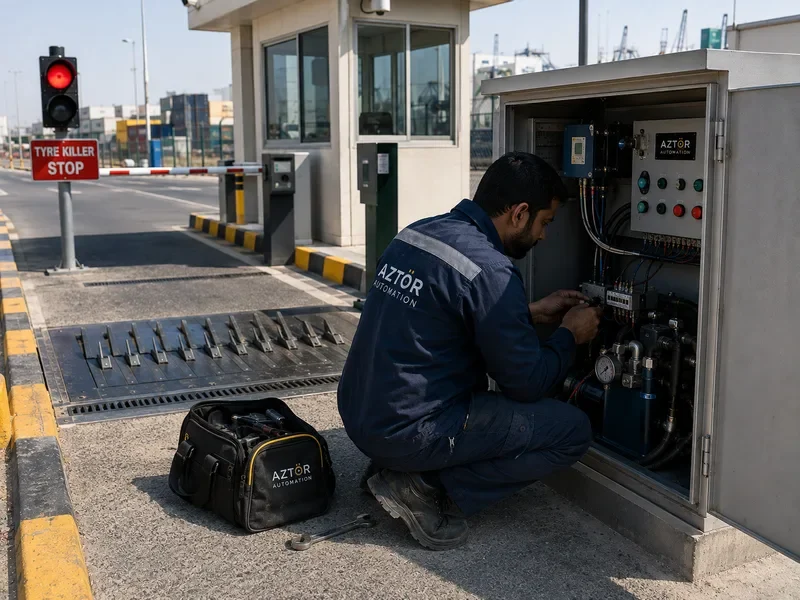
AZTÖR can inspect spike assemblies, springs, shafts, bearings, actuators, hydraulic components where applicable, control panels, position sensors, loops and access-control interfaces.
Common faults include spikes remaining down, spikes failing to retract, uneven movement, damaged spikes, broken springs, mechanical jamming, hydraulic leakage, actuator faults, controller faults and vehicle-detection problems.
Sand, stones and road debris can cause mechanical obstruction and should be removed through appropriate maintenance rather than allowing debris to accumulate around moving components.
A damaged spike should be repaired or replaced rather than left in a condition that changes the intended vehicle-control function.
After a significant vehicle impact or unauthorised crossing, the spike assembly, frame, anchors, foundation and operating mechanism should be inspected.
Automatic systems also require testing of their safety sequence after repairs.
Preventive maintenance can include cleaning, spike and spring inspection, lubrication where specified by the manufacturer, mechanical checks, hydraulic or actuator inspection, control-panel testing, position-sensor testing, loop verification, traffic-light checks and complete operating-sequence testing.
AZTÖR Automation provides Tyre Killer installation, security automation, vehicle access automation, repair and maintenance across Dubai, Abu Dhabi, Sharjah, Ajman, Ras Al Khaimah, Fujairah and Umm Al Quwain, with suitable project and technical support available across the wider GCC.
Key Features
- Heavy-duty tyre killers
- Automatic tyre killers
- Mechanical tyre killers
- One-way tyre killers
- Directional vehicle control
- Wrong-way vehicle deterrence
- Rising spike systems
- Retractable spike systems
- Automatic retractable spikes
- Surface-mounted tyre killers
- Embedded tyre killers
- Flush-mounted options
- Hydraulic tyre killer options
- Electro-mechanical options
- Heavy vehicle options
- Single-lane systems
- Multi-lane systems
- Controlled vehicle entrances
- Security checkpoint applications
- Guardhouse control
- Push-button control
- Key-switch control
- Control-console operation
- ANPR integration
- UHF Vehicle Access integration
- RFID integration
- Visitor Vehicle Management integration
- Intercom integration
- Access-control integration
- Security automation integration
- Gate automation integration
- Parking Barrier integration
- Automatic Bollard integration
- Road Blocker integration
- Layered entrance security
- Security interlocking
- Induction loop integration
- Vehicle presence detection
- Vehicle passage detection
- Safety loop integration
- Photocell integration
- Position detection
- Traffic-light integration
- Warning-light integration
- Audible warning options
- Emergency override options
- Manual lowering options
- Power-failure management
- UPS integration where suitable
- Generator integration where suitable
- Emergency vehicle access
- Heavy-duty steel construction
- Roadway installation
- Outdoor UAE installation
- Corrosion-resistant options
- Civil foundation works
- Drainage coordination
- Underground utility coordination
- Spike replacement
- Spring replacement
- Mechanical repair
- Hydraulic repair
- Actuator repair
- Control-panel repair
- Loop detector repair
- Sensor replacement
- Access-control troubleshooting
- Preventive maintenance
- AMC support
Technical Specification
| Solution Type | Directional tyre-deflation vehicle security system |
|---|---|
| Primary Function | Restrict unauthorised or wrong-direction vehicle movement |
| Application | Controlled commercial, industrial and security vehicle entrances |
| Configuration | Mechanical or automatic |
| Spike Operation | Fixed directional, mechanically retracting or automatically retracting according to system |
| Drive Technology | Mechanical, hydraulic, electro-mechanical, pneumatic or manufacturer specific |
| Installation Type | Surface mounted, embedded or manufacturer specific |
| Lane Width | Project and manufacturer specific |
| System Width | Manufacturer and project specific |
| Spike Height | Manufacturer and model specific |
| Spike Construction | Heavy-duty steel or manufacturer specific |
| Traffic Direction | Project specific |
| Permitted Direction | Defined during installation |
| Operating Speed | Manufacturer and site specific |
| Vehicle Type | Product and project specific |
| Heavy Vehicle Suitability | Available on suitable systems |
| Control Panel | Automatic systems |
| Guardhouse Control | Available |
| Push Button | Available on automatic systems |
| Key Switch | Available |
| ANPR Integration | Available |
| UHF Integration | Available |
| RFID Integration | Available |
| Visitor Management Integration | Available |
| Intercom Integration | Available |
| Parking Barrier Integration | Available |
| Road Blocker Integration | Available |
| Automatic Bollard Integration | Available |
| Automatic Gate Integration | Available |
| Induction Loop Integration | Available |
| Vehicle Presence Detection | Available |
| Safety Loop | Available on suitable automatic systems |
| Photocell Integration | Available |
| Position Detection | Manufacturer specific |
| Traffic Lights | Available |
| Audible Warning | Available where required |
| Interlocking | Available on suitable automatic control systems |
| Emergency Override | Project and manufacturer specific |
| Manual Operation | Manufacturer specific |
| Power Failure Behaviour | Automatic system and project specific |
| UPS Integration | Project specific |
| Generator Integration | Project specific |
| Foundation | Product and installation specific |
| Drainage | Site and manufacturer specific |
| Outdoor Application | Available |
| Environmental Rating | Manufacturer and model specific |
| Corrosion Protection | Manufacturer and project specific |
| Crash Rating | Not inherent to a tyre killer; only where independently documented for a specific product |
| Installation | New installation, replacement or suitable retrofit |
| Maintenance | Spikes, springs, mechanisms, actuators, controls, drainage, sensors and access integration |
Tyre Killers should be selected according to traffic direction, lane width, vehicle type, operating frequency, road construction, underground services, drainage, access-control requirements and the site's security procedure. Because the system is intentionally capable of damaging tyres during prohibited movement, warning signage, controlled approach speed, pedestrian separation and emergency operating procedures are important parts of the design. A Tyre Killer should not be represented as a crash-rated vehicle-stopping barrier unless the specific complete system has independently documented impact performance. AZTÖR Automation provides a free site inspection before finalising the system and security automation design.
Typical Applications
- Government facilities
- Government compounds
- Security facilities
- Controlled parking exits
- Restricted parking entrances
- Industrial facilities
- Factories
- Manufacturing plants
- Warehouses
- Logistics centres
- Distribution centres
- Corporate compounds
- Business parks
- Data centres
- Utility facilities
- Power facilities
- Oil and gas facilities
- Ports
- Marine facilities
- Airports
- Service entrances
- Fleet entrances
- Contractor entrances
- Staff entrances
- Security checkpoints
- Vehicle checkpoints
- Guardhouse-controlled entrances
- Private roads
- Restricted roads
- One-way vehicle exits
- One-way vehicle entrances
- ANPR-controlled entrances
- UHF-controlled entrances
- Automatic gate entrances
- Parking Barrier entrances
- Road Blocker security entrances
- Automatic Bollard entrances
- Layered vehicle security systems
- High-security entrances where appropriate