Dock Shelters
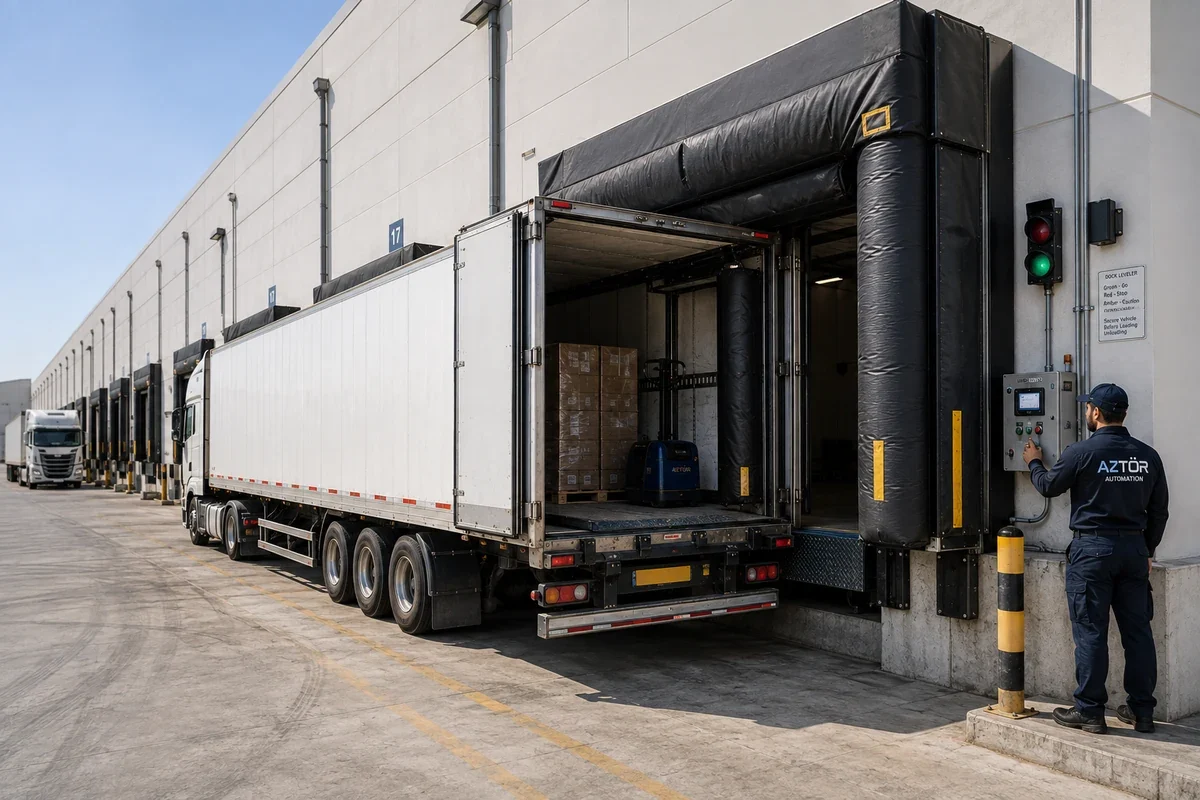
Dock shelters are loading-bay systems installed around warehouse doorways to create a protective interface between the building and a truck or trailer during loading and unloading. They help reduce the open space around the vehicle while goods, forklifts and personnel move between the warehouse and trailer.
AZTÖR supplies, installs, replaces and maintains dock shelters for warehouses, logistics centres, distribution facilities, factories, cold stores and other commercial and industrial loading bays across the UAE.
A dock shelter is not simply a cover above the loading door. The complete system needs to suit the loading-bay opening, dock height, vehicle dimensions, approach position, traffic frequency and environmental requirements of the facility.
Different vehicle fleets require different shelter solutions. A warehouse receiving trailers of relatively consistent dimensions may have different requirements from a distribution centre handling vehicles with substantial variation in height and width.
Common solutions include retractable curtain dock shelters, fixed or framed shelters, inflatable dock shelters and other manufacturer-specific loading-bay sealing systems. The appropriate type depends on the vehicle fleet and required level of environmental separation.
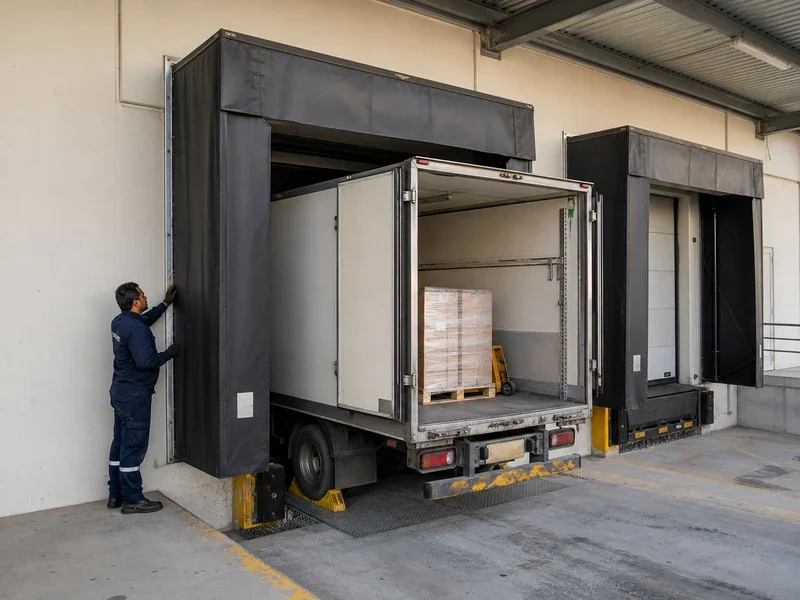
Curtain-type dock shelters generally use flexible side and top curtains that interact with the rear of the vehicle as it approaches the dock. They provide a practical solution for many general warehouse and logistics applications.
The curtain material and supporting structure must tolerate repeated contact associated with normal docking operations. Flexible or retractable construction can help the shelter accommodate suitable vehicle movement and reduce the likelihood of damage from normal positioning variation.
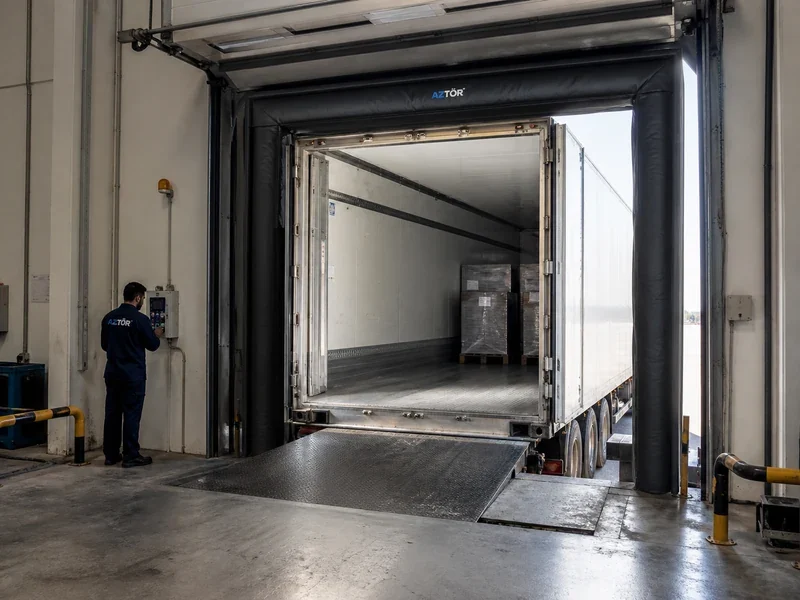
Inflatable dock shelters provide a different approach. After the vehicle is correctly positioned, inflatable side and/or top sections expand around the vehicle body to reduce the surrounding gaps. They can be particularly useful where stronger environmental separation is required.
For cold storage and air-conditioned logistics facilities in the UAE, reducing the exposed area around a docked vehicle can help limit unnecessary entry of hot outside air during loading. Actual energy performance depends on the complete loading bay, vehicle, door-opening time, shelter design and operational procedure.
Dock shelters can also help reduce the entry of dust, wind and rain into the loading area. They should not, however, automatically be described as completely airtight or weatherproof because sealing performance depends on the vehicle interface and selected system.
AZTÖR provides a free site inspection for applicable dock shelter projects. We assess the doorway, dock height, building face, dock leveller position, vehicle widths and heights, approach arrangement, bumpers, traffic frequency and environmental requirements before recommending a configuration.
Vehicle dimensions are particularly important. The shelter must provide an appropriate working range for the trucks expected to use the bay without creating unsuitable interference with doors, mirrors, tail lifts or other vehicle components.
The vehicle should contact the dock bumpers rather than use the shelter structure as a stopping device. Dock bumpers help establish the intended vehicle position and protect the loading-bay structure from normal docking contact.
Damaged or excessively compressed bumpers can change the vehicle's final position relative to the shelter. Bumpers, dock shelter and dock leveller should therefore be considered as interacting components rather than unrelated products.
Dock shelters are commonly coordinated with dock levellers and sectional overhead doors. The sectional door closes the building opening, the leveller bridges the transition to the trailer and the shelter helps reduce the surrounding environmental gap while the vehicle is docked.
The complete loading-bay arrangement can also incorporate vehicle restraints, wheel guides, wheel chocks, traffic lights, dock lights and other equipment according to the site's operational and safety requirements.
For temperature-controlled warehouses, inflatable shelters or other enhanced sealing systems can be coordinated with insulated sectional doors and suitable dock equipment to support the cold-chain interface.
Where vehicles vary considerably in height, adjustable or manufacturer-specific top sealing arrangements may be considered. The correct solution depends on the vehicle fleet and selected shelter system.
Tail-lift vehicles require particular attention. Certain loading arrangements can interfere with conventional side or bottom sealing components, so the shelter and dock configuration should be checked against the actual vehicle operation.
Dock shelters can also protect loading-bay personnel and goods from direct external exposure while a vehicle is positioned at the bay. The level of protection depends on the shelter type, vehicle fit and weather conditions.
For UAE installations, fabric and flexible components should be selected with consideration for heat, UV exposure, dust, sand and repeated mechanical contact. External frames, fixings and supporting components should also be appropriate for the site environment.
Wind exposure should be considered, particularly at open logistics yards and exposed building elevations. The shelter structure and flexible components must be appropriate for the selected system and installation conditions.
A damaged shelter curtain should not be ignored. Torn fabric, bent frames or loose fixing components can reduce environmental performance and may cause further damage as trucks continue using the bay.
AZTÖR can inspect existing dock shelters and replace suitable side curtains, head curtains, flexible components, frame sections, inflatable components and other compatible parts subject to the manufacturer and condition of the equipment.
Where an existing shelter repeatedly suffers vehicle-impact damage, simply replacing the damaged fabric may not solve the underlying problem. Vehicle approach, bumpers, shelter dimensions, wheel guides and dock layout should also be reviewed.
Preventive maintenance can include checking fabric condition, stitching or joints, flexible supports, frames, fixings, bumpers and inflatable components where applicable.
For inflatable dock shelters, the blower, air distribution system, inflatable cushions, controls and associated electrical components should also be inspected according to the manufacturer's maintenance requirements.
AZTÖR provides dock shelter supply, installation, replacement, repair and preventive maintenance across Dubai, Abu Dhabi, Sharjah, Ajman, Ras Al Khaimah, Fujairah and Umm Al Quwain, with suitable loading-bay support available across the wider GCC.
Key Features
- Industrial loading-bay dock shelters
- Warehouse dock shelter systems
- Retractable dock shelters
- Curtain-type dock shelters
- Flexible side curtains
- Flexible head curtains
- Inflatable dock shelter options
- Inflatable side cushion options
- Inflatable top cushion options
- Vehicle-specific sealing solutions
- Multi-vehicle loading applications
- Truck and trailer interface
- Reduced loading-bay exposure
- Supports temperature-controlled operations
- Helps reduce hot-air infiltration
- Helps limit dust entry
- Weather-protection support
- Cold-chain loading applications
- Heavy-duty flexible curtain materials
- Retractable frame options
- Impact-tolerant configurations according to selected system
- Vehicle-size accommodation
- Adjustable top arrangements where available
- Dock bumper coordination
- Dock leveller coordination
- Sectional overhead door coordination
- Vehicle-restraint coordination
- Traffic-light coordination
- Wheel-guide coordination
- Dock-light coordination
- Tail-lift vehicle assessment
- External UAE applications
- UV-resistant material options according to selected system
- Replaceable side curtain options
- Replaceable head curtain options
- Frame repair and replacement
- Inflatable cushion repair
- Blower servicing for inflatable systems
- Control troubleshooting
- Existing dock shelter replacement
- Preventive maintenance and AMC support
Technical Specification
| Product Type | Loading bay dock shelter |
|---|---|
| Primary Function | Reduce open space around a docked vehicle during loading |
| Application | Warehouse, logistics, industrial and temperature-controlled loading bays |
| Shelter Type | Retractable, curtain, inflatable or manufacturer-specific system |
| Side Interface | Flexible curtain, inflatable cushion or system-specific arrangement |
| Top Interface | Head curtain, adjustable section, inflatable cushion or system-specific arrangement |
| Frame Construction | Manufacturer-specific steel or engineered support frame |
| Curtain Material | Reinforced flexible industrial fabric according to selected system |
| Vehicle Range | Selected according to expected truck and trailer dimensions |
| Opening Size | Project and loading-bay specific |
| Dock Height | Project specific |
| Vehicle Width | Fleet and system specific |
| Vehicle Height | Fleet and system specific |
| Vehicle Position | Determined by dock layout and bumper arrangement |
| Retraction | Available on suitable curtain shelter systems |
| Inflation System | Available on inflatable dock shelter systems |
| Blower | Manufacturer-specific on inflatable systems |
| Control | Manufacturer-specific on powered inflatable systems |
| Environmental Separation | Dependent on vehicle fit and selected shelter system |
| Thermal Performance | Complete loading-bay and system specific |
| Weather Protection | Application and system specific |
| Wind Suitability | Manufacturer and installation specific |
| UV Resistance | According to selected fabric material |
| Dock Bumpers | Coordinated with vehicle stopping position |
| Dock Leveller Integration | Compatible as part of complete loading-bay system |
| Sectional Door Integration | Compatible |
| Vehicle Restraint Integration | Compatible as part of loading-bay system |
| Traffic Light Integration | Available as part of wider loading-bay controls |
| Wheel Guides | Available as complementary loading-bay equipment |
| Tail-Lift Compatibility | Requires project and vehicle assessment |
| Installation | New installation or existing shelter replacement |
| Maintenance | Fabric, frame, fixings, inflatable components and blower systems as applicable |
Dock shelter dimensions and configuration must be selected from the actual loading bay and vehicle fleet. Truck width, trailer height, dock height, bumper projection, tail-lift arrangement and vehicle-positioning tolerance all affect performance. A shelter should not automatically be described as airtight or completely weatherproof. AZTÖR provides a free site inspection to assess the loading bay and expected vehicles before final system selection.
Typical Applications
- Warehouses
- Logistics centres
- Distribution centres
- Fulfilment centres
- Loading bays
- Loading docks
- Factories
- Manufacturing facilities
- Cold storage warehouses
- Temperature-controlled warehouses
- Refrigerated logistics facilities
- Food distribution facilities
- Food-processing facilities
- Frozen-food warehouses
- FMCG warehouses
- Pharmaceutical warehouses
- Healthcare distribution facilities
- Retail distribution centres
- Supermarket distribution centres
- E-commerce fulfilment centres
- Third-party logistics facilities
- Cargo facilities
- Airport logistics facilities
- Freight terminals
- Automotive warehouses
- Spare-parts warehouses
- Packaging facilities
- Commercial storage facilities
- Industrial loading facilities
- Existing loading-bay upgrades