Turnstiles
Turnstiles provide controlled pedestrian passage by allowing authorised users to enter or exit through a managed access point while helping prevent unrestricted movement into secured areas.
AZTÖR Automation supplies, installs, integrates, upgrades, repairs and maintains pedestrian turnstile systems for offices, commercial towers, residential developments, factories, warehouses, data centres, government facilities, schools, hospitals, gyms and other controlled premises across the UAE.
Turnstiles are available in several configurations including tripod turnstiles, flap barriers, swing barriers, speed gates and full-height turnstiles. The correct type depends on the required security level, pedestrian volume, architectural environment, accessibility requirements and access-control technology.
AZTÖR provides a free site inspection for applicable Turnstile projects. We assess entrance width, expected pedestrian flow, required number of lanes, entry and exit directions, accessibility, emergency egress, credential technology, existing access control, electrical and network requirements and the surrounding architectural layout before recommending a solution.
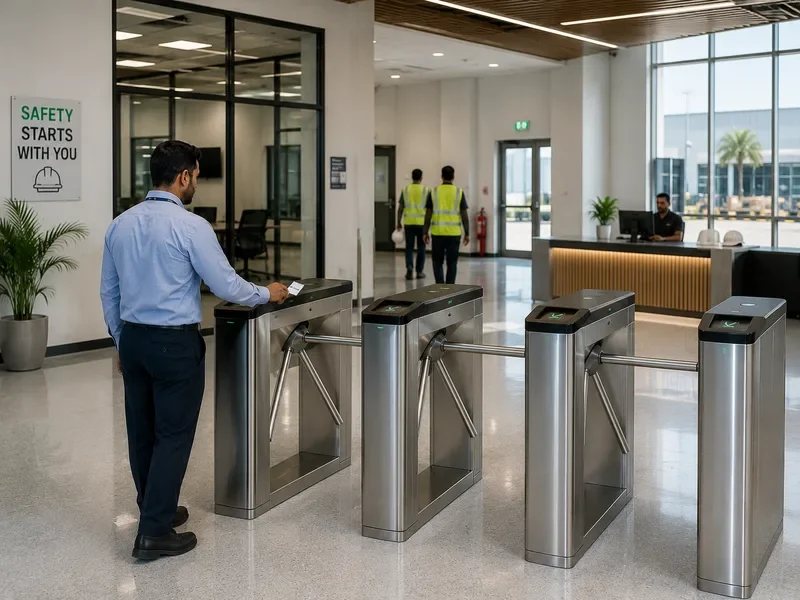
Tripod turnstiles use rotating three-arm mechanisms to provide controlled pedestrian passage. They are commonly used for staff entrances, factories, warehouses, gyms, labour accommodation and other applications where practical controlled access is required.
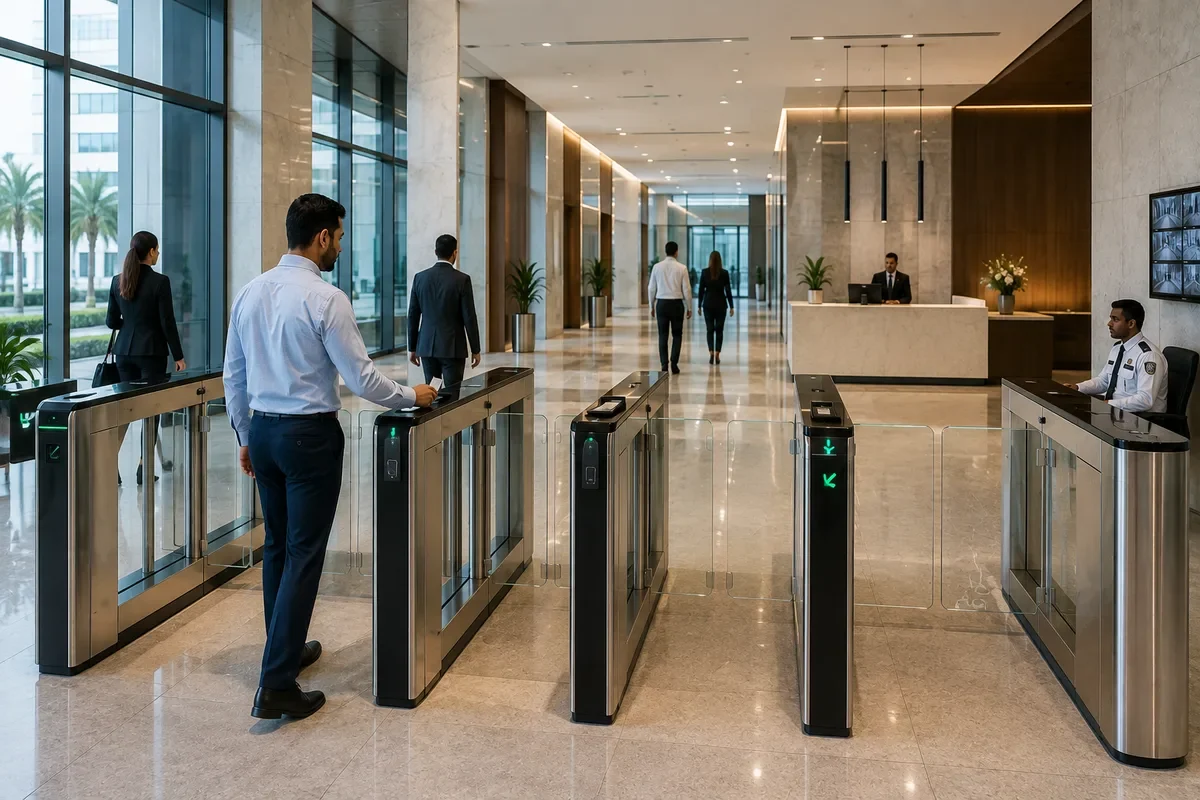
Flap barriers use retractable barrier wings within pedestrian lanes. Their compact appearance makes them suitable for many office lobbies, commercial buildings, metro-style entrances and other modern interior environments.
Swing barrier turnstiles use motorised swinging panels, typically glass or another manufacturer-specific barrier material, to open a pedestrian passage after successful authorisation.
Swing barriers can provide wider passage lanes and are often considered where wheelchair users, people with reduced mobility, luggage, trolleys or other accessibility requirements need to be accommodated.
Speed gates are premium pedestrian access systems designed for controlled, efficient movement through corporate lobbies and other high-traffic environments.
Depending on the selected system, speed gates can use swing or retractable barrier technology together with multiple pedestrian-detection sensors.
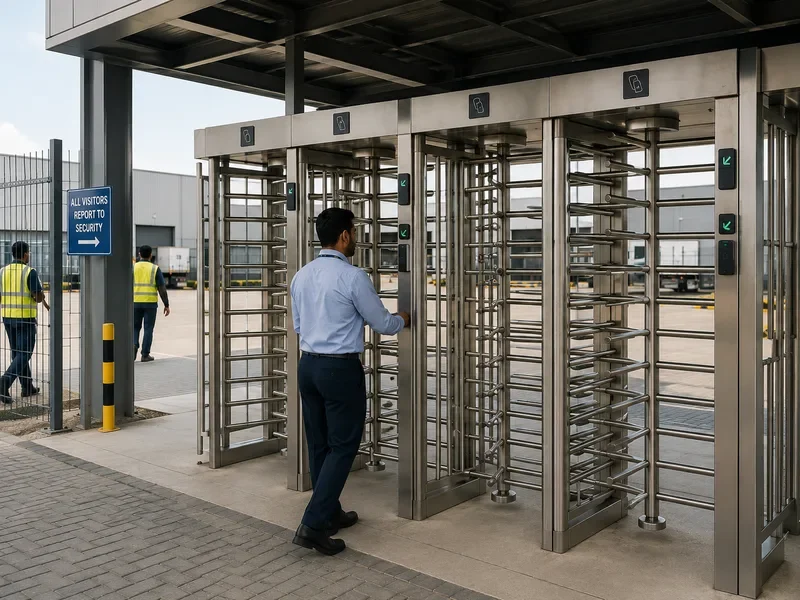
Full-height turnstiles provide a substantially higher physical level of pedestrian access restriction than waist-height systems.
They are commonly considered for industrial sites, warehouses, perimeter entrances, staff compounds, data centres and other locations where stronger pedestrian separation is required.
Single-lane and multi-lane full-height configurations are available from suitable manufacturers.
The security level of a turnstile should be matched to the actual application.
A premium glass speed gate may provide excellent controlled access in an office lobby but should not automatically be considered equivalent to a full-height physical security turnstile.
Likewise, a full-height turnstile may provide strong physical restriction but may not provide the architectural appearance expected in a premium commercial reception.
Pedestrian flow is an important design factor.
The number of users arriving during peak periods should be considered rather than designing only around average daily traffic.
Office shift changes, factory shift changes, school arrival periods, events and other concentrated traffic can create significantly different throughput requirements.
The number of turnstile lanes should therefore be selected according to expected peak movement, credential verification time and required entry and exit configuration.
Turnstiles can be configured for entry only, exit only or bidirectional passage depending on the selected model and control system.
Some installations use dedicated entry and exit lanes, while suitable bidirectional turnstiles can change passage direction according to configured operating requirements.
Access authorisation can be provided using RFID cards, key fobs, PIN credentials, biometric terminals, facial recognition, QR codes, mobile credentials or other technologies supported by the selected access-control system.
RFID card access is widely used for employee and resident turnstile systems because individual credentials can be centrally assigned and revoked.
Biometric authentication can be considered where the application requires stronger user verification and the selected platform supports the required technology.
Facial recognition terminals can provide contactless user authentication at suitable turnstile entrances.
Biometric systems should be implemented with appropriate consideration of user enrolment, privacy, retention, security and applicable UAE data-protection requirements.
QR access can be particularly useful for visitors, contractors and event-style temporary access.
A Visitor Management platform can issue a temporary QR credential that allows passage through the authorised turnstile during the permitted period.
Mobile credentials can provide another contactless access option where supported by the selected platform.
Turnstiles can integrate with Door Access Control so the same authorised credential can operate the building entrance, turnstile and selected internal doors.
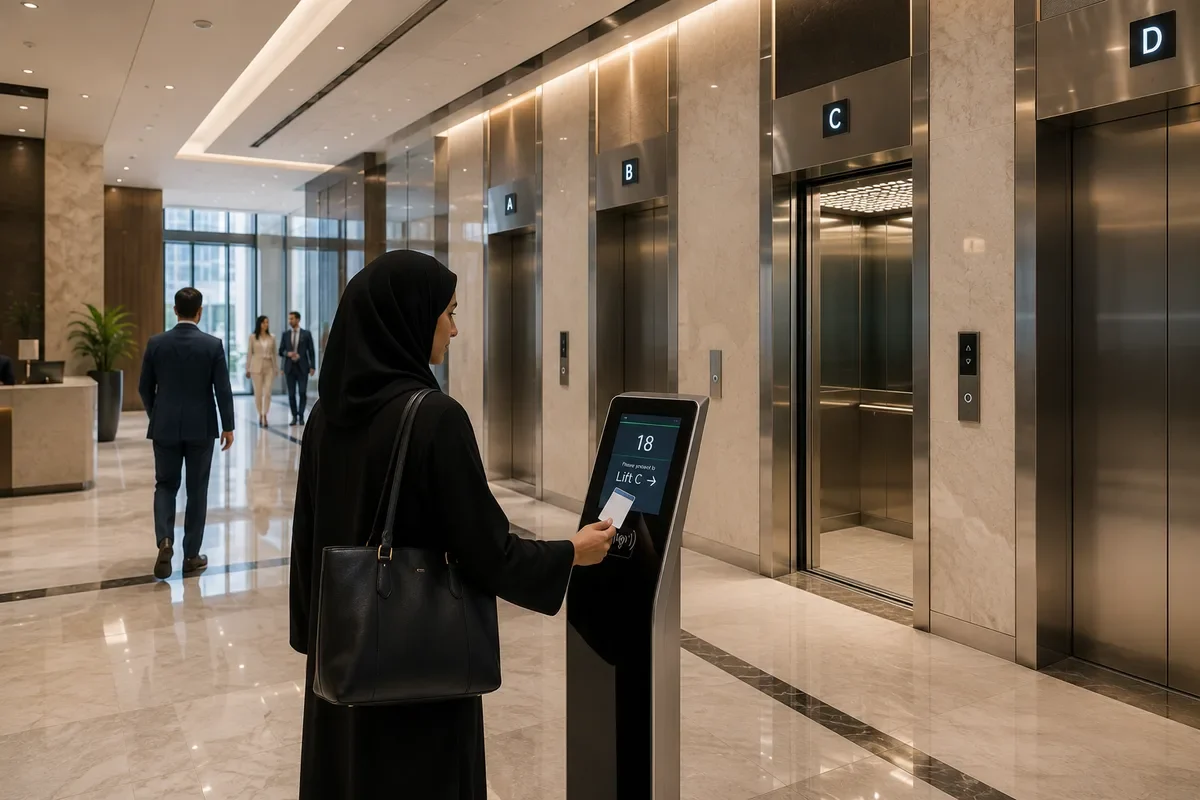
Elevator Access can also be incorporated into the wider access-control architecture.
For example, an employee may authenticate at the turnstile, enter the secure lobby and then receive access only to the elevator floors and office doors associated with their permissions.
Cabinet Access can extend the same layered security architecture further to server racks, lockers or other protected enclosures.
This creates a coordinated security path from pedestrian entrance through floor, room and individual protected asset.
Turnstile readers and access-control controllers perform different functions.
The credential reader identifies or authenticates the user, while the controller and configured permissions determine whether passage should be authorised.
The turnstile then performs the physical pedestrian-control function.
Suitable systems can use integrated readers within the turnstile cabinet or externally mounted credential terminals depending on the equipment and architectural design.
Reader mounting should allow comfortable presentation without causing users to stop in an unsafe or obstructive position.
For high-throughput entrances, credential reading and gate response should be coordinated to maintain smooth pedestrian flow.
Modern speed gates and flap or swing barriers can incorporate multiple optical or infrared sensors to monitor pedestrian movement through the lane.
Depending on the selected system, sensor logic can help detect unauthorised passage conditions such as tailgating, wrong-way movement, lane intrusion or passage by more than one person following a single authorisation.
The exact detection capabilities vary significantly between manufacturers and models and should not be assumed for every turnstile.
Anti-tailgating functionality can improve controlled access but does not guarantee that every possible unauthorised passage attempt will be detected.
Where higher security is required, the turnstile should form part of a wider security design involving access control, CCTV, guards or other appropriate measures.
CCTV can be positioned around turnstile entrances to provide visual monitoring.
Where compatible systems support integration, access events can be associated with relevant surveillance footage through a Video Management System.
A denied credential, forced passage or other security event can then be investigated together with the corresponding camera view.
Turnstile systems can also integrate with Visitor Management.
Visitors can be pre-registered by reception, security, a tenant or an authorised host.
A temporary QR, card, mobile or other supported credential can then provide access only during the approved visit period.
Suitable platforms can automatically expire visitor credentials after their permitted validity.
Contractor access can be managed in a similar way.
Temporary workers can be given access to selected entrances and time schedules without being issued unrestricted permanent credentials.
For factories and industrial facilities, turnstiles can support controlled staff movement at shift entrances.
Integration with access control can help ensure only authorised employees or contractors enter restricted operational areas.
Turnstile access records can also provide useful movement information, but they should not automatically be treated as a complete time-and-attendance system.
Where formal employee attendance, payroll or working-hours management is required, a dedicated Time & Attendance platform or supported integration should be configured.
Suitable access-control platforms can integrate turnstile events with Time & Attendance functions.
However, system design should consider scenarios such as users entering through alternative authorised routes, emergency exits or tailgating, which can affect simple entry/exit assumptions.
Accessibility must be considered from the beginning of the turnstile design.
A standard narrow tripod lane may not provide appropriate wheelchair access.
A wider swing barrier, accessible gate or other suitable controlled passage should therefore be incorporated where required.
Accessible lanes can also accommodate users with luggage, delivery items, pushchairs or other legitimate wider-passage requirements.
The wider lane should still use appropriate access-control and pedestrian-detection logic.
Emergency egress is another critical design consideration.
Turnstiles must not create an inappropriate obstruction to required emergency evacuation.
Depending on the selected equipment and approved life-safety strategy, suitable turnstiles may provide free rotation, automatic opening, barrier retraction, drop-arm functionality or another emergency passage arrangement.
The exact emergency behaviour depends on the turnstile type, manufacturer, project and approved fire and life-safety requirements.
Fire-alarm integration can be incorporated where required so compatible turnstiles respond according to the approved emergency sequence.
The required behaviour should be defined during design rather than assuming every turnstile must operate identically during an alarm.
Tripod turnstiles may use a drop-arm mechanism on suitable models to create freer passage during an emergency or power-loss condition.
Flap barriers and speed gates may retract or open their barrier wings according to their design and emergency configuration.
Swing barriers may move to an open position where the approved system supports this operation.
Full-height turnstiles require particular attention to emergency egress because their physical structure provides significantly greater restriction.
A separate emergency exit gate or another approved egress arrangement may be necessary depending on the site and life-safety strategy.
AZTÖR does not treat ordinary access-controlled turnstiles as substitutes for required emergency exit arrangements.
Power-failure behaviour should also be established during design.
The system may fail open, fail in a free-passage condition, retain a defined secure state or use another manufacturer-specific response depending on the equipment and application.
Backup power can be incorporated for suitable access-control controllers, readers and turnstile systems where required.
Backup duration should be calculated from the actual connected equipment rather than applying a universal number of hours.
Turnstiles can be installed as standalone access points or as part of a centralised enterprise security platform.
A small office may require only a few lanes, while a large corporate campus, industrial facility or multi-building development may require central management of many pedestrian entrances.
Role-based administration can restrict which operators are allowed to create users, change permissions, issue visitor credentials or review security events.
Multi-tenant buildings can use separate access groups for different companies.
A central building administrator can retain overall system control while tenant-specific permissions are managed according to the selected platform and property policy.
Turnstiles can also be integrated with intercom or reception workflows.
A visitor who cannot authenticate can contact reception or security before being granted controlled passage where the system design supports remote authorisation.
For premium office and commercial environments, turnstile aesthetics can be coordinated with the interior architecture.
Stainless steel, glass panels, slim cabinets and manufacturer-specific premium finishes can be considered according to the selected product.
The equipment should still be selected primarily around pedestrian flow, security, accessibility and serviceability rather than appearance alone.
Outdoor turnstiles require specific environmental consideration.
Full-height and suitable other turnstiles can be selected for external UAE conditions where their environmental rating and construction support the application.
Heat, direct sunlight, dust, sand, humidity and coastal corrosion can affect readers, controllers, mechanical components and finishes.
Outdoor readers and biometric terminals should also be selected according to their documented environmental ratings.
Ingress protection should be based on the actual manufacturer's product rating rather than assuming all outdoor-looking turnstiles are weatherproof.
Foundation and floor conditions are important.
Turnstile cabinets and frames need secure structural fixing according to the manufacturer.
Raised floors, marble, tiles, concrete slabs and other finished surfaces require different installation considerations.
Before drilling, embedded electrical services, floor heating, waterproofing and other concealed infrastructure should be considered where relevant.
Power, network and access-control cabling should ideally be planned before the final floor finish on new projects.
For retrofit projects, cable routing should be coordinated so the installation remains technically sound and visually appropriate.
Turnstile lane alignment is important.
Poor alignment between cabinets or barrier panels can affect appearance, sensor performance and physical operation.
Pedestrian sensors should be commissioned according to the manufacturer's required geometry and operating logic.
Existing turnstiles can often be integrated with newer access-control systems after compatibility assessment.
For example, an older card-controlled turnstile may potentially be upgraded with newer RFID readers, biometric terminals, facial recognition, QR visitor access or mobile credentials.
The existing controller inputs, operating logic, turnstile condition and available interfaces should be checked first.
Different access-control brands and turnstile systems are not automatically interchangeable.
Reader protocols, relay interfaces, controller communication, credential technologies, software licensing and manufacturer-specific APIs can affect integration.
AZTÖR assesses the existing equipment before proposing an upgrade rather than assuming replacement of the complete turnstile is necessary.
Common turnstile faults include the lane not opening after valid access, barriers remaining open, tripod arms not rotating correctly, flap or swing panels failing to move, pedestrian sensors generating false alarms, readers going offline and turnstiles not responding to access-control commands.
A credential can be successfully authorised while the turnstile still fails to open because of controller, relay, drive, sensor, power or mechanical problems.
Conversely, a turnstile that remains open may have an emergency input, fire-alarm interface, controller command, sensor fault or mechanical issue.
Tripod turnstiles can develop mechanical wear in rotating mechanisms, locking assemblies and dampers.
Flap and swing barrier systems require inspection of motors, drive assemblies, barrier panels, sensors and controller electronics.
Speed gates depend heavily on accurate pedestrian sensor operation as well as mechanical and electronic condition.
Full-height turnstiles require inspection of the rotating assembly, locking mechanism, frame, bearings and access-control interface.
Preventive maintenance can include mechanical inspection, alignment checks, barrier-panel inspection, reader testing, controller communication, pedestrian-sensor testing, emergency-release testing, fire-interface verification where applicable, power-supply checks and complete entry/exit sequence testing.
High-traffic entrances benefit particularly from planned maintenance because turnstile failure can quickly affect pedestrian movement and building security.
AZTÖR Automation provides Turnstile installation, access control integration, security automation, repair and maintenance across Dubai, Abu Dhabi, Sharjah, Ajman, Ras Al Khaimah, Fujairah and Umm Al Quwain, with suitable project and technical support available across the wider GCC.
Key Features
- Pedestrian access control
- Automatic turnstiles
- Tripod turnstiles
- Flap barrier turnstiles
- Swing barrier turnstiles
- Speed gates
- Full-height turnstiles
- Waist-height turnstiles
- Single-lane turnstiles
- Multi-lane turnstiles
- Entry-only operation
- Exit-only operation
- Bidirectional operation
- Accessible pedestrian lanes
- Wide-lane access
- Wheelchair access options
- RFID card access
- Key fob access
- PIN access options
- Biometric access
- Fingerprint access
- Facial recognition integration
- QR access
- Mobile credentials
- Multi-factor authentication options
- Employee access
- Resident access
- Tenant access
- Visitor access
- Contractor access
- Temporary credentials
- Time-based permissions
- Access group management
- Centralised access management
- Multi-tenant management
- Multi-site management
- Pedestrian detection
- Passage monitoring
- Tailgating detection options
- Wrong-way detection options
- Lane intrusion detection options
- Access event logging
- Denied access events
- Door Access Control integration
- Elevator Access integration
- Visitor Management integration
- Time & Attendance integration
- CCTV integration
- VMS integration
- Intercom integration
- Intrusion Detection integration
- Smart Building integration
- Fire-alarm integration where required
- Emergency opening options
- Drop-arm options
- Free-passage options
- Emergency exit integration
- Backup power options
- Stainless-steel construction options
- Glass barrier options
- Premium lobby solutions
- Industrial turnstiles
- Outdoor turnstile options
- Existing turnstile retrofit
- Reader upgrades
- Biometric upgrades
- QR visitor upgrades
- Controller upgrades
- Turnstile motor repair
- Mechanical turnstile repair
- Pedestrian sensor repair
- Reader replacement
- Control-board repair
- Preventive maintenance
- AMC support
Technical Specification
| Solution Type | Automatic pedestrian access control |
|---|---|
| Primary Function | Controlled entry and exit of authorised pedestrians |
| Turnstile Type | Tripod, flap barrier, swing barrier, speed gate, full height or manufacturer specific |
| Application | Commercial, residential, industrial and secure pedestrian entrances |
| Lane Configuration | Single or multiple lanes |
| Passage Direction | Entry, exit or bidirectional |
| Lane Width | Manufacturer, model and accessibility specific |
| Accessible Lane | Available |
| Barrier Type | Tripod arm, flap wing, swing panel, rotating full-height assembly or manufacturer specific |
| Barrier Material | Stainless steel, glass, acrylic or manufacturer specific |
| Cabinet Construction | Manufacturer and model specific |
| Operating Speed | Manufacturer and configuration specific |
| Pedestrian Throughput | Credential, model and project specific |
| Drive Technology | Electromechanical, motorised or manufacturer specific |
| RFID Access | Available |
| Key Fob Access | Available |
| PIN Access | Available on suitable systems |
| Fingerprint Integration | Available |
| Facial Recognition Integration | Available |
| QR Access | Available |
| Mobile Credential | Available on compatible platforms |
| Multi-Factor Authentication | Available on suitable systems |
| Visitor Management Integration | Available |
| Door Access Integration | Available |
| Elevator Access Integration | Available |
| Time & Attendance Integration | Available where compatible |
| CCTV/VMS Integration | Available where compatible |
| Intercom Integration | Available where compatible |
| Pedestrian Detection | Available on suitable optical turnstiles |
| Tailgating Detection | Model and sensor specific |
| Wrong-Way Detection | Available on suitable systems |
| Lane Intrusion Detection | Available on suitable systems |
| Access Event Logging | Available |
| Emergency Operation | Manufacturer and project specific |
| Fire Alarm Interface | Available where required and compatible |
| Emergency Free Passage | Manufacturer and life-safety strategy specific |
| Drop Arm | Available on suitable tripod models |
| Automatic Barrier Opening | Available on suitable speed, flap and swing systems |
| Backup Power | Available on suitable systems |
| Indoor Application | Available |
| Outdoor Application | Available on suitably rated systems |
| Environmental Rating | Manufacturer and model specific |
| Foundation | Manufacturer and site specific |
| Network | Platform and manufacturer specific |
| Software | Access-control platform specific |
| Installation | New installation, expansion, retrofit or replacement |
| Maintenance | Mechanical, drive, sensors, readers, controllers, safety and integration |
Turnstiles should be selected according to pedestrian volume, peak traffic, required security level, lane width, accessibility, credential technology, emergency egress, environmental conditions and the building's wider access-control architecture. Tripod, flap, swing, speed-gate and full-height systems provide different levels of security and user experience and should not be treated as interchangeable. Emergency and fire-alarm behaviour must follow the approved life-safety strategy. AZTÖR Automation provides a free site inspection before finalising the Turnstile and security automation design.
Typical Applications
- Commercial towers
- Corporate offices
- Office buildings
- Corporate headquarters
- Business parks
- Residential towers
- Residential communities
- Mixed-use developments
- Government facilities
- Data centres
- Server facilities
- Factories
- Manufacturing plants
- Warehouses
- Logistics centres
- Industrial facilities
- Staff entrances
- Employee entrances
- Contractor entrances
- Visitor entrances
- Security checkpoints
- Reception areas
- Office lobbies
- Commercial lobbies
- Building entrances
- Hospitals
- Healthcare facilities
- Schools
- Universities
- Educational campuses
- Hotels
- Gyms
- Fitness centres
- Sports facilities
- Staff accommodation
- Labour accommodation
- Construction site entrances
- Restricted pedestrian areas
- Critical infrastructure
- Ports
- Airports
- Multi-tenant buildings
- High-security pedestrian entrances
- Outdoor perimeter entrances