RFID Vehicle Access
RFID Vehicle Access provides controlled vehicle entry and exit using registered electronic credentials. When a valid RFID credential is presented within the designed reading range, the access-control system verifies its permission and can send an opening command to the connected parking barrier or automatic gate.
AZTÖR designs, supplies, installs, integrates, upgrades and maintains RFID vehicle access solutions for residential communities, commercial buildings, offices, staff parking, warehouses, factories and other controlled vehicle entrances across the UAE.
RFID is a broad technology category rather than one universal vehicle-access product. Different RFID systems operate at different frequencies and reading ranges, so the correct technology should be selected according to how vehicles are expected to approach and use the entrance.
Shorter-range RFID access can be suitable where drivers intentionally present a card or credential near a reader. Longer-range vehicle identification is normally better addressed through a purpose-designed long-range RFID or UHF solution.
This distinction is important when planning the entrance. A standard proximity card reader mounted beside a vehicle lane should not be expected to provide the same hands-free reading distance as a dedicated long-range vehicle reader.
AZTÖR provides a free site inspection for applicable RFID vehicle-access projects. We assess the entry and exit lanes, barrier or gate, vehicle stopping position, required reading distance, traffic volume, credential type, network infrastructure and access-management requirements before recommending the system.
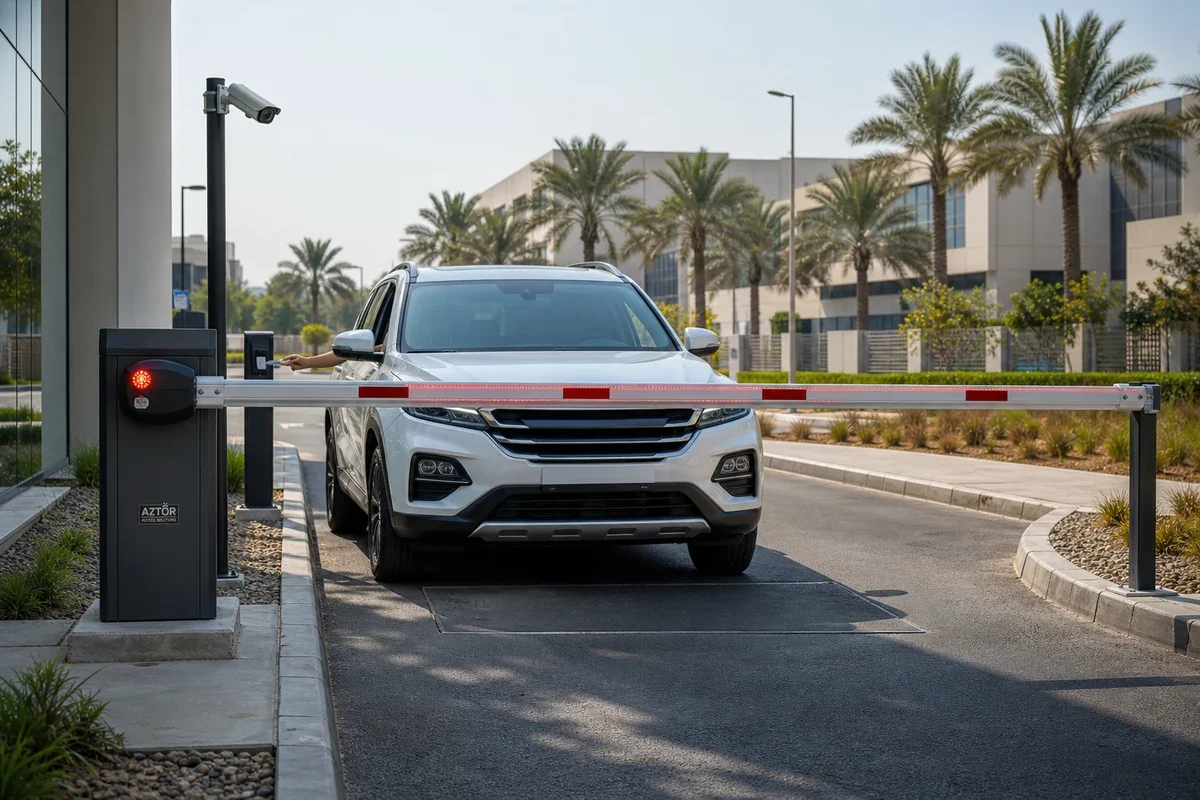
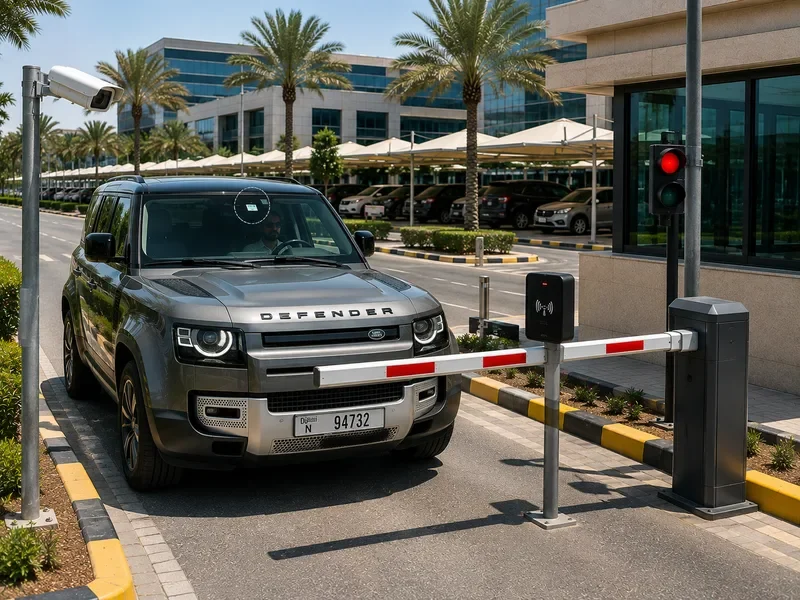
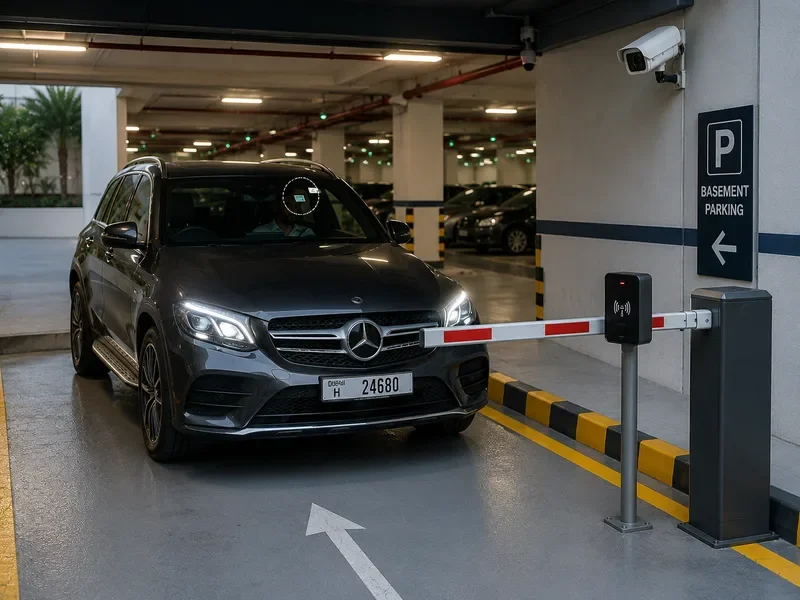
For a simple controlled parking entrance, an RFID reader can be installed at a convenient driver-accessible position. The driver presents an authorised credential, the access controller validates it and the barrier opens according to the configured logic.
Reader pedestals can be used where there is no suitable wall or guardhouse position. Pedestal height and setback should be designed so drivers can reach the reader comfortably without leaving the vehicle.
The reader position should also avoid forcing drivers to approach kerbs, islands, barriers or other structures at an unsafe angle.
RFID credentials can include cards, tags and other manufacturer-specific credential formats. Vehicle-oriented systems can also use appropriately selected tags according to the reader technology and application.
Each credential should be assigned a unique identity within the access-control system rather than treating every vehicle as having the same opening command.
This allows individual credentials to be added, suspended or removed without replacing all of the credentials used at the property.
For residential communities, RFID credentials can be assigned to individual residents, apartments or authorised vehicles according to the community's access policy.
Commercial properties can issue credentials to employees, tenants, contractors or other approved vehicle users.
Parking permissions can be configured by entrance, user group, date, time or schedule where supported by the selected access-control platform.
If an employee leaves the organisation or a resident changes, the relevant credential can be disabled without affecting other authorised users.
Lost RFID cards or tags should also be removed from the access database promptly. This is one of the operational advantages of individually managed credentials compared with uncontrolled duplication of simple gate remotes.
RFID vehicle access can operate automatic parking barriers as well as compatible sliding, swing, folding and other automated vehicle gates.
The RFID system provides identification and authorisation. The barrier or gate controller remains responsible for physically operating the entrance.
Vehicle presence and safety should therefore be handled separately. Induction loops, photocells and other suitable devices can be used to detect vehicles and support safe barrier or gate operation.
An RFID credential being successfully accepted does not confirm that the vehicle has completely passed through the barrier lane.
For automatic closing, the control sequence should therefore use suitable vehicle detection and safety logic rather than relying only on a fixed timer after the credential is read.
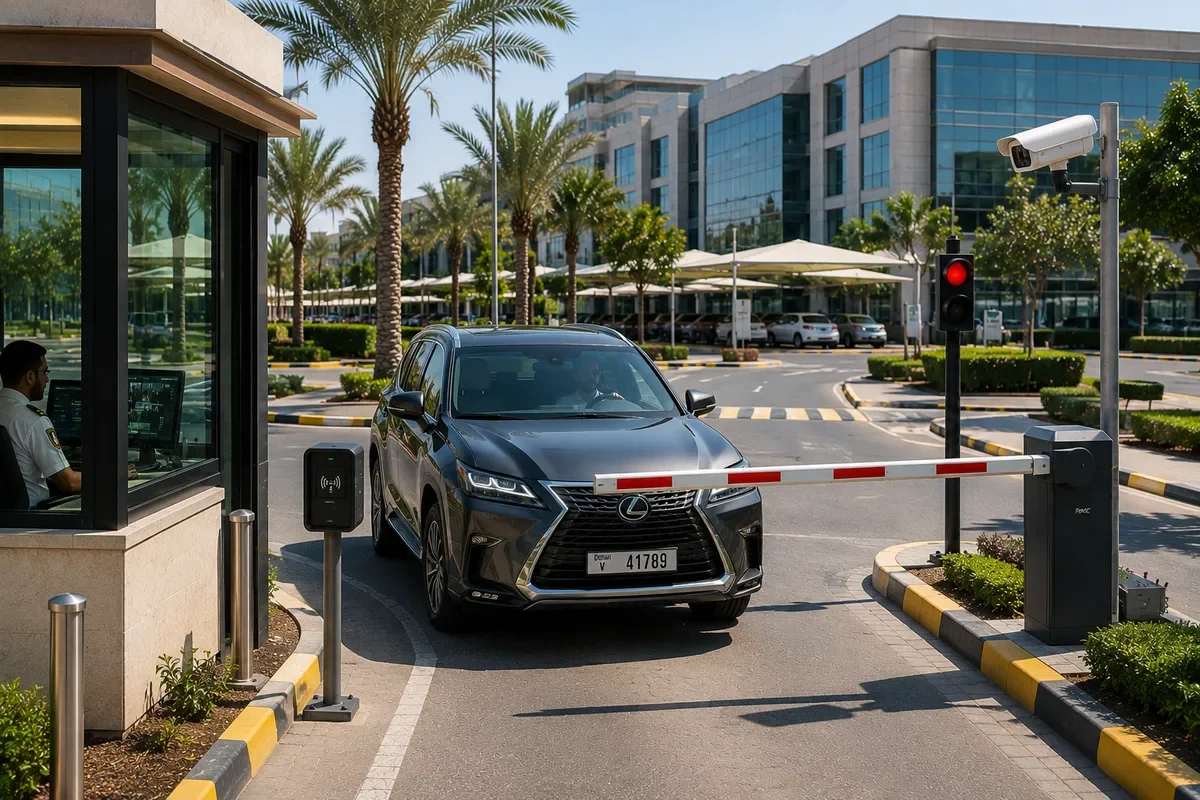
RFID access can also integrate with guard-room controls and intercoms so vehicles without a valid credential can follow a separate authorised visitor procedure.
Visitor vehicles do not necessarily need permanent RFID credentials. Temporary credentials, intercom approval, QR access, ANPR registration or other visitor workflows can be used depending on the property.
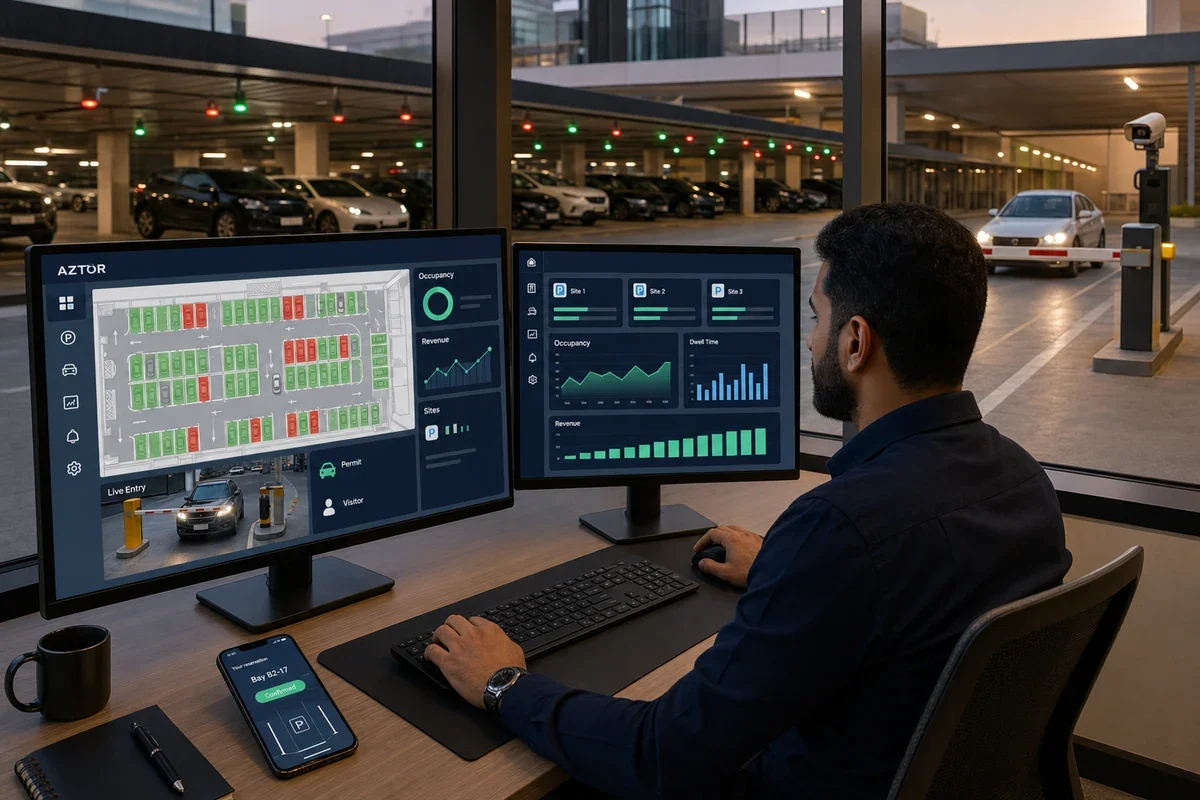
RFID can form part of a wider Smart Parking Management system. Registered users can be identified at the entrance while the parking platform manages occupancy, parking allocation, visitors or other operational functions.
RFID can also coexist with ANPR. The two technologies identify vehicles or users in different ways and can be used for separate user groups or combined within a suitable access strategy.
ANPR identifies the vehicle by its number plate, while RFID identifies a registered electronic credential. Changing the vehicle's number plate does not automatically update an RFID credential, and transferring an RFID credential to another vehicle may be possible unless the site's operational controls prevent it.
Where stronger vehicle-to-credential association is required, the system design can use suitable mounting methods, credential management or additional verification technologies.
Long-range UHF RFID is particularly useful where regular vehicles should be identified automatically as they approach the entrance without requiring the driver to lower the window or present a card.
Because long-range vehicle identification has different reader, antenna and tag considerations, AZTÖR treats UHF vehicle access as a specialist configuration rather than assuming every RFID reader can provide long-range operation.
Reader range should never be selected simply by choosing the longest advertised distance. Excessive reading range can cause the wrong lane, nearby vehicle or unintended credential to be detected.
The objective is a controlled read zone appropriate to the actual entrance.
At adjacent entry and exit lanes, reader positioning, antenna direction and power settings become especially important to reduce cross-reading between lanes.
Metal surfaces, windscreens, tag placement, reader orientation, interference and the surrounding environment can all influence RFID performance.
Vehicle tags should therefore be installed in a location compatible with the selected technology. A tag that performs correctly on one type of windscreen or mounting surface may behave differently on another.
Where a credential is intended to remain associated with one vehicle, tamper-evident or manufacturer-specific vehicle tags can be considered where supported.
RFID systems can maintain access-event records on suitable platforms, allowing authorised users to review credential activity according to configured permissions and data-retention requirements.
The record may include credential identity, user or vehicle reference, reader, entrance, date, time and access result depending on the selected system.
Centralised access management can allow several vehicle entrances to use the same credential database.
Multi-site operation may also be possible where the selected access-control platform supports several properties or locations.
RFID vehicle access can be integrated with compatible building access-control systems where the customer wants common credential management for vehicle and pedestrian access.
Whether the same physical credential should be used for both applications depends on the selected technology, security policy and reader compatibility.
For residential and commercial upgrades, existing automatic barriers can often be retained. AZTÖR can inspect the existing barrier controller and install a compatible access-control interface where technically suitable.
Existing automatic gates can similarly be upgraded from remote-only operation to managed RFID access without necessarily replacing the gate motor.
RFID can also operate alongside existing remote controls during a phased migration, allowing a property to introduce managed access without changing every user on the same day.
For outdoor UAE entrances, readers, pedestals, enclosures, controllers and cabling should be selected and installed for the expected heat, sunlight, dust, sand, humidity and environmental exposure.
Controllers and power supplies should be installed in suitable protected enclosures. Outdoor cable joints and connectors also require proper protection rather than being left exposed.
Common RFID faults include credentials not reading, reduced reading range, authorised credentials being rejected, barriers not opening after a valid read, intermittent operation or readers going offline.
The problem can originate from the credential, reader, antenna, wiring, power supply, access controller, database permissions, network, interface relay or the barrier or gate itself.
AZTÖR troubleshoots the complete access chain before recommending component replacement.
Preventive maintenance can include reader inspection, credential testing, mounting checks, controller and power-supply inspection, access database review, communication testing and functional testing with the connected gate or parking barrier.
AZTÖR provides RFID vehicle access installation, integration, upgrades, troubleshooting and maintenance across Dubai, Abu Dhabi, Sharjah, Ajman, Ras Al Khaimah, Fujairah and Umm Al Quwain, with suitable vehicle-access solutions available across the wider GCC.
Key Features
- RFID vehicle access control
- Automatic vehicle identification
- RFID card access
- RFID tag access
- Vehicle RFID credentials
- Proximity vehicle access
- Long-range RFID options
- UHF RFID options where required
- Hands-free vehicle access options
- Registered vehicle credentials
- Individual credential management
- Resident vehicle access
- Tenant vehicle access
- Employee vehicle access
- Contractor vehicle access
- Staff parking access
- Credential activation
- Credential deactivation
- Lost credential blocking
- Temporary credential options
- Scheduled access permissions
- Time-based access permissions
- Entrance-specific permissions
- Automatic parking barrier integration
- Sliding gate integration
- Swing gate integration
- Gate automation integration
- Access-control integration
- Reader pedestal installation
- Driver-side reader positioning
- Controlled RFID read zones
- Multi-lane access options
- Entry and exit lane management
- Anti-cross-read design considerations
- Induction loop integration
- Vehicle presence detection
- Safety photocell integration
- Automatic closing integration
- Guard-room control
- Intercom integration
- Visitor access integration
- ANPR integration
- Smart Parking Management integration
- Central credential database
- Access-event records
- Multi-entry management
- Multi-site options where supported
- Existing barrier retrofit
- Existing gate retrofit
- Remote-control system upgrades
- Reader replacement
- RFID controller replacement
- Power-supply repair
- Credential troubleshooting
- Barrier interface troubleshooting
- Outdoor UAE installations
- Preventive maintenance and AMC support
Technical Specification
| Solution Type | RFID vehicle access control system |
|---|---|
| Primary Function | Identify authorised RFID credentials and control vehicle entrance access |
| Application | Residential, commercial, parking and industrial vehicle entrances |
| Credential Type | RFID card, tag or manufacturer-specific credential |
| RFID Technology | Selected according to required application and reading range |
| Reading Range | Reader, credential, antenna, mounting and environment specific |
| Short-Range Access | Available |
| Long-Range Access | Available using suitable RFID/UHF technology |
| Hands-Free Access | Available with suitable long-range configuration |
| Reader Type | Proximity, long-range or manufacturer specific |
| Vehicle Tag | Available |
| Access Card | Available |
| Reader Pedestal | Available |
| Access Controller | Standalone, networked or integrated |
| Credential Database | Available |
| Individual User Management | Available |
| Credential Activation | Available |
| Credential Deactivation | Available |
| Scheduled Access | Available on suitable platforms |
| Time-Based Permissions | Available |
| Entry Records | Available on suitable systems |
| Exit Records | Available on suitable systems |
| Barrier Integration | Available |
| Automatic Gate Integration | Available |
| ANPR Integration | Available |
| Intercom Integration | Available |
| Smart Parking Integration | Available |
| Induction Loop Integration | Available |
| Safety Photocell Integration | Available |
| Multi-Lane Operation | Available |
| Multi-Entry Management | Available |
| Multi-Site Management | Available on suitable platforms |
| Communication | Controller and manufacturer specific |
| Network | Standalone, Ethernet or manufacturer-specific architecture |
| Software | Platform specific |
| User Permissions | Platform specific |
| Data Retention | Customer, platform and applicable requirement specific |
| Outdoor Application | Available with suitable equipment |
| Environmental Rating | Manufacturer and model specific |
| Power Supply | Manufacturer and equipment specific |
| Installation | New installation or existing barrier/gate retrofit |
| Maintenance | Credentials, readers, controllers, power, network and gate/barrier interface |
RFID vehicle access should be selected according to the required reading distance, vehicle approach, lane arrangement, credential type, traffic volume and security requirements. Reading range is affected by reader and antenna design, credential type, mounting surface, vehicle position and surrounding environment. Short-range RFID and long-range UHF vehicle identification should not be treated as identical solutions. AZTÖR provides a free site inspection before finalising the RFID access design.
Typical Applications
- Residential communities
- Gated communities
- Villa compounds
- Apartment towers
- Residential towers
- Commercial buildings
- Office towers
- Business parks
- Corporate campuses
- Staff parking
- Employee parking
- Tenant parking
- Resident parking
- Private car parks
- Basement parking
- Multi-storey car parks
- Hotels
- Hospitals
- Schools
- Universities
- Government facilities
- Warehouses
- Logistics centres
- Distribution centres
- Factories
- Industrial facilities
- Contractor entrances
- Vehicle checkpoints
- Fleet entrances
- Private parking entrances
- Automatic gate entrances
- Automatic barrier entrances
- Existing remote-control upgrades
- Managed vehicle access systems