Industrial Cleanroom Doors
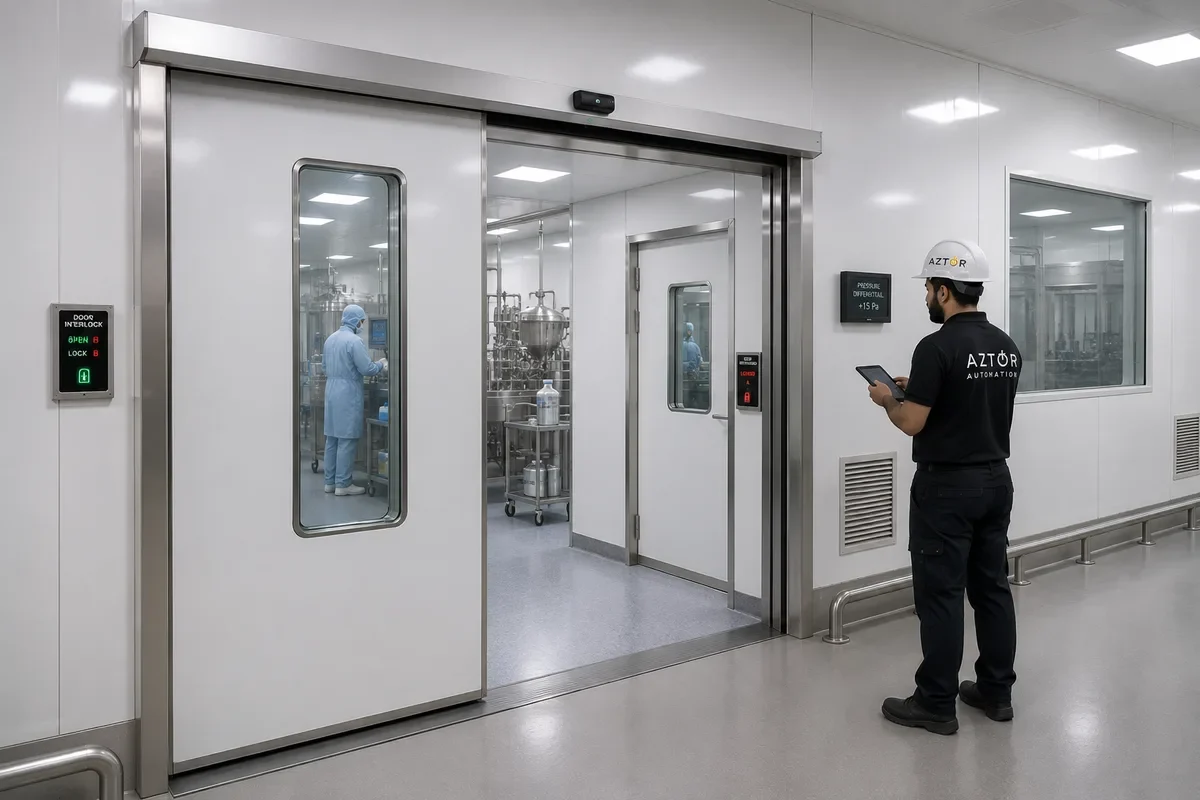
Industrial cleanroom doors are specialist door systems used where hygiene, controlled airflow, pressure management, contamination control and reliable access are more important than with a conventional industrial door. They are commonly installed in pharmaceutical production, laboratories, food processing, electronics manufacturing and other controlled environments.
AZTÖR supplies, installs, automates and maintains industrial cleanroom doors for new facilities, expansions and suitable retrofit projects across the UAE.
Cleanroom door selection starts with the process requirement. Room classification, pressure regime, required air leakage performance, cleaning procedure, traffic type, opening frequency, wall-panel construction and access-control requirements can all influence the correct door system.
Depending on the application, solutions can include hinged cleanroom doors, automatic sliding cleanroom doors, hermetic sliding doors, high speed cleanroom doors and other specialist controlled-environment door configurations.
Door surfaces should be appropriate for the cleaning regime and intended environment. Suitable systems can use smooth powder-coated metal, stainless steel, laminate or other manufacturer-specific hygienic finishes with details designed to minimise unnecessary ledges and difficult-to-clean areas.
Cleanroom doors are often integrated directly into modular cleanroom wall systems. Frame dimensions, panel thickness, wall construction and finished floor levels therefore need to be coordinated before manufacturing rather than treated as a conventional door installed after the room is complete.
Air leakage is an important consideration where pressure differentials must be maintained between adjoining spaces. Depending on the project, suitable door systems can use perimeter gaskets, drop seals or specialist sealing arrangements to reduce uncontrolled air transfer.
However, a door should not automatically be described as airtight or hermetic simply because it has seals. Where a project requires a specific leakage rate, pressure performance or hermetic classification, the selected complete system should have appropriate technical documentation for that requirement.
Positive-pressure cleanrooms are commonly designed so that air moves toward less-clean adjoining spaces when openings occur. Negative-pressure environments may be used where containment is required. The door must therefore be selected as part of the complete room pressure and HVAC strategy rather than considered independently.
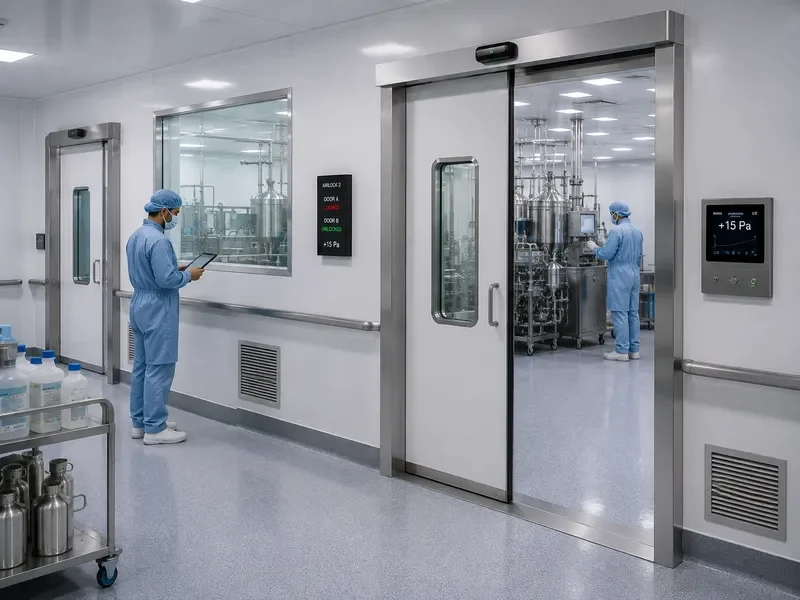
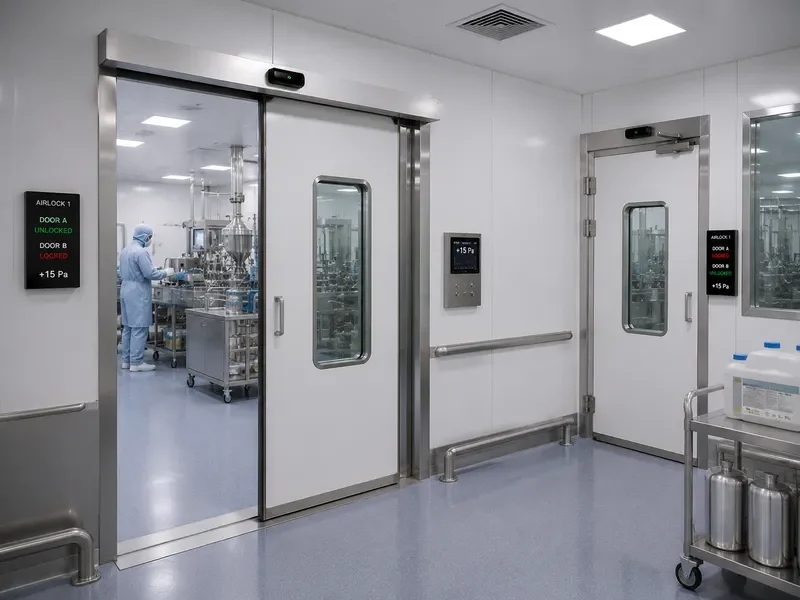
Interlocking is frequently required between cleanroom doors. In a typical two-door airlock, the control system can prevent the second door from opening until the first door has closed, helping protect the intended pressure cascade and movement procedure.
Interlock logic can be integrated with door status sensors, electromagnetic locking, access control, emergency release and building-management interfaces according to the approved project design.
AZTÖR provides a free site inspection for applicable industrial cleanroom door projects. We assess the opening, cleanroom panel construction, floor condition, available clearances, traffic flow, pressure requirements, access-control requirements and required automation before final system selection.
Manual hinged cleanroom doors can be appropriate for personnel access and lower-frequency openings. Suitable hinges, closers, handles, locks, seals and vision panels can be selected according to the room and operational requirement.
Automatic sliding cleanroom doors can reduce physical contact and provide convenient movement through frequently used controlled areas. Activation can use touchless sensors, elbow switches, access-control commands or other compatible devices.
Hermetic sliding doors can be considered where a higher level of perimeter sealing is required. Their closing movement and sealing mechanism differ from a conventional automatic sliding door, and any claimed leakage or hermetic performance should be based on the selected manufacturer's documented system.
High speed cleanroom doors can be useful for production or logistics openings with frequent personnel, trolley or material movement. Rapid closing reduces the time an opening remains exposed and can support environmental separation when the selected system is appropriate for the cleanroom process.
For pharmaceutical and food applications, cleaning chemicals and wash-down procedures should be considered when selecting door surfaces, seals, hardware, sensors and electrical components. Stainless-steel configurations can be considered where the application requires enhanced corrosion resistance and cleanability.
Flush vision panels can be incorporated into suitable doors to provide visibility while avoiding unnecessary projections. Glazing construction and sealing should be selected according to the cleanroom and safety requirements.
Touchless access can help reduce unnecessary contact with door hardware. Depending on the selected system, activation can include hand sensors, wave sensors, elbow switches, automatic sensors or authorised access-control credentials.
Access control can also be integrated where movement between controlled zones needs to be restricted or recorded. Compatible card readers, biometric readers and other credential systems can interface with the door and interlock controls according to the project's security requirements.
Door automation must work with the cleanroom process rather than against it. Opening time, closing delay, sensor detection zones and interlock sequence should therefore be configured around actual personnel and material movement.
Emergency operation is also important. Interlocked or access-controlled doors must incorporate the appropriate emergency release and life-safety logic required by the project so that contamination-control measures do not compromise safe egress.
Industrial cleanroom doors should not automatically be described as fire rated. Where an opening also requires fire resistance, the selected complete door assembly must satisfy the applicable project fire requirement with appropriate supporting documentation.
Similarly, ISO cleanroom classification applies to the controlled environment and its airborne particle concentration; it should not be presented as a generic certification of an individual door unless the particular product has documented performance or certification relevant to the stated claim.
AZTÖR can also troubleshoot existing cleanroom doors with sealing, alignment, automation, interlock or access-control problems. Repairs can include hinges, closers, seals, drop seals, rollers, operators, sensors, locks, control panels and interlock components subject to system compatibility.
Preventive maintenance is particularly important where door performance contributes to controlled-environment operation. Seals, alignment, closing behaviour, interlocks, locks, sensors and automatic operators should be checked at suitable intervals based on equipment and usage.
AZTÖR provides industrial cleanroom door supply, installation, automation, repair and preventive maintenance across Dubai, Abu Dhabi, Sharjah, Ajman, Ras Al Khaimah, Fujairah and Umm Al Quwain, with suitable controlled-environment door support available across the wider GCC.
Key Features
- Specialist industrial cleanroom door systems
- Controlled-environment applications
- Pharmaceutical cleanroom applications
- Food-processing cleanroom applications
- Laboratory applications
- Controlled manufacturing applications
- Manual hinged cleanroom doors
- Automatic sliding cleanroom doors
- Hermetic sliding door options
- High speed cleanroom door options
- Single-leaf configurations
- Double-leaf configurations where applicable
- Cleanroom wall-panel integration
- Flush-frame options
- Smooth cleanable surfaces
- Powder-coated metal options
- Stainless-steel options
- Hygienic finish options
- Reduced ledge and projection designs
- Perimeter gasket sealing
- Drop-seal options
- Enhanced air-leakage control
- Pressure-controlled room applications
- Positive-pressure applications
- Negative-pressure applications
- Airlock door applications
- Two-door interlocking
- Multi-door interlocking where required
- Door-status monitoring
- Electromagnetic locking options
- Automatic door operators
- Touchless activation
- Wave sensor activation
- Elbow-switch activation
- Automatic sensor activation
- Access-control integration
- Card reader integration
- Biometric access integration
- Flush vision panel options
- Safety glazing options
- Safety photocells on suitable automatic systems
- Presence detection
- Emergency release integration
- BMS interface options
- Cleanroom control-system integration
- Door seal replacement
- Operator and sensor repair
- Interlock troubleshooting
- Access-control troubleshooting
- Preventive maintenance and AMC support
Technical Specification
| Product Type | Industrial cleanroom door |
|---|---|
| Primary Function | Controlled access and environmental separation |
| Application | Pharmaceutical, laboratory, food, electronics and controlled manufacturing environments |
| Door Configuration | Hinged, sliding, hermetic, high speed or specialist cleanroom system |
| Leaf Configuration | Single or double leaf according to selected system |
| Door Material | Powder-coated metal, stainless steel, laminate or manufacturer-specific construction |
| Door Core | Manufacturer and application specific |
| Surface Finish | Smooth cleanable hygienic finish |
| Frame | Cleanroom-compatible frame according to wall construction |
| Wall Integration | Modular cleanroom panel or project-specific construction |
| Operation | Manual or automatic |
| Sealing | Perimeter gasket, drop seal or specialist manufacturer-specific arrangement |
| Air Leakage | Selected according to documented project requirement |
| Pressure Application | Positive, negative or neutral-pressure area according to project design |
| Hermetic Performance | Only where supported by selected system documentation |
| Interlocking | Available |
| Door Status Monitoring | Available |
| Locking | Mechanical, electromagnetic or compatible access-controlled locking |
| Automatic Operator | Available according to selected door configuration |
| Touchless Activation | Available |
| Access Control | Compatible integration available |
| Card Reader | Available through compatible access-control system |
| Biometric Reader | Available through compatible access-control system |
| Vision Panel | Flush or system-specific glazing option |
| Safety Sensor | According to selected automatic door system |
| Emergency Release | According to project and life-safety requirements |
| BMS Interface | Available where compatible |
| Cleanroom Control Interface | Available according to selected system |
| Operating Temperature | Manufacturer and application specific |
| Chemical Resistance | Material and manufacturer specific |
| Wash-Down Suitability | Only where selected system is designed for the required cleaning regime |
| Fire Rating | Only where supported by a specifically tested and documented complete door assembly |
| Installation | New installation, replacement or suitable cleanroom retrofit |
| Maintenance | Seals, hardware, automation, sensors, locks, interlocks and controls |
Industrial cleanroom doors must be selected around the complete controlled-environment requirement, including room classification, pressure differential, air-leakage criteria, wall-panel construction, cleaning regime, traffic and access-control logic. The terms airtight, hermetic, fire rated or a specific leakage performance should only be used where supported by technical documentation for the selected complete system. AZTÖR provides a free site inspection and coordinates final door requirements with the client's cleanroom, HVAC, MEP and project teams where applicable.
Typical Applications
- Pharmaceutical manufacturing facilities
- Pharmaceutical cleanrooms
- Medicine production facilities
- Biotechnology facilities
- Laboratories
- Research laboratories
- Medical laboratories
- Healthcare production facilities
- Sterile production areas
- Controlled manufacturing environments
- Electronics manufacturing
- Semiconductor facilities
- Precision manufacturing
- Medical device manufacturing
- Food-processing facilities
- Food production clean areas
- Dairy production facilities
- Beverage production facilities
- Commercial food laboratories
- Cosmetics manufacturing
- Nutraceutical production facilities
- Packaging cleanrooms
- Quality-control laboratories
- Airlocks
- Personnel airlocks
- Material airlocks
- Gowning areas
- Controlled corridors
- Production suites
- Preparation rooms
- Temperature-controlled clean areas
- Dust-controlled manufacturing areas
- Clean warehouses
- Controlled storage areas
- Industrial hygiene-sensitive facilities