Vehicle Restraints
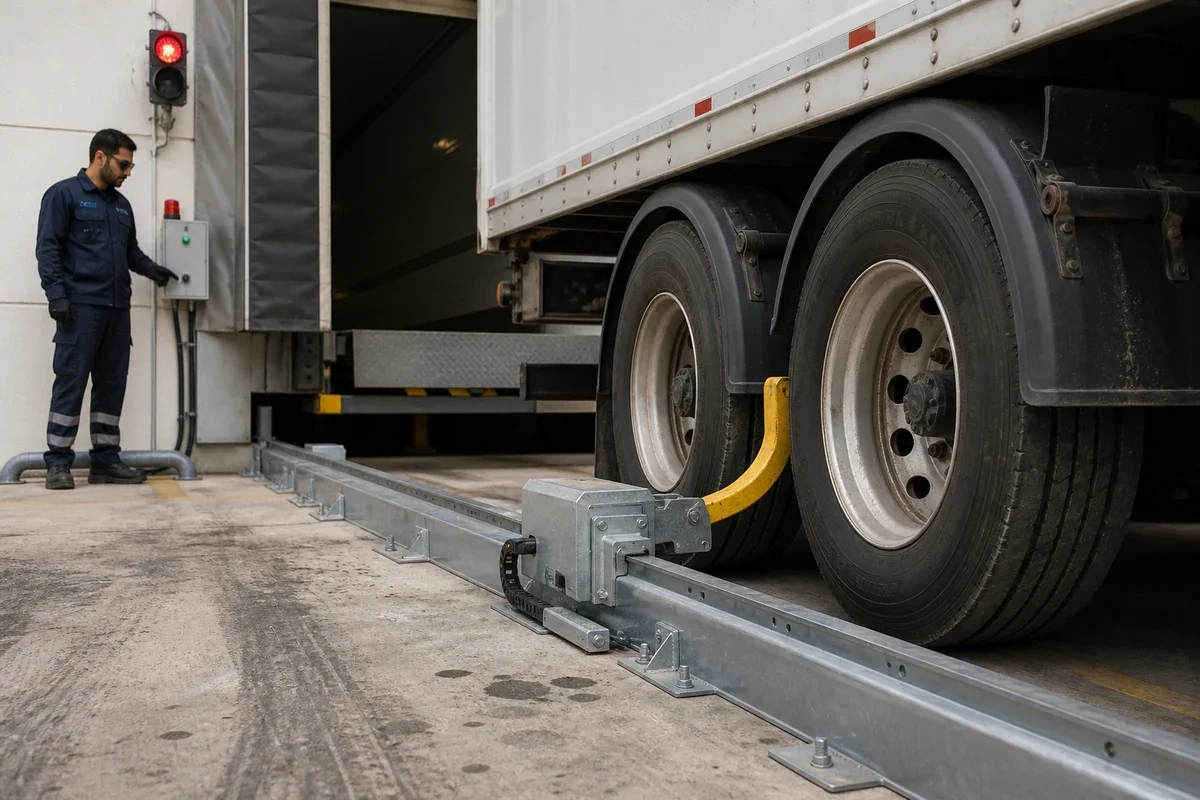
Vehicle restraints are loading-bay safety systems designed to help prevent a compatible truck or trailer from unintentionally moving away from the dock while loading or unloading is taking place.
AZTÖR supplies, installs, integrates, repairs and maintains vehicle restraint systems for warehouses, logistics centres, distribution facilities, factories, cold stores and other industrial loading bays across the UAE.
Unexpected vehicle movement can create a serious loading-bay hazard. If a trailer moves away while a forklift is travelling between the warehouse and vehicle, a dangerous gap can develop between the dock leveller and trailer.
Vehicle movement can occur for several reasons, including premature departure, communication errors, trailer movement during loading, unsuitable parking procedures or other operational conditions. A properly selected restraint forms one part of the site's overall loading-bay safety strategy.
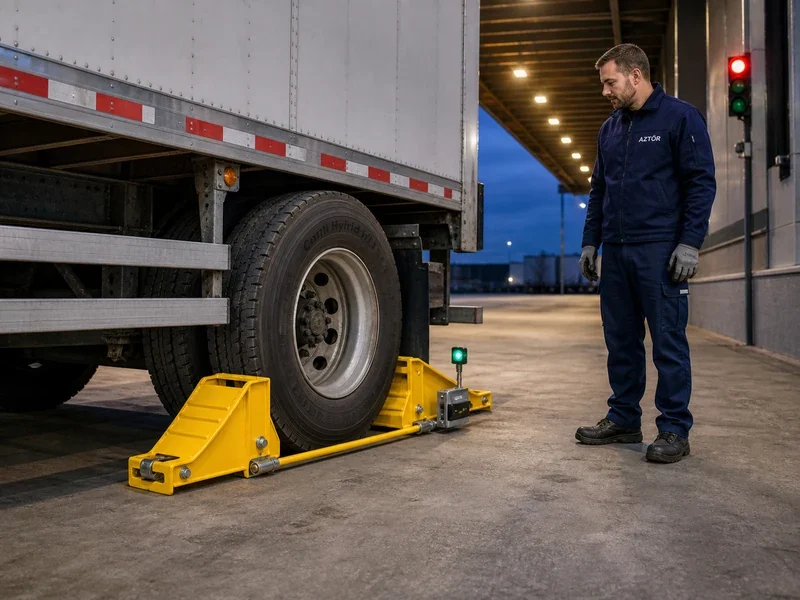
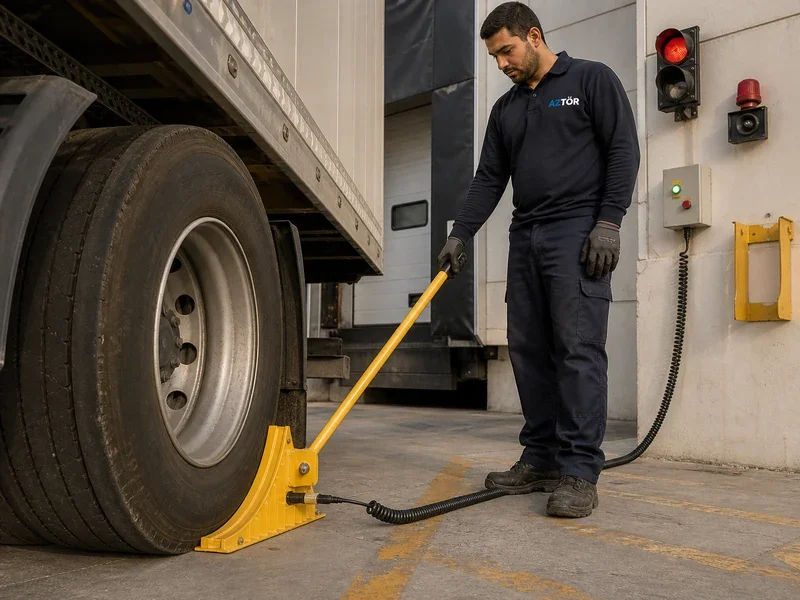
Mechanical wheel chocks are one method of controlling vehicle movement, but engineered vehicle restraints can provide a more integrated solution for suitable loading operations.
Common restraint concepts include systems that engage a compatible rear impact guard or another suitable part of the vehicle, wheel-based restraint systems and other manufacturer-specific designs.
The selected restraint must be compatible with the actual vehicles using the facility. Trailer geometry, rear impact guard configuration, ground clearance, wheel position, tail lifts and other vehicle equipment can all affect whether a particular restraint can engage correctly.
AZTÖR provides a free site inspection for applicable vehicle restraint projects. We assess the loading-bay arrangement, expected vehicle fleet, dock height, leveller, bumpers, approach geometry, available fixing structure and required operating sequence before recommending a solution.
Rear-impact-guard restraint systems are commonly positioned beneath the loading bay. After a compatible trailer reaches the dock, the restraint engages the appropriate vehicle component according to the manufacturer's operating sequence.
Not every truck or trailer has the same rear geometry. A restraint should therefore never be assumed to work with every vehicle simply because it can physically reach the rear of the trailer.
Wheel-based vehicle restraints use a different principle by engaging or blocking a suitable vehicle wheel. These systems can be useful where vehicle configurations make other restraint methods unsuitable, subject to the selected equipment and site requirements.
Manual, powered, hydraulic, electro-mechanical and other manufacturer-specific restraint configurations are available. The appropriate technology depends on the loading operation, vehicle fleet, traffic frequency and required level of control integration.
One of the major advantages of an integrated vehicle restraint is the ability to communicate its status to loading-bay personnel and drivers.
External red and green traffic lights can be used to indicate whether the vehicle should remain stationary or may depart, while internal indicators can communicate loading-bay status to warehouse personnel.
The exact meaning and sequence of lights should follow the selected control system and the site's operating procedure rather than assuming one universal colour sequence for every installation.
Vehicle restraints can also be interlocked with loading bay doors and dock levellers. A suitable control sequence can prevent certain equipment from operating until the required vehicle-restraint condition has been confirmed.
For example, a compatible loading-bay system may require the vehicle to be correctly positioned and restrained before the door or dock leveller is released for operation. At the end of loading, the sequence can be reversed according to the approved operating procedure.
Interlocking does not remove the need for trained operators. Drivers and warehouse personnel still need clear procedures for vehicle arrival, restraint engagement, loading, equipment storage and authorised vehicle release.
Vehicle restraints can be coordinated with sectional loading bay doors, dock levellers, dock shelters, dock seals, wheel guides, dock bumpers, traffic lights and dock lighting as part of a complete loading-bay system.
Wheel guides help position the vehicle laterally during reversing, while dock bumpers establish the docking interface. The vehicle restraint performs a different function by helping control unintended vehicle departure or movement after docking.
A vehicle restraint should not be confused with a dock bumper. Bumpers are primarily intended to protect the dock structure and establish vehicle position; they do not secure the trailer against departure.
Likewise, wheel guides are not restraints. They assist vehicle alignment but do not lock or secure the truck once it has reached the loading bay.
Vehicle restraints can be particularly valuable at high-traffic logistics facilities where many trucks and drivers use the same loading bays throughout the day and communication needs to remain clear and consistent.
Cold storage and food logistics facilities can also integrate restraints into loading-bay controls so vehicle security, dock-door operation and environmental equipment work within a defined loading sequence.
The restraint system should include a method of dealing with vehicles that cannot be engaged normally. The appropriate exception procedure depends on the site, selected equipment and safety assessment and should not involve bypassing the system without controlled authorisation.
Some systems provide vehicle-presence sensing, restraint-position monitoring, audible alarms, communication lights, control-panel indications or other status functions. These capabilities vary by manufacturer and model.
For UAE outdoor loading bays, equipment should be selected for the expected heat, dust, sand, humidity and external exposure. Electrical enclosures, sensors, moving components and protective finishes should suit the operating environment.
The restraint and its foundation or structural fixings must also be appropriate for the forces involved. Secure attachment to suitable concrete or structural elements is essential for the selected equipment to perform as intended.
Installation should therefore consider more than simply mounting the restraint in front of the dock. Vehicle geometry, engagement range, structural fixing conditions, bumper projection and leveller position all need to work together.
AZTÖR can also inspect existing vehicle restraints that fail to engage, remain locked, generate repeated alarms or do not communicate correctly with doors, levellers or traffic lights.
Typical repair requirements can involve sensors, switches, actuators, hydraulic components, motors, control panels, traffic lights, alarms, wiring, mechanical engagement components and structural fixings.
A restraint that has suffered vehicle impact or abnormal loading should be inspected before being returned to normal service. Visible damage is not the only consideration; engagement components and fixings can also require assessment.
Preventive maintenance should include checking the restraint mechanism, engagement surfaces, sensors, switches, controls, communication lights, alarms, structural fixings and interlocked loading-bay equipment.
Operational testing is particularly important. A restraint may appear mechanically intact but still have a sensor, status or interlock fault that prevents the loading-bay sequence from operating correctly.
AZTÖR provides vehicle restraint supply, installation, integration, repair and preventive maintenance across Dubai, Abu Dhabi, Sharjah, Ajman, Ras Al Khaimah, Fujairah and Umm Al Quwain, with suitable loading-bay support available across the wider GCC.
Key Features
- Loading bay vehicle restraint systems
- Truck restraint systems
- Trailer restraint systems
- Rear impact guard restraint options
- Wheel-based restraint options
- Mechanical restraint options
- Electro-mechanical restraint options
- Hydraulic restraint options
- Powered restraint systems
- Manual systems where suitable
- Vehicle movement control
- Premature departure risk reduction
- Trailer movement protection
- Loading-bay safety integration
- Vehicle presence detection where available
- Automatic engagement options
- Manual engagement options
- Restraint position monitoring
- Engagement status indication
- Internal status indicators
- External traffic-light integration
- Red and green communication lights
- Audible warning options
- Driver communication support
- Warehouse operator communication
- Loading bay door interlocking
- Dock leveller interlocking
- Complete dock sequence control
- Dock shelter coordination
- Dock seal coordination
- Wheel-guide coordination
- Dock bumper coordination
- Sectional door integration
- High-traffic logistics applications
- Cold storage loading applications
- Fleet compatibility assessment
- Trailer geometry assessment
- Rear impact guard compatibility assessment
- Tail-lift vehicle assessment
- Exception vehicle procedures
- Control-panel integration
- Sensor monitoring
- Alarm integration
- Safety interlock options
- Heavy-duty structural fixing
- Outdoor UAE configurations
- Corrosion-protection options
- Existing restraint replacement
- Sensor replacement
- Control-panel repair
- Mechanical restraint repair
- Hydraulic-system repair where applicable
- Traffic-light repair
- Interlock troubleshooting
- Preventive maintenance and AMC support
Technical Specification
| Product Type | Loading bay vehicle restraint |
|---|---|
| Primary Function | Help secure compatible vehicles at the loading bay during loading and unloading |
| Application | Warehouse, logistics and industrial loading bays |
| Vehicle Type | Compatible trucks, trailers and commercial vehicles |
| Restraint Type | Rear impact guard, wheel-based or manufacturer-specific system |
| Operation | Manual, mechanical, electro-mechanical, hydraulic or system specific |
| Engagement Method | Selected according to vehicle and restraint design |
| Engagement Range | Manufacturer and model specific |
| Vehicle Compatibility | Requires assessment of actual fleet geometry |
| Rear Impact Guard Compatibility | System and vehicle specific |
| Wheel Restraint Compatibility | Vehicle and system specific |
| Tail-Lift Compatibility | Requires project assessment |
| Vehicle Presence Detection | Available on compatible systems |
| Engagement Monitoring | Available according to selected system |
| Position Monitoring | Manufacturer and model specific |
| Control Panel | Dedicated or integrated loading-bay controller |
| Internal Indicator | Available |
| External Traffic Lights | Available |
| Audible Alarm | Available according to selected system |
| Door Interlocking | Available with compatible controls |
| Dock Leveller Interlocking | Available with compatible controls |
| Traffic Light Interlocking | Available |
| Dock Shelter Coordination | Compatible |
| Dock Seal Coordination | Compatible |
| Wheel Guide Coordination | Compatible |
| Dock Bumper Coordination | Required as part of overall dock geometry |
| Power Supply | According to selected restraint and controls |
| Hydraulic Power Unit | Applicable to selected hydraulic systems |
| Structural Fixing | According to manufacturer and site requirements |
| Foundation | Existing or dedicated concrete/structural arrangement subject to assessment |
| External Installation | Available with suitable system |
| Environmental Suitability | Manufacturer and project specific |
| Emergency or Manual Release | According to selected system and approved procedure |
| Installation | New installation, retrofit or replacement |
| Maintenance | Mechanical, electrical, hydraulic, sensor, control and structural components |
Vehicle restraint selection must be based on the actual trucks and trailers using the loading bay. Rear impact guard geometry, wheel position, ground clearance, tail lifts, dock height, bumper projection and loading-bay arrangement can all affect compatibility. No single restraint should be assumed suitable for every vehicle. Final engagement range, operating sequence and interlocking must follow the selected manufacturer's requirements and the site's safety procedure. AZTÖR provides a free site inspection before final system selection.
Typical Applications
- Warehouses
- Logistics centres
- Distribution centres
- Fulfilment centres
- Loading bays
- Loading docks
- Cold storage warehouses
- Cold-chain logistics centres
- Temperature-controlled warehouses
- Refrigerated distribution facilities
- Factories
- Manufacturing facilities
- Food distribution centres
- Food-processing facilities
- FMCG warehouses
- Pharmaceutical warehouses
- Healthcare distribution facilities
- Retail distribution centres
- Supermarket distribution centres
- E-commerce fulfilment centres
- Third-party logistics facilities
- Cargo facilities
- Airport logistics facilities
- Freight terminals
- Transport depots
- Automotive warehouses
- Industrial facilities
- Commercial storage facilities
- High-traffic loading bays
- Multi-bay logistics facilities
- Existing loading-bay safety upgrades