RFID Readers
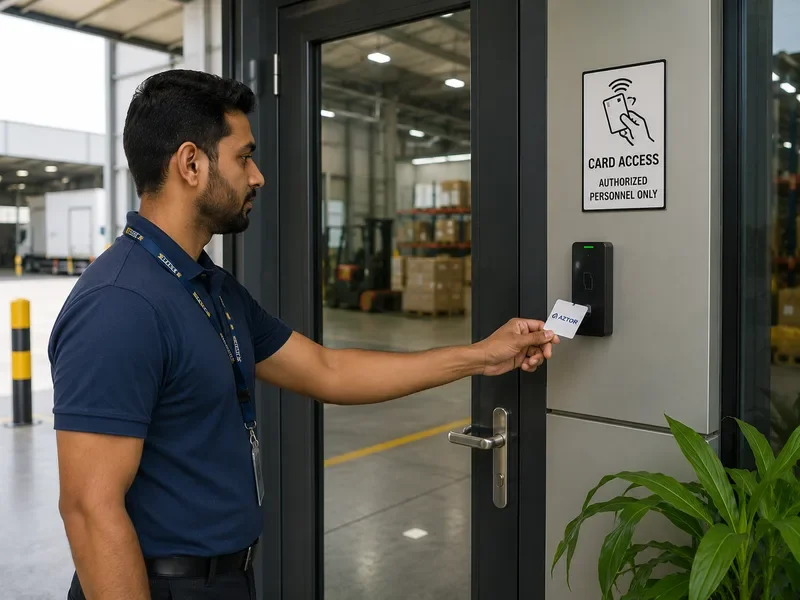
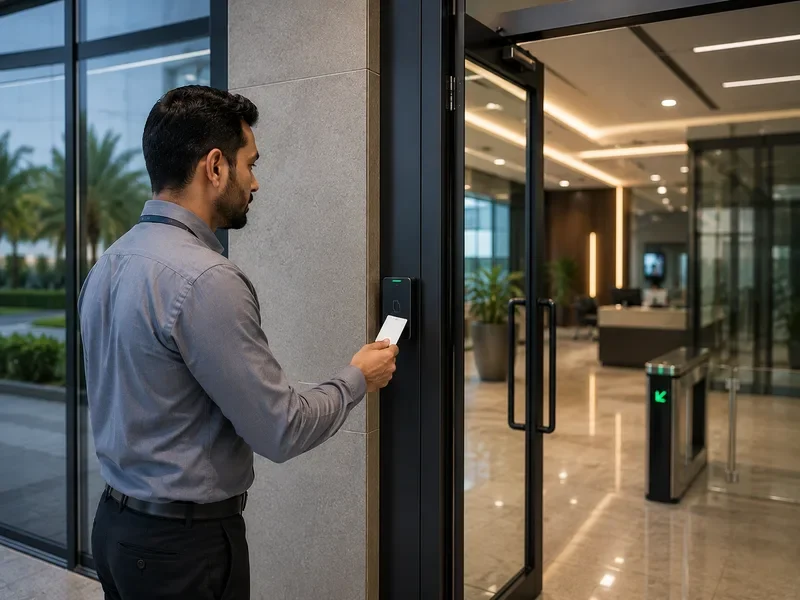
RFID Readers are electronic credential-reading devices used to identify authorised cards, key fobs and other compatible RFID credentials before access is granted to a controlled door, turnstile, elevator or other secured area.
AZTÖR Automation supplies, installs, integrates, replaces and maintains RFID reader systems for offices, commercial towers, residential buildings, hotels, warehouses, factories, healthcare facilities, data centres and other controlled premises across the UAE.
An RFID reader is only one part of a complete access-control system. In a typical installation, the reader captures the credential information and communicates it to an access controller or compatible terminal, while the controller determines whether access should be authorised.
The controller can then provide the appropriate command to an electronic door lock, automatic door, turnstile, elevator access module or another compatible controlled device.
AZTÖR provides a free site inspection for applicable RFID Access Control projects. We assess the existing access system, required doors or access points, credential technology, reader location, controller compatibility, locking hardware, network architecture and required integrations before recommending equipment.
RFID stands for Radio Frequency Identification. In access control, RFID technology allows a compatible reader to communicate with an electronic credential when it is presented within the reader's operating range.
RFID is a broad technology family rather than one universal card format.
Different RFID systems can operate at different frequencies and use different credential technologies, encoding methods, security features and communication protocols.
Low-frequency access credentials, commonly associated with approximately 125 kHz technologies, remain present in many existing access-control installations.
High-frequency systems operating around 13.56 MHz include several widely used smart-card technologies and can provide different credential and security capabilities depending on the selected platform.
The physical appearance of two RFID cards does not prove that they use the same technology.
Likewise, a reader that physically fits an existing installation is not necessarily compatible with the existing cards or controller.
Credential frequency, chip technology, data format, reader-to-controller communication and access-control platform must be considered before replacing an RFID reader.
AZTÖR therefore checks compatibility before recommending replacement readers for existing installations.
RFID readers can be supplied as card-only readers or as combination reader/keypad devices where the selected manufacturer supports them.
A card-plus-PIN configuration can provide multi-factor access for areas requiring additional authentication.
Key fobs can provide the same basic convenience as cards where they use a compatible credential technology.
RFID wristbands and other form factors can also be used on suitable platforms for applications such as gyms, hospitality, recreation or staff environments.
The credential should be individually assigned wherever practical.
Individual credential management allows a lost card or key fob to be disabled without affecting every other user.
When an employee leaves, the credential can be revoked through the access-control platform instead of relying only on the return of a physical key.
Access permissions can be configured by user, door, area, date and time where supported by the selected controller and software.
An employee can therefore use the same RFID credential at several authorised access points while remaining restricted from areas outside their permissions.
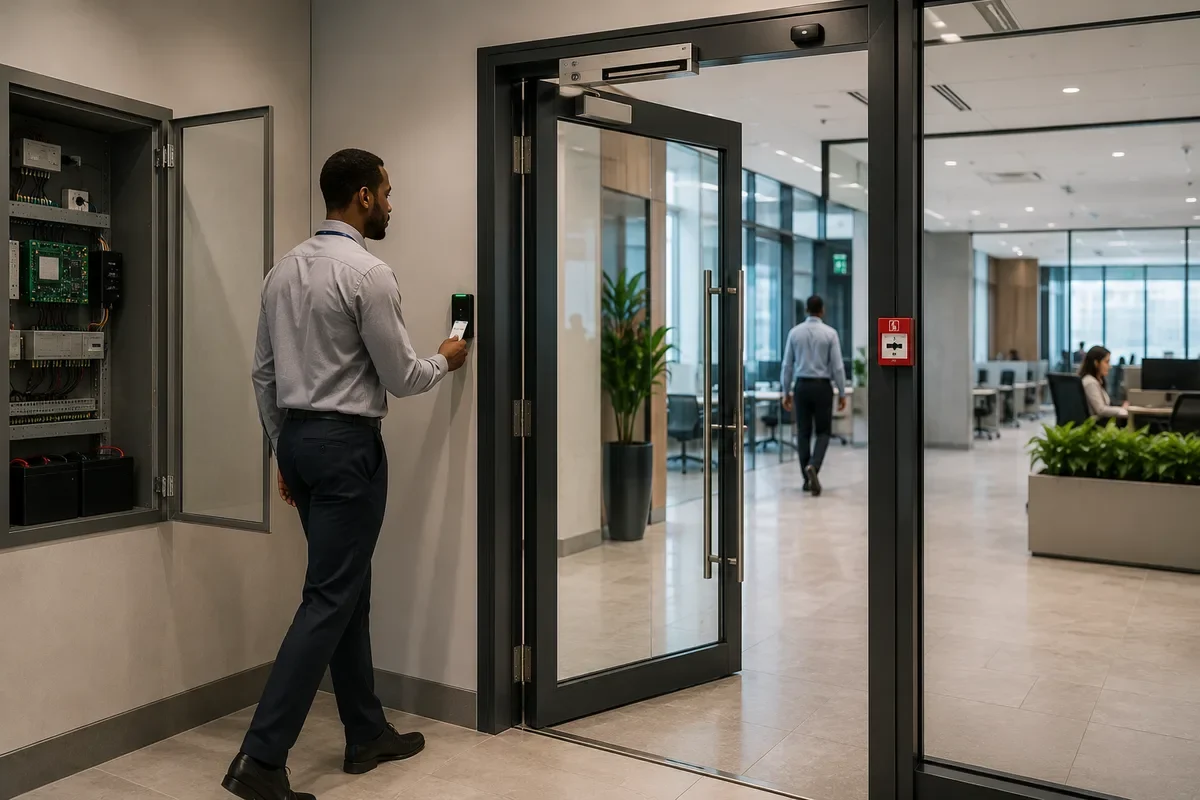
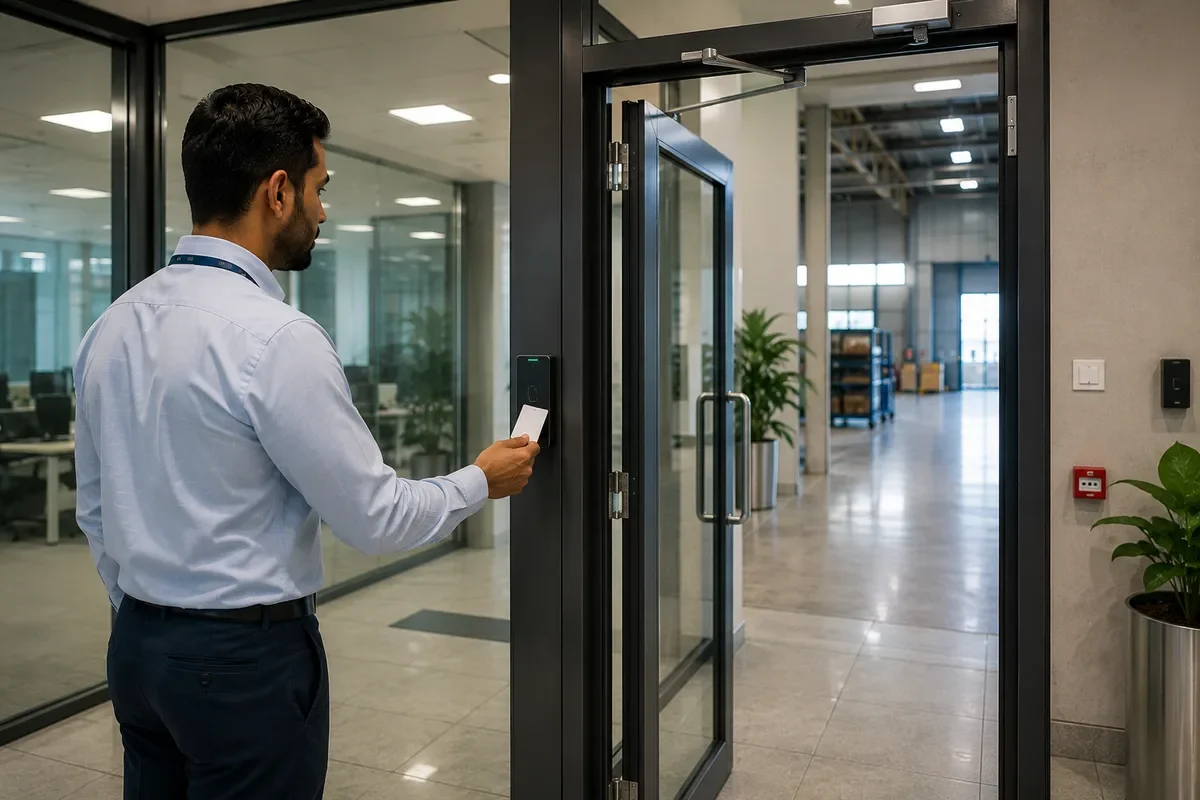
RFID Readers can form the front end of Door Access Control systems.
A user presents their credential at the reader, the access controller verifies the permission and the compatible electronic lock releases if access is authorised.
RFID access can be used with electromagnetic locks, electric strikes, electromechanical locks and other suitable locking arrangements.
The electronic locking hardware must still be selected according to the actual door, frame, emergency egress and life-safety requirements.
RFID Readers can also integrate with Automatic Sliding Doors and Automatic Swing Doors.
Once the access-control system authorises the credential, a compatible automatic door operator can receive an opening command.
The RFID reader provides the access request; it does not replace the automatic door's activation and safety sensors where those devices are required.
RFID Readers are widely used with Turnstiles.
Card readers can be integrated into or mounted on tripod turnstiles, flap barriers, swing barriers, speed gates and suitable full-height turnstile systems.
After credential authorisation, the access controller provides the passage command to the turnstile.
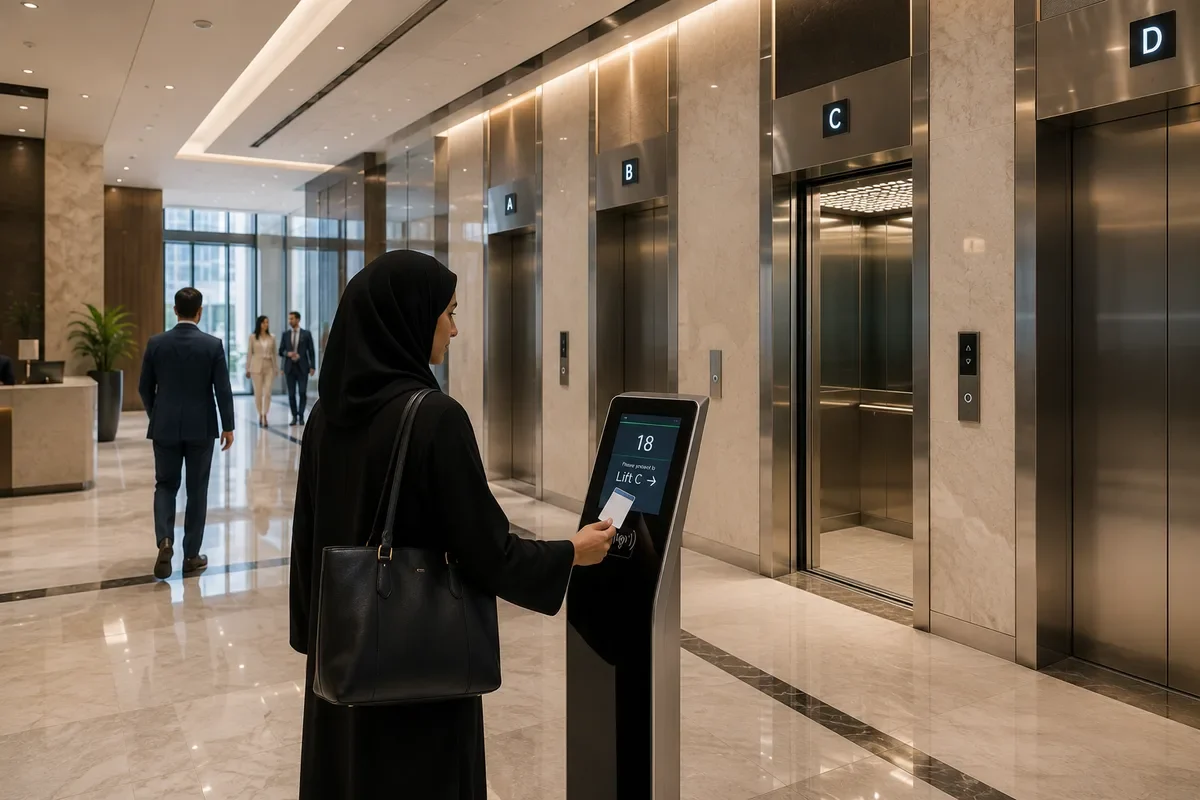
RFID can also form part of Elevator Access Control.
An authorised card or key fob can enable only the elevator floors assigned to that user through a compatible elevator access-control interface.
The same credential can potentially operate the building entrance, Turnstile, Elevator Access and selected internal doors where the access-control architecture is compatible.
RFID Readers can also be used for Cabinet Access.
Server racks, IT cabinets, smart lockers, key cabinets and other suitable protected enclosures can use compatible RFID credentials.
This allows access permissions to extend from the building entrance down to individual protected assets.
For example, a technical employee could use one managed credential to pass through the Turnstile, access the required elevator floor, enter the server room and unlock only the server racks assigned to that person.
This layered access approach can be particularly useful for data centres, corporate facilities and other controlled environments.
RFID reader security depends heavily on the credential technology and system architecture.
Older proximity technologies can provide convenient identification but should not automatically be considered equivalent to newer secure smart-card technologies.
Where higher security is required, AZTÖR can assess suitable modern credential technologies and reader/controller architectures rather than simply replacing an old reader with another device using the same legacy technology.
Credential security features vary by manufacturer and platform.
Encrypted smart-card technologies, secure key management and stronger reader-to-controller communication can be considered for appropriate applications.
Specific encryption or credential-security claims should be based on the selected manufacturer and product rather than assumed for all RFID systems.
Reader-to-controller communication is another important consideration.
Many legacy access-control installations use Wiegand interfaces.
Modern systems may support OSDP or manufacturer-specific communication.
OSDP-capable architectures can provide bidirectional communication and other security and management advantages when supported and correctly configured by both reader and controller.
Installing an OSDP-capable reader does not automatically make an existing controller compatible with OSDP.
Both sides of the connection and the system configuration must support the selected communication method.
Existing Wiegand systems can often continue operating where appropriate, but security, compatibility and future upgrade requirements should be considered when modernising a site.
RFID readers are available for indoor and outdoor applications.
Outdoor readers should have a manufacturer-documented environmental rating appropriate to the actual installation.
UAE outdoor conditions can include intense heat, direct sunlight, dust, sand, humidity and, in coastal areas, increased corrosion exposure.
The reader should therefore be selected according to its documented operating temperature, ingress protection and installation environment rather than appearance alone.
Sunlight can also affect the usability of readers with displays or illuminated interfaces, so mounting location should be considered.
Reader placement affects user experience.
The reader should be positioned where authorised users can comfortably present their credential without obstructing pedestrian movement.
At accessible entrances, reader height and approach should be coordinated with the required accessibility arrangement.
Metal surfaces can affect the performance of some RFID readers.
Where a reader is installed directly onto metal, suitable spacers, mounting arrangements or manufacturer-recommended products may be required.
The effect varies by reader and credential technology and should be assessed during installation.
RFID read range also varies significantly.
Access-control card readers are normally intended for deliberate close-range credential presentation rather than long-distance vehicle identification.
Long-range vehicle access is better handled through a properly designed UHF Vehicle Access system where appropriate.
This distinction is important because UHF is itself part of the wider RFID technology family, but conventional door RFID and long-range UHF vehicle identification serve different operational purposes.
For pedestrian access, a controlled short reading distance can actually be beneficial because the system should identify the credential intentionally presented at a specific door or lane.
Excessive read range at closely spaced doors or turnstile lanes can create unwanted credential reads.
RFID Readers can integrate with Visitor Management where physical visitor cards are issued.
Reception can assign a temporary RFID credential with access limited to the visitor's approved doors, Turnstile or Elevator Access permissions.
The credential can then expire automatically according to the selected platform.
For sites moving away from physical visitor cards, QR or mobile credentials can complement RFID rather than requiring the entire permanent employee credential system to be replaced.
RFID access can also integrate with Time & Attendance platforms where compatible.
However, an access-control reader event should not automatically be treated as a complete attendance record without considering the organisation's attendance workflow and system configuration.
Dedicated Time & Attendance terminals may be more appropriate where formal attendance functions such as shifts, breaks, overtime and payroll integration are required.
RFID Readers can integrate with CCTV and Video Management Systems through the wider access-control platform where supported.
An authorised, denied or other access event can potentially be associated with nearby surveillance footage for security investigation.
Access event records can contain information such as credential holder, reader, door, date, time and access result depending on the selected platform.
Access logs should be retained and accessed according to legitimate operational requirements and applicable UAE data-protection obligations.
RFID Readers can also be combined with biometric authentication.
For higher-control applications, a system may require card plus fingerprint, card plus facial authentication or card plus PIN where supported.
Multi-factor authentication should be applied according to the actual security requirement rather than unnecessarily increasing friction at every access point.
For high-traffic entrances, reader response and access-controller processing should support the required pedestrian flow.
A slow or poorly positioned credential reader can create queues even when the physical Turnstile or automatic door is capable of faster operation.
Reader feedback can include LEDs, audible indicators, displays or other manufacturer-specific signals.
The meaning of these indicators should be configured and understood correctly.
A green indication generally represents an access-related status from the system, but it does not prove that the physical door lock or Turnstile has successfully operated.
A user may receive an authorised indication while the door remains locked because of a failed relay, power supply, cable, lock or mechanical door problem.
AZTÖR therefore troubleshoots the complete access path rather than replacing the RFID reader whenever a door fails to open.
Common RFID reader faults include no power, intermittent credential detection, cards not being recognised, reader communication loss, physical damage, water ingress, damaged cabling or incompatibility after a system change.
If only certain cards fail while others continue working, the issue may involve the credential rather than the reader.
If every credential suddenly stops working at one access point, the reader, controller, power, communication or configuration should be investigated.
If the same credential works at one door but not another, the issue may be permissions, reader technology, hardware or controller configuration.
Reader replacement on an existing system requires careful checking.
The new reader must support the required credential technology and a compatible interface with the access controller.
Simply matching the wire colours or physical size is not a reliable replacement method.
AZTÖR can assess legacy RFID systems and recommend suitable reader replacement, controller upgrades or credential migration.
Where an older credential technology creates compatibility or security limitations, the system can potentially be migrated in stages.
Dual-technology or multi-technology readers can be useful in suitable migration projects because they may allow existing and newer credential technologies to coexist during a planned transition.
The exact supported technologies depend on the selected reader.
This can reduce the operational disruption of replacing every credential at the same moment.
Existing access systems can also be upgraded from card-only access to card-plus-PIN, biometric, mobile or other authentication methods where the controller and management platform support the change.
RFID readers should be maintained as part of the complete access-control system.
Maintenance can include physical inspection, credential testing, mounting checks, cable inspection, communication testing, controller verification and functional testing of the connected lock, automatic door, Turnstile or other access device.
Outdoor readers should be checked for damage, degraded seals, moisture exposure and mounting condition.
Readers at high-traffic locations can also suffer physical wear or impact and may require more frequent inspection.
AZTÖR Automation provides RFID Reader installation, replacement, access control integration, security automation, troubleshooting and maintenance across Dubai, Abu Dhabi, Sharjah, Ajman, Ras Al Khaimah, Fujairah and Umm Al Quwain, with suitable project and technical support available across the wider GCC.
Key Features
- RFID access control readers
- RFID card readers
- Proximity card readers
- Smart card readers
- Key fob readers
- Card and PIN readers
- Multi-technology readers
- Low-frequency RFID options
- High-frequency RFID options
- 13.56 MHz credential options
- 125 kHz legacy credential options
- Secure smart-card options
- Indoor RFID readers
- Outdoor RFID readers
- Weather-resistant reader options
- Standalone reader options
- Networked access control
- Centralised credential management
- Individual user credentials
- User access permissions
- Door-based permissions
- Area-based permissions
- Time-based access
- Temporary access
- Employee access
- Resident access
- Tenant access
- Contractor access
- Visitor card access
- Lost card deactivation
- Credential replacement
- Door Access Control integration
- Automatic Sliding Door integration
- Automatic Swing Door integration
- Turnstile integration
- Elevator Access integration
- Cabinet Access integration
- Visitor Management integration
- Time & Attendance integration
- CCTV integration
- VMS integration
- Intrusion Detection integration
- Electronic lock integration
- Electromagnetic lock integration
- Electric strike integration
- Wiegand interface support where compatible
- OSDP integration where supported
- Multi-factor authentication options
- Card plus PIN options
- Card plus biometric options
- Reader LED indication
- Audible indication
- Reader tamper options
- Access event logging
- Denied access events
- Multi-door access
- Multi-site access
- Existing reader replacement
- Legacy access-control upgrades
- Credential migration
- Multi-technology migration options
- Reader troubleshooting
- Controller troubleshooting
- Cabling repair
- Reader replacement
- Preventive maintenance
- AMC support
Technical Specification
| Solution Type | RFID credential reader for electronic access control |
|---|---|
| Primary Function | Read compatible RFID credentials and transmit access data to the control system |
| Application | Doors, turnstiles, elevators, cabinets and controlled pedestrian access |
| Credential Type | RFID card, key fob or manufacturer-specific RFID credential |
| Frequency | Credential and manufacturer specific |
| Low Frequency | Available on suitable systems |
| High Frequency | Available on suitable systems |
| 125 kHz Support | Available on selected legacy and multi-technology readers |
| 13.56 MHz Support | Available on suitable smart-card readers |
| Credential Technology | Manufacturer and reader specific |
| Secure Smart Card | Available on suitable systems |
| Multi-Technology Reader | Available |
| PIN Keypad | Available on suitable combination readers |
| Multi-Factor Authentication | Available with suitable access-control architecture |
| Read Range | Reader, credential, mounting and environment specific |
| Reader Interface | OSDP, Wiegand or manufacturer specific |
| OSDP | Available on suitable readers and controllers |
| Wiegand | Available on suitable systems |
| Reader Feedback | LED, audible or manufacturer specific |
| Tamper Monitoring | Available on suitable readers |
| Indoor Application | Available |
| Outdoor Application | Available on suitably rated readers |
| Environmental Rating | Manufacturer and model specific |
| Operating Temperature | Manufacturer and model specific |
| Power Supply | Manufacturer and model specific |
| Controller | Standalone, networked or enterprise access controller |
| Door Access Integration | Available |
| Automatic Door Integration | Available |
| Turnstile Integration | Available |
| Elevator Access Integration | Available |
| Cabinet Access Integration | Available |
| Visitor Management Integration | Available |
| Time & Attendance Integration | Available where compatible |
| CCTV/VMS Integration | Available where compatible |
| Electronic Lock Integration | Through compatible access-control system |
| Access Event Logging | Available through suitable controller/software |
| Temporary Credentials | Available through suitable access platform |
| Credential Revocation | Available |
| Multi-Site Management | Available on suitable platforms |
| Installation | New installation, replacement, retrofit or upgrade |
| Maintenance | Reader, cabling, controller, credential and connected access equipment |
RFID Readers are not universally interchangeable. The correct reader depends on credential frequency and technology, card format, reader-to-controller interface, mounting surface, environmental conditions and the existing access-control platform. A card that looks identical to another card may use completely different technology. AZTÖR Automation provides a free site inspection and compatibility assessment before reader replacement, system expansion or credential migration.
Typical Applications
- Office buildings
- Commercial towers
- Corporate headquarters
- Business parks
- Residential towers
- Residential communities
- Apartment buildings
- Hotels
- Hospitals
- Healthcare facilities
- Government buildings
- Schools
- Universities
- Data centres
- Server rooms
- Factories
- Manufacturing facilities
- Warehouses
- Logistics centres
- Industrial facilities
- Staff entrances
- Employee entrances
- Tenant entrances
- Resident entrances
- Visitor entrances
- Restricted rooms
- Office doors
- Glass doors
- Automatic doors
- Turnstiles
- Speed gates
- Tripod turnstiles
- Elevator access
- Server rack access
- Cabinet access
- Smart lockers
- Technical rooms
- IT rooms
- Electrical rooms
- MEP rooms
- Plant rooms
- Laboratories
- Security rooms
- Multi-tenant buildings
- Controlled pedestrian entrances