Automatic Bollards
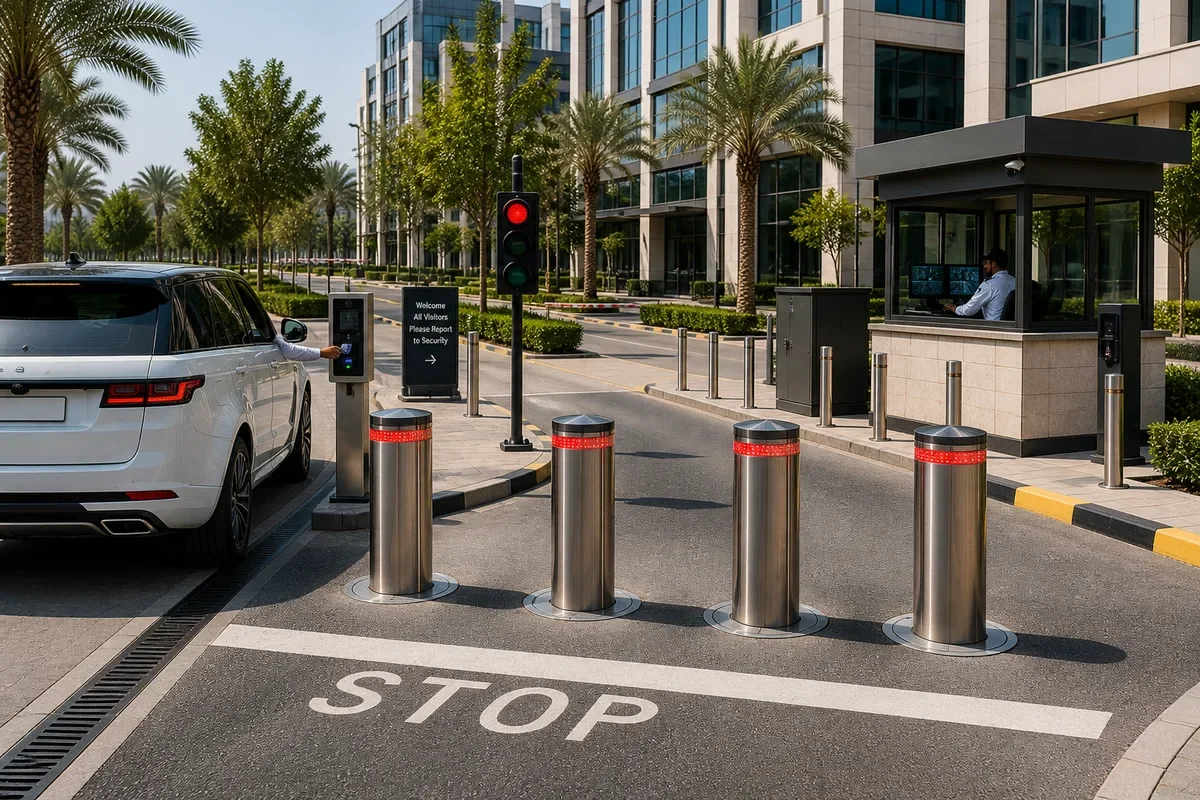
Automatic Bollards provide controlled vehicle access by automatically rising from or retracting into the ground. They are widely used where vehicle movement needs to be restricted without permanently blocking pedestrian movement or changing the appearance of an entrance.
AZTÖR Automation supplies, installs, integrates, repairs and maintains automatic bollard systems for commercial buildings, hotels, residential developments, government facilities, industrial sites, pedestrian zones, private roads and controlled parking entrances across the UAE.
Unlike a conventional parking barrier, an automatic bollard creates a physical restriction at road level rather than using a boom arm above the vehicle lane. This makes bollards useful for entrances where access control, architectural appearance or a stronger physical vehicle restriction is required.
Automatic bollards are available in different constructions and performance categories. The correct system should be selected according to traffic frequency, vehicle type, required security level, operating speed, road construction, drainage conditions and access-control requirements.
AZTÖR provides a free site inspection for applicable automatic bollard projects. We assess the road construction, lane width, vehicle movement, underground services, drainage, traffic frequency, required access method and security objective before recommending the bollard configuration.
A typical automatic bollard consists of a retractable cylinder, underground foundation or casing, drive mechanism, control unit and the required vehicle-access and safety devices.
Hydraulic, electro-mechanical, pneumatic and other manufacturer-specific operating technologies are available depending on the required bollard system.
Hydraulic automatic bollards are commonly used for demanding vehicle-access applications because suitable systems can provide frequent and reliable operation. The actual duty cycle and performance must always be checked against the selected manufacturer's specifications.
Electro-mechanical automatic bollards can also be suitable for many residential and commercial vehicle-access applications depending on the required operating frequency and product design.
The number and spacing of bollards should be determined from the usable lane width, vehicle types and required access restriction rather than simply installing a standard quantity at every entrance.
Multiple bollards can operate together across a wider vehicle entrance. Their control sequence should be coordinated so the lane is properly restricted when the bollards are raised.
Automatic bollards can be operated from a guardhouse, push button, key switch, remote control or compatible access-control system.
For smarter vehicle access automation, bollards can integrate with ANPR. When an authorised number plate is recognised and the required safety conditions are satisfied, the system can command the bollards to lower.
RFID and UHF vehicle access can also be integrated for residents, employees, tenants and other regular authorised users.
UHF is particularly useful where registered vehicles need hands-free long-range identification as they approach the bollard-controlled entrance.
Visitor Vehicle Management can be integrated so temporary visitors are authorised through ANPR, QR, intercom or another approved workflow without receiving permanent vehicle credentials.
Intercoms can provide an exception process for vehicles that are not automatically authorised. Security personnel can verify the visitor and lower the bollards using an authorised control.
Automatic bollards can also operate as part of a Smart Parking Management or wider vehicle-access automation system.
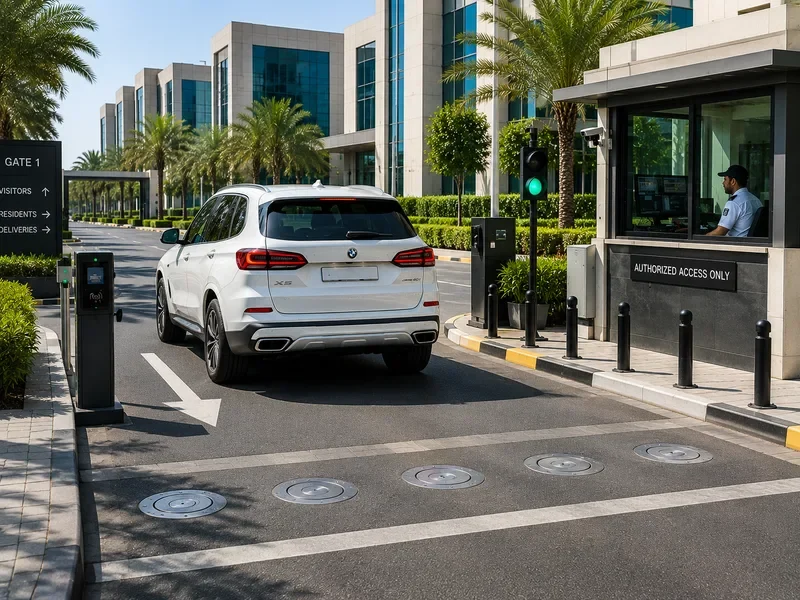
Traffic lights are particularly useful at bollard-controlled entrances. A red signal can instruct the driver to stop while the bollard is raised or moving, and a green signal can indicate when the configured system considers the lane available for authorised passage.
Warning lights, illuminated bollard tops, audible warnings or other signalling devices may also be available depending on the selected system.
Vehicle detection is critical to safe automatic bollard operation. Induction loops or other suitable vehicle-presence technologies can be positioned according to the required control sequence.
A safety loop can help prevent the bollard from rising while a vehicle remains in the protected detection area.
Additional loops can be used for approach detection, passage confirmation or other automation functions depending on the lane design.
Photocells or other compatible presence devices can also form part of the safety system where appropriate.
Access authorisation and safety detection should remain separate. An ANPR camera successfully recognising a vehicle does not by itself confirm that the vehicle has completely cleared the bollard.
The control sequence should therefore verify appropriate vehicle conditions before allowing the bollard to rise.
Automatic bollards can be configured with different operating behaviours during a power failure depending on the selected product and project requirements.
Some systems can incorporate emergency lowering, manual release, battery-supported control, UPS or other manufacturer-specific arrangements. The required fail-safe or fail-secure behaviour should be determined during design rather than assumed.
Emergency vehicle access must also be considered where bollards are installed on routes used by fire, ambulance, police or other authorised emergency vehicles.
Suitable systems can provide emergency controls, guard override, fire-alarm integration or other project-specific arrangements where required and compatible.
Drainage is one of the most important considerations for retractable bollards because part of the equipment is installed below road level.
The installation should consider rainwater, irrigation water, groundwater conditions and site drainage so water does not unnecessarily accumulate around the underground bollard assembly.
Drainage requirements vary significantly between products and sites. Depending on the system, the installation may require a suitable drainage layer, drain connection, sump or another manufacturer-approved arrangement.
Underground utility detection is equally important before excavation. Electrical cables, water lines, drainage pipes, telecommunications and other services can affect the proposed bollard position.
Civil works should follow the selected manufacturer's foundation and installation requirements. An automatic bollard should not simply be placed into an arbitrary concrete pit.
Road level and finished paving also need careful coordination so the bollard's top assembly sits correctly relative to the surrounding finished surface.
For existing roads, AZTÖR assesses the available construction depth and underground conditions before finalising the proposed system.
Outdoor equipment should be selected for UAE environmental conditions including heat, direct sunlight, dust, sand and humidity.
Corrosion resistance is particularly important for exposed and coastal locations. Stainless steel sleeves, suitable coatings or other manufacturer-specific finishes can be selected according to the environment and architectural requirements.
Reflective bands and illuminated tops can improve bollard visibility, particularly at night.
Automatic bollards are available in different cylinder diameters, heights and finishes. These dimensions are manufacturer and model specific and should be selected according to the project rather than treated as universal specifications.
For sites where automatic operation is not required at every lane, fixed and removable bollards can also be combined with automatic bollards as part of the wider access-control design.
Automatic bollards should not automatically be described as crash-rated or anti-ram bollards.
A standard automatic rising bollard may provide controlled vehicle restriction but does not necessarily have independently tested vehicle-impact performance.
Where protection against hostile or high-energy vehicle impact is required, a certified crash-rated bollard system should be selected according to the required security assessment and documented test performance.
Crash-rated bollards can be tested under recognised vehicle-impact standards such as ASTM F2656/F2656M, IWA 14-1 or other project-specified standards. The applicable requirement must be established for the actual project, and different standards or ratings should not be treated as directly interchangeable without proper technical assessment.
A crash rating applies to the tested bollard system and installation configuration, including relevant foundations and structural components. Installing a heavy-looking bollard does not make it crash rated.
Likewise, increasing the steel thickness of a standard automatic bollard does not create a documented crash rating.
Where a security consultant, authority or project specification requires a particular impact performance, AZTÖR can work around the specified requirement and suitable documented manufacturer systems.
Automatic bollards can also be installed at premium entrances where the objective is controlled access rather than hostile-vehicle protection.
Hotels, private developments and commercial properties often use retractable bollards because the entrance can remain visually open when vehicle access is permitted.
Pedestrian interaction must also be considered. Bollards should be positioned and operated so the vehicle-control system does not create unnecessary hazards for pedestrians using nearby routes.
Where pedestrian traffic crosses the bollard lane, appropriate signalling, layout and operating procedures should be considered.
For high-frequency entrances, operating speed, duty cycle and traffic throughput become particularly important. A system intended for occasional private access should not automatically be used at a heavily trafficked commercial entrance.
The complete access sequence should also be considered. A fast bollard provides little benefit if vehicle identification, security verification or traffic signalling creates a significant delay.
Automatic bollards can be installed at entry lanes, exit lanes or bidirectional controlled access points depending on the traffic design.
For bidirectional entrances, the control logic needs to coordinate vehicles approaching from both directions and avoid conflicting access commands.
Centralised access-control systems can manage several bollard entrances where supported.
Multi-site management may also be available through compatible access platforms for organisations operating several properties.
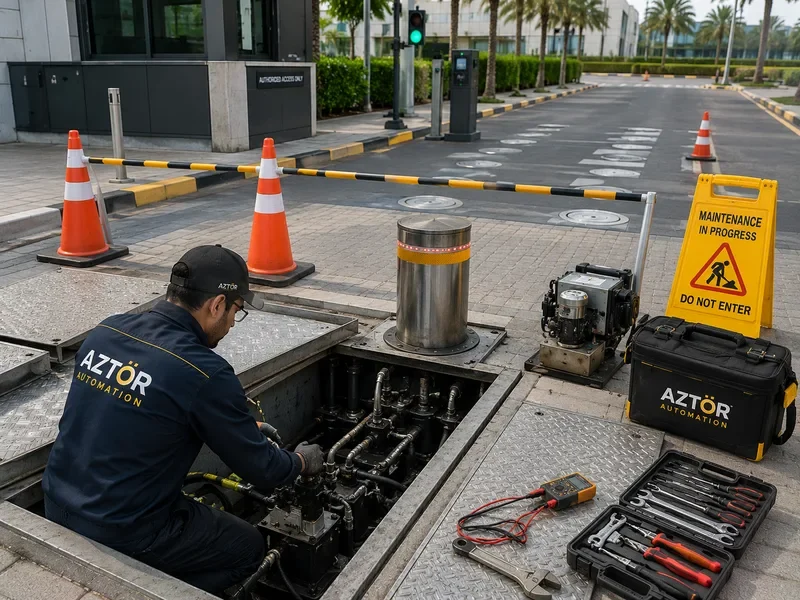
Existing automatic bollards can often be repaired rather than completely replaced. AZTÖR can inspect the mechanical or hydraulic assembly, control panel, sensors, loops, access-control interface and civil condition before recommending the appropriate repair.
Common faults include bollards not rising, not lowering, moving slowly, stopping midway, remaining permanently lowered, hydraulic leakage, control-panel faults, loop detection problems or access-control commands not reaching the bollard controller.
Water accumulation, debris and damaged underground components can also affect retractable bollard performance.
A bollard that does not lower after access authorisation may have a control, power, hydraulic, mechanical or safety-input problem.
A bollard that does not rise after the vehicle passes may be receiving a continuous vehicle-presence signal or may have a sensor, loop, controller or mechanical fault.
Preventive maintenance is especially important because automatic bollards combine underground mechanical equipment, vehicle traffic, electrical controls and outdoor environmental exposure.
Maintenance can include functional testing, cleaning, drainage inspection, hydraulic checks where applicable, mechanical inspection, control-panel testing, loop and sensor verification, signalling checks and access-control integration testing.
For impact-rated security bollards, maintenance and component replacement should follow the relevant manufacturer's requirements so the documented system configuration is not unintentionally altered.
AZTÖR Automation provides automatic bollard installation, vehicle access automation, parking automation, repairs and maintenance across Dubai, Abu Dhabi, Sharjah, Ajman, Ras Al Khaimah, Fujairah and Umm Al Quwain, with suitable automation and technical support available across the wider GCC.
Key Features
- Automatic rising bollards
- Retractable vehicle bollards
- Automatic vehicle access control
- Parking access automation
- Vehicle entrance automation
- Hydraulic bollard options
- Electro-mechanical bollard options
- Heavy-duty bollard options
- Commercial automatic bollards
- Residential automatic bollards
- Industrial automatic bollards
- High-frequency operation options
- Multiple bollard synchronisation
- Single-lane bollard systems
- Multi-lane bollard systems
- Bidirectional entrance control
- Automatic lowering
- Automatic raising
- Guardhouse control
- Push-button control
- Key-switch control
- Remote-control integration
- Access-control integration
- ANPR integration
- RFID integration
- UHF vehicle access integration
- Visitor Vehicle Management integration
- Intercom integration
- Smart Parking Management integration
- Induction loop integration
- Vehicle presence detection
- Vehicle passage detection
- Safety loop integration
- Photocell integration
- Traffic-light integration
- Warning-light integration
- Audible warning options
- Illuminated bollard options
- Reflective visibility bands
- Emergency control options
- Manual release options
- Power-failure management
- Fire-alarm integration where applicable
- Emergency vehicle access options
- Stainless steel finish options
- Corrosion-resistant finishes
- Outdoor UAE installation
- Drainage coordination
- Civil foundation works
- Underground service coordination
- Existing bollard repair
- Hydraulic system repair
- Control-panel repair
- Loop detector repair
- Sensor replacement
- Access-control troubleshooting
- Preventive maintenance
- AMC support
- Crash-rated bollard options where specifically required
- Certified impact-rated solutions where documented
Technical Specification
| Solution Type | Automatic retractable vehicle bollard system |
|---|---|
| Primary Function | Controlled restriction and release of vehicle access |
| Application | Residential, commercial, parking, industrial and security entrances |
| Operation | Automatic rising and lowering |
| Drive Technology | Hydraulic, electro-mechanical or manufacturer specific |
| Bollard Quantity | Project and lane-width specific |
| Bollard Diameter | Manufacturer and model specific |
| Raised Height | Manufacturer and model specific |
| Operating Speed | Manufacturer and model specific |
| Duty Cycle | Manufacturer and model specific |
| Traffic Frequency | Selected according to application |
| Cylinder Material | Steel, stainless steel or manufacturer specific |
| Finish | Manufacturer and project specific |
| Reflective Band | Available |
| Illuminated Top | Available on suitable models |
| Control Panel | Available |
| Push Button | Available |
| Key Switch | Available |
| Remote Control | Available |
| ANPR Integration | Available |
| RFID Integration | Available |
| UHF Integration | Available |
| Visitor Management Integration | Available |
| Intercom Integration | Available |
| Smart Parking Integration | Available |
| Induction Loop Integration | Available |
| Safety Loop | Available |
| Photocell Integration | Available |
| Traffic Lights | Available |
| Audible Warning | Available where required |
| Emergency Override | Project and manufacturer specific |
| Manual Release | Manufacturer specific |
| Power Failure Behaviour | Selected according to project and manufacturer |
| Battery Backup | Available on compatible control arrangements |
| UPS Integration | Project specific |
| Fire Alarm Interface | Available where technically required and compatible |
| Drainage | Site and manufacturer specific |
| Foundation | Manufacturer and project specific |
| Underground Installation Depth | Manufacturer and model specific |
| Outdoor Application | Available |
| Environmental Rating | Manufacturer and model specific |
| Impact Rating | Only for independently tested and documented systems |
| Crash Rating | Project and certified product specific |
| Vehicle Impact Standard | Project-specified recognised standard where required |
| Installation | New installation or replacement |
| Maintenance | Mechanical, hydraulic, electrical, drainage, sensors and control system |
Automatic bollards must be selected according to lane width, vehicle traffic, operating frequency, road construction, underground services, drainage, safety requirements and the required level of physical security. Standard automatic bollards should not be represented as crash rated unless the complete selected system has documented vehicle-impact test performance for the required configuration. AZTÖR Automation provides a free site inspection before finalising the bollard, civil works and access automation design.
Typical Applications
- Residential communities
- Gated communities
- Luxury villas
- Apartment developments
- Commercial towers
- Office buildings
- Business parks
- Corporate campuses
- Hotels
- Resorts
- Shopping developments
- Mixed-use developments
- Private roads
- Private parking entrances
- VIP entrances
- Pedestrian zones
- Restricted vehicle areas
- Government facilities
- Embassies and diplomatic facilities
- Hospitals
- Healthcare facilities
- Schools
- Universities
- Warehouses
- Logistics centres
- Factories
- Industrial facilities
- Data centres
- Utility facilities
- Vehicle checkpoints
- Security entrances
- Staff parking
- Service entrances
- Loading areas
- Controlled access roads
- Automatic parking entrances
- ANPR-controlled entrances
- UHF vehicle entrances
- High-security entrances
- Critical infrastructure where specified systems are required