Road Blockers
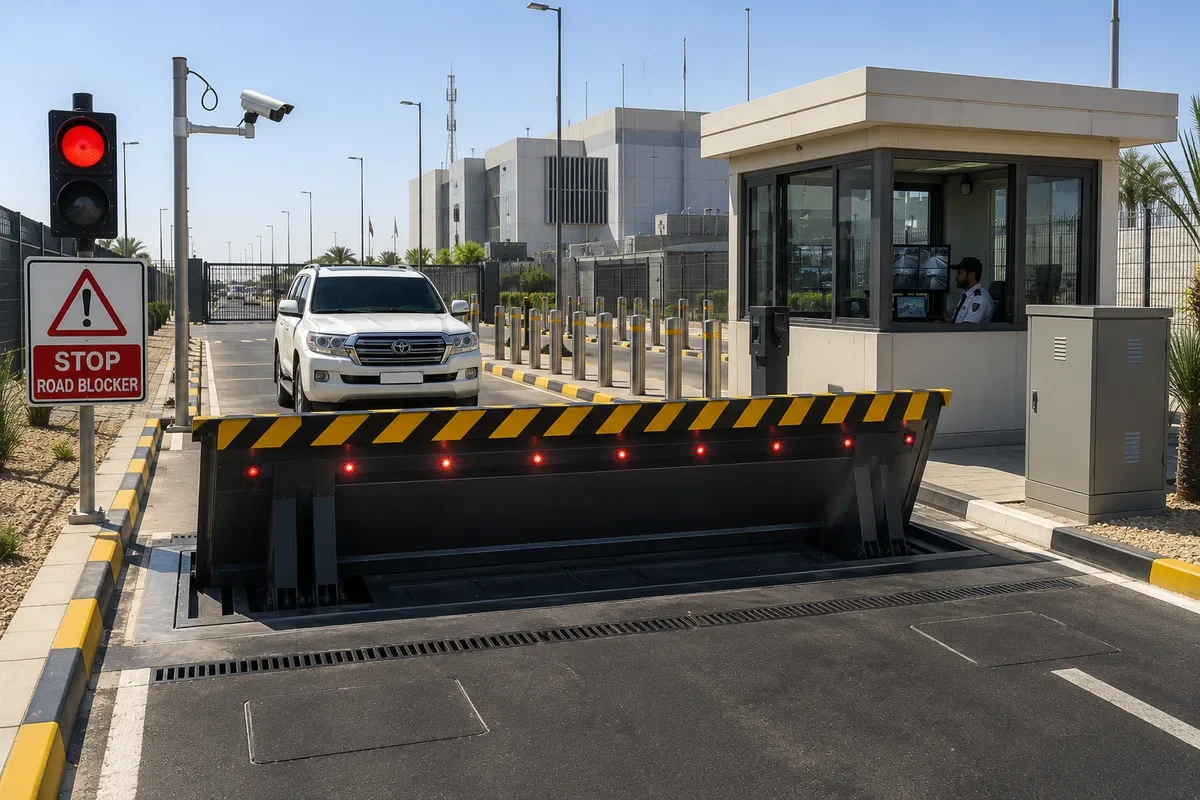
Road Blockers are heavy-duty vehicle access devices installed across a roadway to create a substantial physical barrier when raised and a clear vehicle passage when lowered.
AZTÖR Automation supplies, installs, integrates, repairs and maintains road blocker systems for government facilities, industrial sites, logistics facilities, commercial properties, data centres, sensitive compounds and other controlled vehicle entrances across the UAE.
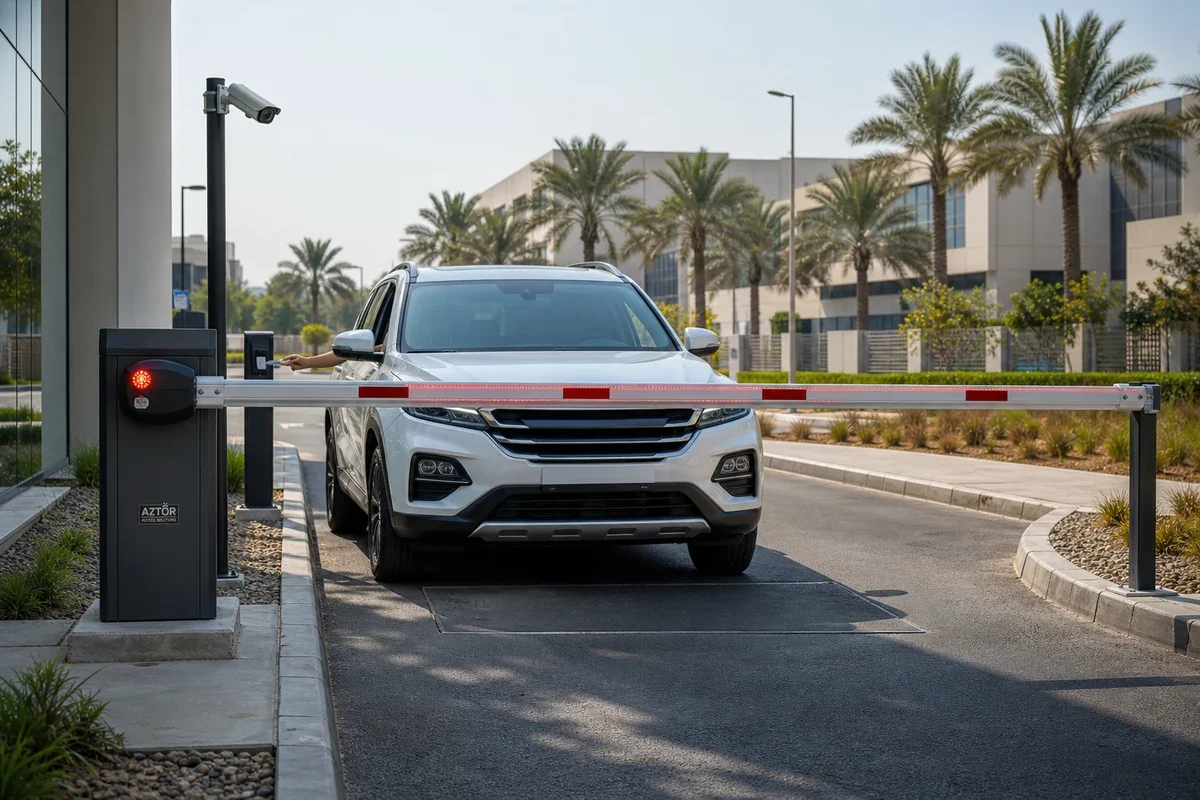
A road blocker is different from a conventional Parking Barrier. A boom barrier primarily manages vehicle access and traffic flow, while a road blocker creates a much more substantial physical obstruction across the vehicle lane.
Road blockers are also different from Automatic Bollards. Bollards use individual rising posts, whereas a road blocker normally raises a continuous reinforced blocking element across a defined section of roadway.
The appropriate solution depends on the site's actual security objective, traffic frequency, lane width, vehicle types, access-control process, road construction and required impact performance.
AZTÖR provides a free site inspection for applicable road blocker projects. We assess the entrance geometry, lane width, vehicle approach, traffic volume, required security level, existing access-control system, underground utilities, drainage, civil works and emergency operating requirements before finalising the proposed system.
Road blockers are commonly available in hydraulic and other manufacturer-specific drive configurations. Hydraulic systems are widely used for demanding applications where a powerful and controlled raising and lowering mechanism is required.
The hydraulic power unit, control panel and associated components must be selected as part of the complete road blocker system rather than treated as independent generic equipment.
Road blocker dimensions, raised height, foundation depth, operating speed and duty cycle vary considerably between manufacturers and models.
A standard dimension should therefore not be assumed before the actual lane and security requirements have been reviewed.
Road blockers can be installed across single vehicle lanes or incorporated into wider multi-lane security entrances.
Where several lanes are involved, each blocker and its access sequence should be coordinated with the wider traffic-management and security strategy.
Road blockers can be controlled from a guardhouse using authorised push-button, key-switch or control-console operation.
They can also integrate with compatible access-control systems where automatic or semi-automatic vehicle authorisation is required.
ANPR can be used to identify authorised vehicle number plates before the road blocker is lowered.
UHF Vehicle Access can provide hands-free long-range identification for registered staff, resident, fleet or other authorised vehicles.
RFID, card readers, biometric systems and other access technologies can also form part of the wider entrance-control process where appropriate.
Visitor Vehicle Management can integrate temporary vehicle permissions, ANPR, intercom and security approval with the road blocker entrance.
At higher-security locations, automatic access authorisation may still be followed by guard or security verification before the blocker is lowered. The operating sequence should match the site's actual security policy.
Intercom systems can provide communication with drivers whose vehicles are not automatically authorised.
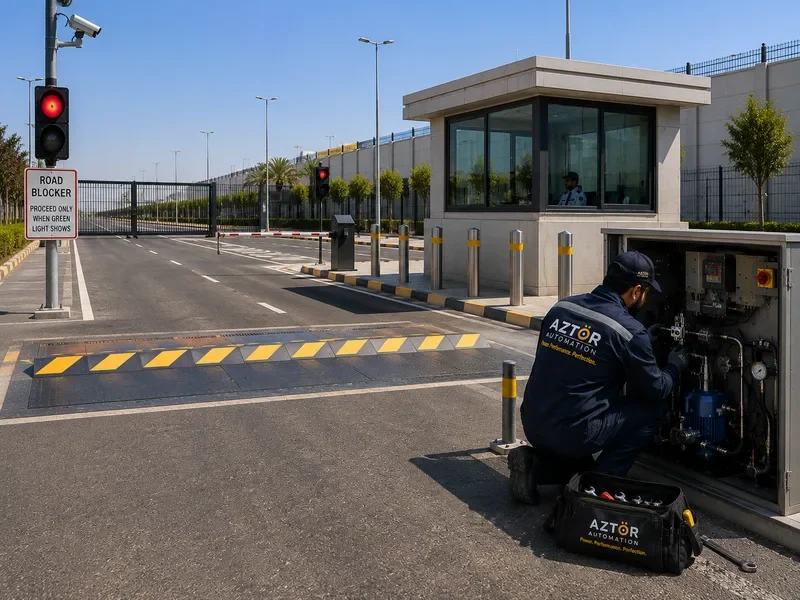
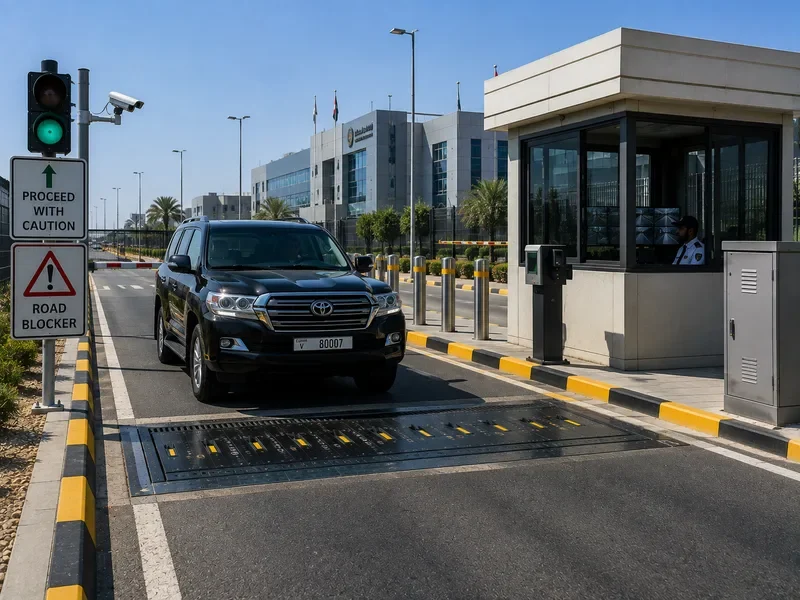
Traffic lights are particularly important at road blocker entrances because drivers need a clear indication of whether the blocking element is raised, moving or fully lowered for authorised passage.
Red and green traffic signals can therefore be coordinated with the road blocker controller.
Warning lights, audible alarms and other signalling devices may also be incorporated according to the selected system and site requirements.
Vehicle detection is a critical part of automatic road blocker operation.
Induction loops can be installed to detect approaching vehicles, confirm vehicle presence and help determine when the vehicle has cleared the protected area.
Safety loops can help prevent the blocker from rising while a vehicle remains within the configured detection zone.
Photocells or other suitable presence-detection technologies can also be incorporated where required by the system design.
Access identification and physical vehicle detection should not be confused.
An ANPR camera recognising an authorised number plate does not prove that the vehicle has completely passed over and cleared the road blocker.
The control sequence should therefore use appropriate vehicle-detection and safety logic before the blocker is allowed to rise.
For entrances with both inbound and outbound traffic, the system needs appropriate directional logic so conflicting vehicle movements do not result in unsafe commands.
Road blockers can also operate with automatic gates or parking barriers as part of a layered entrance.
For example, an outer Parking Barrier may manage traffic and initial vehicle identification while a road blocker provides a more substantial inner security control.
A sliding or swing security gate may also form another layer where the site requires both vehicle stopping and perimeter closure.
The operating sequence between the barrier, road blocker and gate needs to be designed carefully so devices do not issue conflicting commands.
Security interlocking can be configured on suitable control systems. One device may need to reach a defined safe position before another device is permitted to operate.
The exact sequence is project specific and should be established through the site's security and traffic requirements.
Road blockers can be supplied in different physical configurations, including surface-mounted and foundation-mounted or shallow/deep foundation systems depending on manufacturer design.
Conventional foundation-mounted blockers generally require significant civil preparation because the blocking mechanism retracts below or into the roadway.
Shallow-mount road blockers can be useful where underground installation depth is restricted, although their actual foundation requirements remain manufacturer specific.
Surface-mounted road blockers or wedge-style systems may be suitable where extensive excavation is undesirable or underground services restrict conventional installation.
Surface-mounted does not mean that foundations are unnecessary. The selected system still requires appropriate structural anchoring and civil works.
Underground services are a major consideration before road blocker installation. Electrical cables, water lines, drainage, telecommunications, irrigation and other utilities can affect the available installation location and depth.
Drainage is equally important for systems containing below-ground equipment.
Rainwater, wash water, irrigation, groundwater and other water sources should be considered so the road blocker pit and operating mechanism are not exposed to inappropriate water accumulation.
The drainage solution may include gravity drainage, a sump, pump or another manufacturer-approved arrangement depending on site conditions.
The surrounding road surface must also be designed to accommodate vehicle loading and provide a correct transition over the road blocker when it is fully lowered.
Heavy commercial vehicles may create substantially different loading conditions from passenger cars, so expected vehicle types should be established during design.
For UAE installations, outdoor equipment must be suitable for high temperatures, direct sunlight, dust, sand, humidity and the actual environmental exposure.
The hydraulic power unit and control equipment should be installed in a suitable protected location according to manufacturer requirements.
Corrosion protection is particularly important for underground and external structural components, especially in coastal or frequently wet environments.
Emergency operation should be planned before installation.
Depending on the selected system and project requirements, emergency lowering, manual operation, accumulator-assisted operation, UPS-supported controls, generator support or other manufacturer-specific arrangements may be considered.
The required behaviour during a mains power failure should be deliberately defined. A high-security site may have different requirements from a commercial vehicle entrance.
Emergency vehicle access also needs consideration where fire, ambulance, police or other authorised emergency vehicles may need to use the controlled route.
Fire-alarm or emergency-system integration may be possible where technically appropriate, but the required operating logic should follow the approved project strategy rather than a generic automatic response.
Not every Road Blocker is automatically crash rated.
A heavy hydraulic road blocker may look substantial and provide strong physical restriction, but this alone does not establish documented vehicle-impact performance.
Where hostile-vehicle mitigation is required, the selected road blocker should have independently documented impact-test performance for the required complete system and installation configuration.
Recognised vehicle-impact testing can include ASTM F2656/F2656M, IWA 14-1 or another project-specified standard.
The required performance can depend on factors such as test vehicle mass, impact speed and permitted penetration.
These values should come from the actual security requirement and selected manufacturer's test documentation rather than being invented as a generic road blocker specification.
Different impact standards and classifications should not be treated as automatically equivalent.
A road blocker tested to one configuration should also not automatically be assumed to provide the same documented performance if its dimensions, foundation, structural components or installation arrangement are materially changed.
For critical infrastructure, embassies, government properties, data centres and other sensitive sites, the required hostile-vehicle mitigation performance should normally be established by the project security design, consultant or relevant authority.
AZTÖR can then work around the specified requirement and technically suitable manufacturer systems.
Where certified impact resistance is not required, road blockers can still be used as robust vehicle-control devices at industrial compounds, logistics facilities and other controlled entrances.
This distinction is important because a customer requiring reliable access control does not necessarily need the same system as a site requiring protection against deliberate high-energy vehicle attack.
Road blockers can also integrate with CCTV and VMS systems so vehicle access events can be viewed alongside surveillance where compatible.
ANPR records can similarly form part of the authorised vehicle-access history.
At logistics and industrial facilities, the road blocker can be integrated into guardhouse procedures for staff vehicles, contractors, suppliers and fleet movements.
At data centres and sensitive commercial sites, multiple access technologies and security verification stages can be coordinated according to the site's requirements.
Automatic operation should not remove the need for a defined security override procedure.
Authorised personnel should have an appropriate method of controlling the road blocker if an ANPR reader, access-control server, network or other connected system fails.
Road blocker controls should also be protected against unauthorised operation.
Physical control panels, network interfaces and remote access should be limited according to the security architecture of the project.
Existing road blockers can often be repaired or upgraded depending on their mechanical condition and availability of compatible components.
AZTÖR can inspect the hydraulic power pack, cylinders, hoses, valves, blocker mechanism, control panel, sensors, induction loops, traffic lights and access-control interfaces.
Common faults include a blocker failing to rise, failing to lower, moving slowly, stopping midway, hydraulic leakage, control-panel faults, loop detector faults, limit or position-sensor faults and access-control commands not reaching the road blocker controller.
If the blocker does not lower after successful vehicle authorisation, the problem may exist within the control interface, safety logic, hydraulic system, position detection or mechanical assembly.
If the blocker remains lowered after a vehicle passes, a vehicle-detection loop or another safety input may still be active, or the system may have a control, hydraulic or mechanical fault.
Abnormal noise, uneven movement or visible hydraulic leakage should be investigated rather than repeatedly operating the equipment.
Following significant vehicle impact, the complete road blocker and surrounding civil structure should be inspected before normal operation resumes.
Preventive maintenance is particularly important for road blockers because they combine heavy mechanical equipment, hydraulics or other drives, underground components, traffic loads, sensors and access-control systems.
Maintenance can include cleaning, drainage inspection, mechanical checks, hydraulic fluid and leakage inspection where applicable, cylinder and hose inspection, control-panel testing, limit and position verification, induction-loop testing, traffic-light testing and complete operational sequencing.
For certified crash-rated systems, repairs and replacement components should follow the manufacturer's requirements so the documented configuration is not unintentionally compromised.
AZTÖR Automation provides Road Blocker installation, repair, maintenance, parking automation and high-security vehicle access automation across Dubai, Abu Dhabi, Sharjah, Ajman, Ras Al Khaimah, Fujairah and Umm Al Quwain, with suitable project and technical support available across the wider GCC.
Key Features
- Automatic road blockers
- Hydraulic road blockers
- Heavy-duty road blockers
- Vehicle access road blockers
- Security road blockers
- Rising road blockers
- Wedge road blockers
- Shallow-mount road blocker options
- Surface-mounted road blocker options
- Foundation-mounted road blockers
- High-security vehicle access
- Automatic vehicle access automation
- Single-lane systems
- Multi-lane systems
- Bidirectional access control
- Hydraulic power unit
- Automatic raising
- Automatic lowering
- Guardhouse control
- Control-console operation
- Push-button control
- Key-switch control
- Access-control integration
- ANPR integration
- UHF Vehicle Access integration
- RFID integration
- Visitor Vehicle Management integration
- Intercom integration
- Parking automation integration
- Gate automation integration
- Parking Barrier integration
- Automatic gate integration
- CCTV integration
- VMS integration
- Induction loop integration
- Vehicle presence detection
- Vehicle passage detection
- Safety loop integration
- Photocell integration
- Traffic-light integration
- Red and green signal control
- Warning-light integration
- Audible warning options
- Security interlocking
- Layered entrance control
- Emergency override options
- Manual operation options
- Power-failure management
- UPS integration where suitable
- Generator integration where suitable
- Fire-alarm interface where applicable
- Emergency vehicle access options
- Heavy vehicle applications
- Outdoor UAE installation
- Corrosion-resistant construction options
- Drainage coordination
- Civil foundation works
- Underground utility coordination
- Road blocker repair
- Hydraulic system repair
- Hydraulic cylinder repair
- Hydraulic hose replacement
- Control-panel repair
- Position sensor repair
- Loop detector repair
- Traffic-light repair
- Access-control troubleshooting
- Preventive maintenance
- AMC support
- Crash-rated systems where specifically required
- Certified impact-rated systems where documented
- Hostile vehicle mitigation options where specified
Technical Specification
| Solution Type | Automatic heavy-duty road blocker |
|---|---|
| Primary Function | Controlled physical restriction of vehicle access |
| Application | Commercial, industrial, government and high-security vehicle entrances |
| Operation | Automatic raising and lowering |
| Drive Technology | Hydraulic or manufacturer specific |
| Configuration | Rising wedge or manufacturer-specific road blocker design |
| Lane Width | Project and manufacturer specific |
| Blocker Width | Manufacturer and project specific |
| Raised Height | Manufacturer and model specific |
| Lowered Position | Vehicle passage position |
| Operating Speed | Manufacturer and model specific |
| Duty Cycle | Manufacturer and model specific |
| Vehicle Loading | Project and selected system specific |
| Hydraulic Power Unit | Available on hydraulic systems |
| Control Panel | Available |
| Guardhouse Control | Available |
| Push Button | Available |
| Key Switch | Available |
| ANPR Integration | Available |
| UHF Integration | Available |
| RFID Integration | Available |
| Visitor Management Integration | Available |
| Intercom Integration | Available |
| Automatic Gate Integration | Available |
| Parking Barrier Integration | Available |
| CCTV/VMS Integration | Available where compatible |
| Induction Loop Integration | Available |
| Vehicle Presence Detection | Available |
| Safety Loop | Available |
| Photocell Integration | Available |
| Traffic Lights | Available |
| Audible Warning | Available where required |
| Interlocking | Available on suitable control systems |
| Emergency Override | Project and manufacturer specific |
| Manual Operation | Manufacturer specific |
| Power Failure Behaviour | Project and manufacturer specific |
| UPS Integration | Project specific |
| Generator Integration | Project specific |
| Fire Alarm Interface | Available where technically required and compatible |
| Foundation Type | Deep, shallow or manufacturer-specific structural arrangement |
| Surface-Mounted Option | Available from suitable manufacturers |
| Drainage | Site and manufacturer specific |
| Underground Installation | Product and project specific |
| Outdoor Application | Available |
| Environmental Rating | Manufacturer and model specific |
| Corrosion Protection | Manufacturer and project specific |
| Impact Rating | Only for independently tested and documented systems |
| Crash Rating | Project and certified product specific |
| Vehicle Impact Standard | Project-specified recognised standard where required |
| Installation | New installation, replacement or suitable retrofit |
| Maintenance | Mechanical, hydraulic, electrical, drainage, sensors and access-control system |
Road Blockers should be selected according to the required security level, lane width, expected vehicle types, traffic frequency, operating speed, road construction, underground utilities, drainage, emergency operation and access-control requirements. A road blocker must not be described as crash rated solely because of its size, steel construction or hydraulic drive. Any impact rating should be supported by documented testing of the selected complete system and applicable installation configuration. AZTÖR Automation provides a free site inspection before finalising the road blocker, civil works and vehicle access automation design.
Typical Applications
- Government facilities
- Government compounds
- Embassies
- Diplomatic facilities
- Critical infrastructure
- Data centres
- Utility facilities
- Power facilities
- Telecommunication facilities
- Military and defence facilities where applicable
- Police and security facilities
- Airports
- Ports
- Marine facilities
- Industrial facilities
- Factories
- Manufacturing plants
- Warehouses
- Logistics centres
- Distribution centres
- Oil and gas facilities
- Commercial compounds
- Corporate campuses
- Business parks
- Sensitive commercial properties
- Hotels with controlled entrances
- VIP entrances
- Service entrances
- Vehicle checkpoints
- Security checkpoints
- Staff vehicle entrances
- Contractor entrances
- Fleet entrances
- Private roads
- Controlled access roads
- High-security parking entrances
- ANPR-controlled entrances
- UHF-controlled entrances
- Guardhouse-controlled entrances
- Layered vehicle security entrances
- Hostile vehicle mitigation applications where specified