Dock Seals
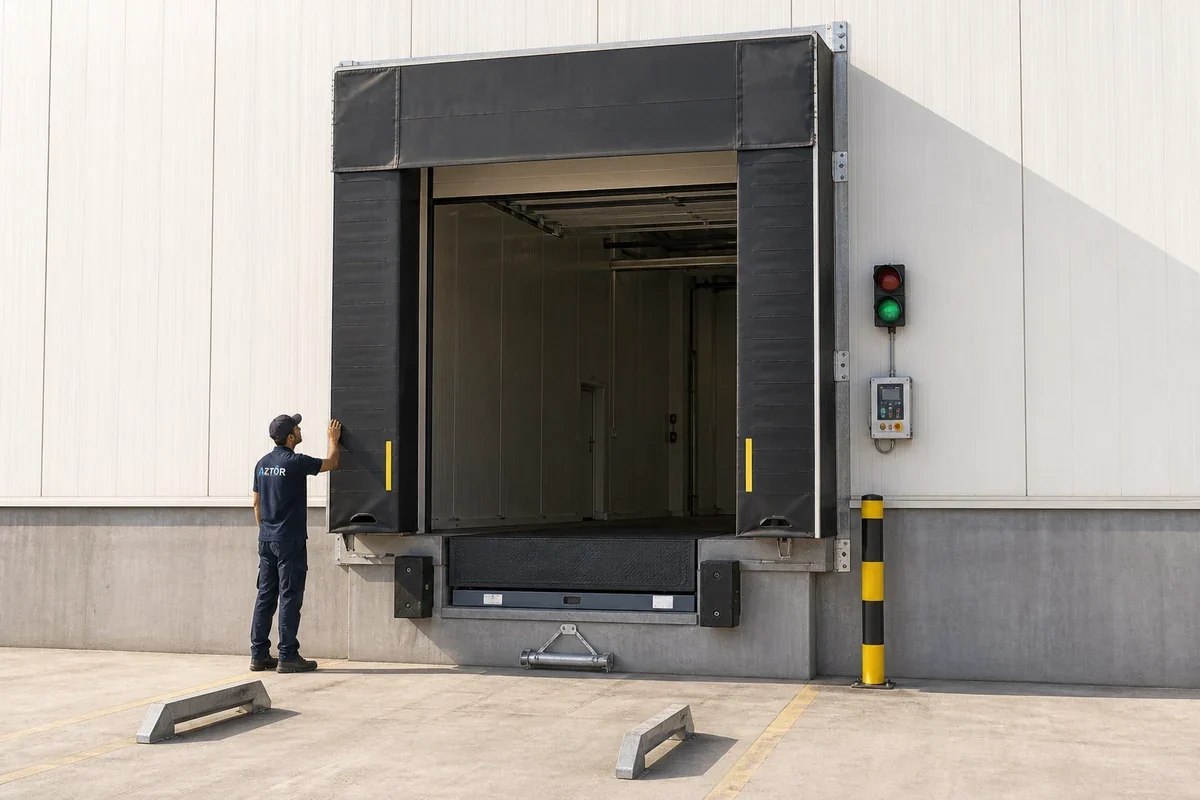
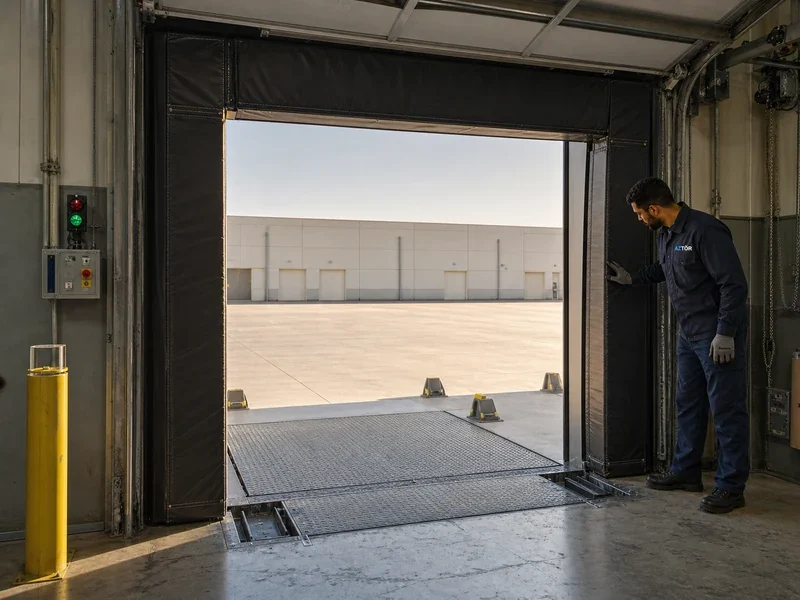
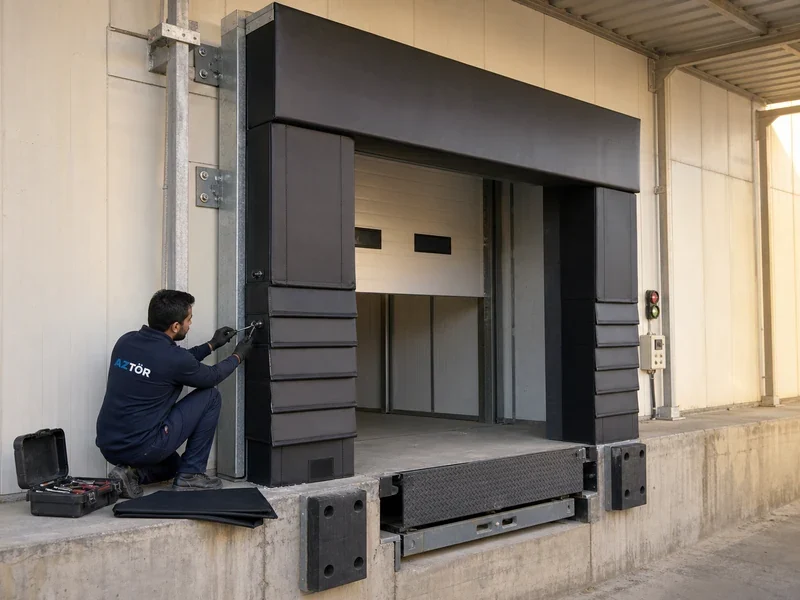
Dock seals are loading-bay systems designed to create a close interface between the building and the rear of a truck or trailer while goods are being loaded or unloaded. Unlike a conventional dock shelter, a dock seal typically uses compressible side and head pads that make direct contact with the vehicle body.
AZTÖR supplies, installs, replaces and maintains dock seals for warehouses, logistics centres, distribution facilities, cold stores, food facilities and other industrial loading bays across the UAE.
Dock seals are particularly useful where the facility handles a reasonably consistent range of vehicle sizes and requires improved environmental separation around the loading-bay opening.
When the vehicle reverses toward the dock, its rear body compresses against the side and head pads while the vehicle is stopped at the designed dock position. This helps reduce the gaps through which hot air, dust and external weather can enter the loading area.
Vehicle compatibility is one of the most important considerations. Dock seals should not be selected only from the warehouse doorway dimensions because vehicle width, height, rear-door configuration, dock height and bumper projection all affect the final interface.
AZTÖR provides a free site inspection for applicable dock seal projects. We assess the loading-bay opening, building face, dock height, dock leveller, bumpers, expected vehicle fleet, trailer dimensions, approach arrangement and environmental requirements before recommending a configuration.
Side pads are normally positioned vertically on both sides of the loading-bay opening. Their width, projection and compression characteristics need to match the intended vehicle position while preserving a practical clear opening for loading operations.
The upper seal can use a fixed head pad, adjustable head pad, curtain-style arrangement or another manufacturer-specific configuration. Adjustable arrangements can be useful where vehicle heights vary within the operating range of the selected system.
The amount of pad compression is important. Too little contact can leave unnecessary gaps, while excessive compression can accelerate wear, interfere with vehicle bodies and place unnecessary stress on the seal structure.
Dock bumpers play a critical role in controlling the final vehicle position. The truck should stop against the designed bumper arrangement rather than continue reversing until the dock seal itself becomes the stopping device.
Bumper projection, condition and position should therefore be checked whenever a dock seal is installed or replaced. Worn or damaged bumpers can allow excessive compression and contribute to repeated dock seal damage.
The outer face of a dock seal is commonly manufactured from heavy-duty flexible material designed to withstand repeated contact and abrasion from vehicle movement. Internal pad construction and covering materials vary by manufacturer and application.
Wear pleats, protective flaps or reinforced contact surfaces can be incorporated into suitable systems to help protect high-contact areas from repeated trailer movement.
In UAE warehouses, dock seals can help reduce the direct entry of hot ambient air while the loading bay is occupied by a vehicle. This can be particularly valuable for air-conditioned warehouses and temperature-controlled logistics facilities.
Cold stores and refrigerated distribution facilities can also benefit from an appropriately selected dock seal by reducing uncontrolled air exchange around the vehicle interface. Actual thermal performance depends on the complete loading bay, vehicle fit, door-opening duration and operating procedure.
A dock seal should not automatically be described as completely airtight. Gaps can remain around vehicle doors, hinges, bumpers, underbody areas and other interfaces. Where a higher level of environmental sealing is required, an inflatable dock shelter or another specialist system may be more appropriate.
Vehicle variation is therefore important when deciding between a dock seal and dock shelter. Dock seals generally perform best when vehicles fall within a suitable dimensional range, whereas flexible or inflatable shelters may better accommodate certain wider fleet variations.
Tail-lift vehicles require special consideration because the lift platform and associated equipment can interfere with conventional dock seal arrangements. The actual vehicle configuration should be reviewed before selection.
Dock seals can be coordinated with dock levellers, sectional overhead doors and other loading-bay equipment. The leveller bridges the transition between the dock and trailer floor while the seal helps reduce environmental gaps around the vehicle body.
The wider loading-bay solution can also incorporate vehicle restraints, traffic lights, wheel guides, dock lights and other suitable equipment according to the site's safety and operational requirements.
For temperature-controlled loading bays, the dock seal can be coordinated with insulated sectional doors and suitable dock levellers to create a more complete cold-chain interface.
For UAE conditions, external materials should be selected with consideration for heat, UV exposure, dust, sand and repeated vehicle contact. Fixings and supporting structures also need to suit the installation environment.
Dock seals are exposed to continuous mechanical wear. Trailer movement during loading, suspension height changes and repeated docking contact can gradually damage the pad covers even when vehicles are positioned correctly.
AZTÖR can inspect worn dock seals and replace suitable side pads, head pads, curtains, protective covers, reinforcement components and related parts where compatible replacements are available.
Torn fabric should be addressed before the internal pad is extensively damaged. Early repair or replacement of the contact surface can sometimes prevent a relatively small defect from developing into a complete seal replacement.
Repeated damage should also trigger an inspection of vehicle alignment, bumpers and seal dimensions. Replacing the same damaged pad repeatedly without correcting the underlying docking condition is unlikely to provide a lasting solution.
Preventive maintenance includes checking pad condition, covers, seams, fixings, supporting frames, bumpers and the overall vehicle interface. Loading-bay staff should also report torn covers, loose components or abnormal vehicle contact promptly.
AZTÖR provides dock seal supply, installation, replacement, repair and preventive maintenance across Dubai, Abu Dhabi, Sharjah, Ajman, Ras Al Khaimah, Fujairah and Umm Al Quwain, with suitable loading-bay support available across the wider GCC.
Key Features
- Industrial loading-bay dock seals
- Warehouse dock seal systems
- Compression dock seals
- Foam-pad dock seal configurations
- Side sealing pads
- Head sealing pads
- Adjustable head pad options
- Head curtain options where applicable
- Heavy-duty flexible outer covers
- Reinforced contact surfaces
- Wear pleat options
- Replaceable protective covers
- Vehicle-contact sealing
- Truck and trailer applications
- Reduced loading-bay exposure
- Helps reduce hot-air infiltration
- Helps reduce dust entry
- Supports temperature-controlled operations
- Cold storage applications
- Cold-chain logistics applications
- Vehicle-size-specific configurations
- Fleet compatibility assessment
- Project-specific pad dimensions
- Controlled pad compression
- Dock bumper coordination
- Dock leveller coordination
- Sectional overhead door coordination
- Vehicle-restraint coordination
- Traffic-light coordination
- Wheel-guide coordination
- Dock-light coordination
- Tail-lift vehicle assessment
- External UAE applications
- UV-resistant material options
- Heat-resistant material selection
- Side pad replacement
- Head pad replacement
- Fabric cover replacement
- Frame and fixing repair
- Existing dock seal replacement
- Loading-bay inspection
- Preventive maintenance and AMC support
Technical Specification
| Product Type | Loading bay dock seal |
|---|---|
| Primary Function | Reduce environmental gaps around a docked vehicle |
| Application | Warehouse, logistics, cold storage and industrial loading bays |
| Seal Type | Compression pad, adjustable head, curtain or manufacturer-specific configuration |
| Side Seals | Compressible side pads |
| Top Seal | Head pad, adjustable pad, curtain or system-specific arrangement |
| Pad Construction | Manufacturer-specific resilient or foam-core construction |
| Outer Cover | Heavy-duty flexible industrial fabric |
| Contact Surface | Reinforced or wear-resistant covering according to selected system |
| Wear Pleats | Available on suitable configurations |
| Vehicle Range | Selected according to expected fleet dimensions |
| Vehicle Width | Fleet and system specific |
| Vehicle Height | Fleet and system specific |
| Opening Size | Project specific |
| Dock Height | Project specific |
| Seal Projection | Selected according to dock and vehicle geometry |
| Compression | Manufacturer and application specific |
| Vehicle Stopping Position | Controlled by suitable dock bumper arrangement |
| Dock Bumpers | Required according to loading-bay design |
| Environmental Separation | Dependent on vehicle fit and selected system |
| Thermal Benefit | Complete loading-bay and operational-condition specific |
| Dust Reduction | Dependent on complete vehicle and dock interface |
| Weather Protection | Application and system specific |
| UV Resistance | According to selected outer-cover material |
| Tail-Lift Compatibility | Requires vehicle and loading-bay assessment |
| Dock Leveller Integration | Compatible |
| Sectional Door Integration | Compatible |
| Vehicle Restraint Integration | Compatible as part of wider loading-bay system |
| Traffic Light Integration | Available as complementary loading-bay equipment |
| Wheel Guides | Available as complementary equipment |
| Installation | New installation or existing seal replacement |
| Maintenance | Pads, covers, seams, frames, fixings and bumpers |
Dock seals should be selected from the actual vehicle fleet and loading-bay geometry rather than the doorway dimensions alone. Vehicle width and height, dock height, bumper projection, required pad compression, rear-door arrangement and tail-lift equipment can all affect suitability. Dock seals should not automatically be described as airtight. AZTÖR provides a free site inspection to establish the appropriate configuration before installation or replacement.
Typical Applications
- Warehouses
- Logistics centres
- Distribution centres
- Loading bays
- Loading docks
- Cold storage warehouses
- Cold-chain logistics centres
- Temperature-controlled warehouses
- Refrigerated distribution facilities
- Food distribution centres
- Food-processing facilities
- Frozen-food warehouses
- Dairy distribution facilities
- Meat and poultry facilities
- FMCG warehouses
- Supermarket distribution centres
- Retail distribution facilities
- Pharmaceutical warehouses
- Healthcare distribution facilities
- E-commerce fulfilment centres
- Third-party logistics facilities
- Factories
- Manufacturing facilities
- Packaging facilities
- Cargo facilities
- Airport logistics facilities
- Freight terminals
- Automotive warehouses
- Commercial storage facilities
- Existing loading-bay upgrades