Cold Storage Doors
Cold storage doors are specialist insulated door systems designed to separate areas operating at different temperatures while allowing controlled movement of personnel, forklifts, trolleys and goods. They are commonly used in cold rooms, freezer rooms, food-processing facilities, pharmaceutical storage and temperature-controlled logistics operations.
In the UAE, cold storage door performance is particularly important because the temperature difference between refrigerated interiors and surrounding ambient conditions can be substantial. Selecting the correct door helps reduce unnecessary heat infiltration, condensation-related problems and refrigeration load while supporting efficient daily operations.
AZTÖR supplies, installs, automates, repairs and maintains cold storage doors according to the temperature range, opening dimensions, traffic frequency, hygiene requirements and operating environment of each facility.
Cold storage is not one single door type. Depending on the application, solutions can include insulated sliding doors, hinged cold-room doors, automatic sliding doors, high speed insulated doors, freezer doors and other specialist temperature-controlled door systems.
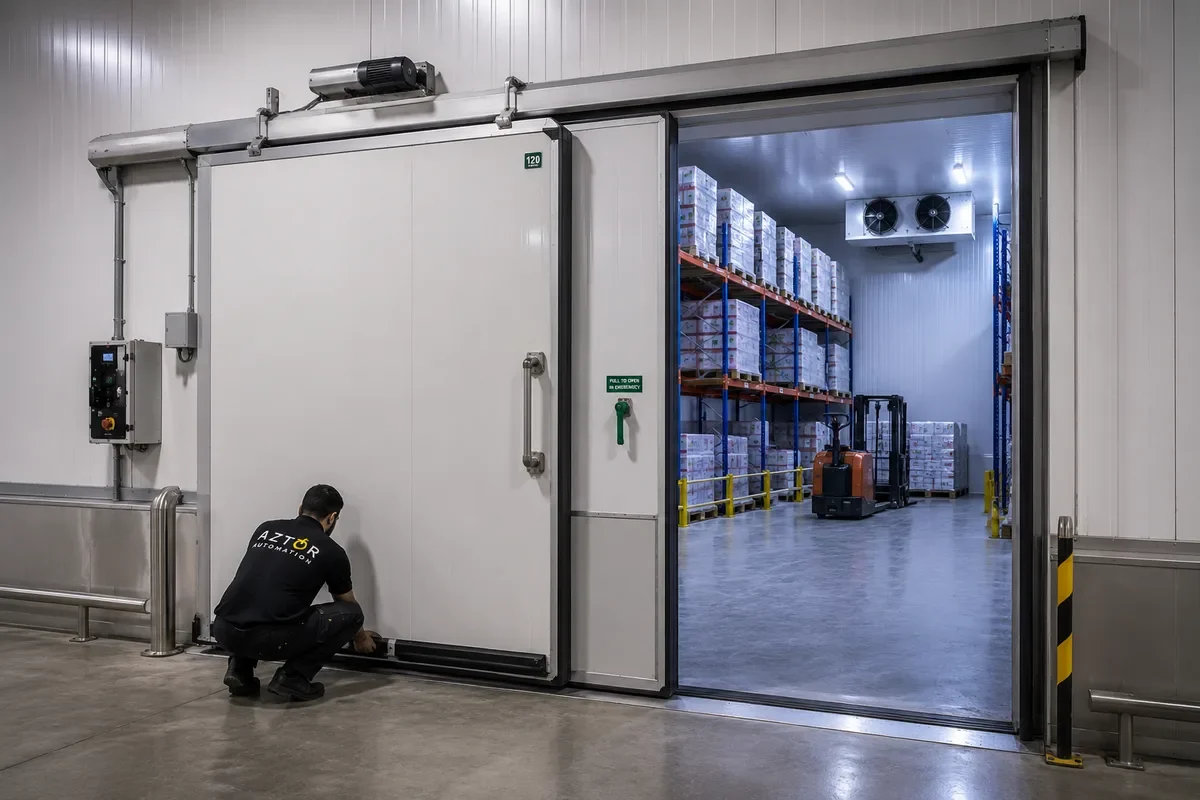
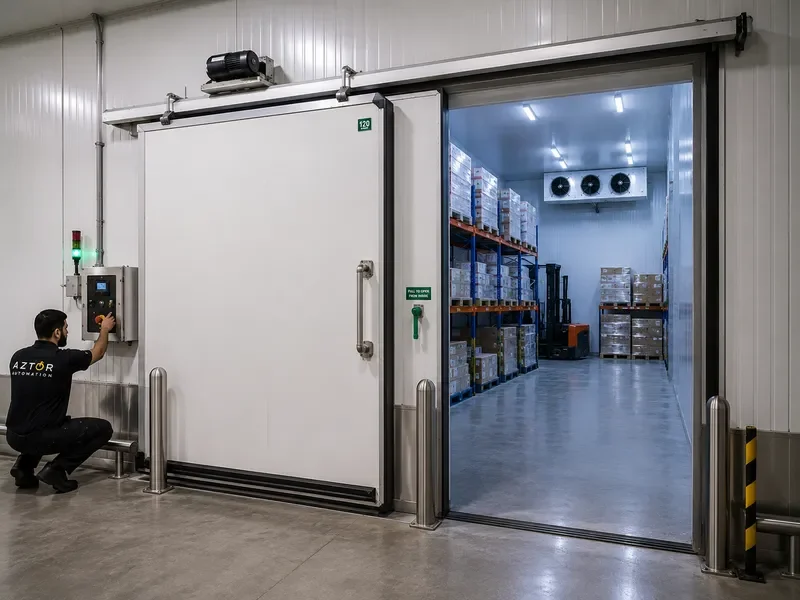
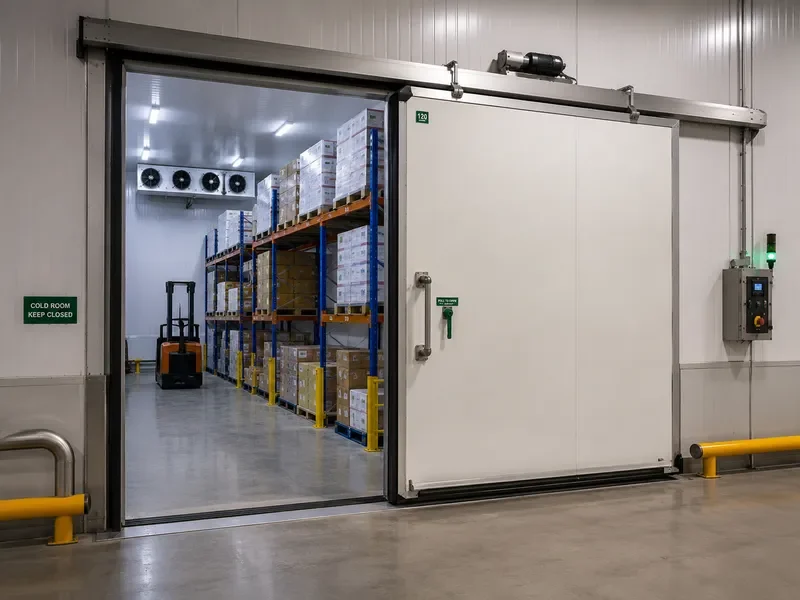
Insulated sliding cold storage doors are widely used for larger openings because the door leaf moves horizontally without occupying the swing area in front of the opening. Manual and automatic configurations can be selected according to door size and operating frequency.
Hinged insulated doors are commonly used for personnel access, smaller cold rooms and openings with relatively low traffic. Appropriate hinges, handles, latches, seals and emergency release arrangements are selected according to the application.
High speed cold storage doors can be particularly useful for frequently accessed logistics and production openings. Rapid opening and closing reduces the amount of time the doorway remains exposed, helping limit unnecessary exchange of warm and cold air.
For freezer applications, the specification requires additional attention. Very low internal temperatures combined with warm, humid surrounding air can create condensation, frost and ice around door interfaces. Suitable freezer-door systems may therefore incorporate heated frames, heated thresholds, heated seals or other anti-freeze measures depending on the manufacturer and application.
Door panels normally use insulated sandwich construction with a manufacturer-specific insulating core. Panel thickness and thermal performance vary according to the required temperature, door dimensions and selected system, so AZTÖR does not apply one standard panel thickness or U-value to every cold storage project.
The perimeter seal is just as important as the insulated panel. A highly insulated door panel will provide limited benefit if damaged or incorrectly adjusted seals allow excessive air infiltration around the opening.
AZTÖR provides a free site inspection for applicable cold storage door projects. We assess the clear opening, wall and panel construction, internal and external temperatures, traffic type, operating frequency, floor condition, available clearances and required control method before confirming the door configuration.
For existing cold rooms, we also inspect how the door interfaces with insulated wall panels and surrounding construction. Correct alignment and sealing are important for maintaining reliable closure and reducing unnecessary gaps.
Automatic cold storage doors can be activated using push buttons, pull cords, remote controls, radar sensors, induction loops or compatible access-control equipment depending on the selected system and operational requirement.
Forklift routes require careful consideration of opening speed, sensor position, visibility and door protection. In high-traffic facilities, the objective is to allow efficient vehicle movement while returning the opening to the closed position as quickly as practical.
Depending on the selected automatic system, safety equipment can include photocells, safety edges, light curtains, presence detection and other manufacturer-specific protective functions.
Personnel safety must also be considered for walk-in cold rooms and freezers. Where applicable, doors should incorporate a suitable internal emergency release arrangement so that personnel can open the door from inside even when the external locking arrangement is engaged.
Hygienic environments may require smooth, cleanable door surfaces and suitable corrosion-resistant materials. Food, pharmaceutical and healthcare-related applications should be specified according to the actual hygiene and cleaning requirements of the facility.
Stainless-steel finishes can be considered for appropriate food-processing, pharmaceutical or wash-down environments. The required grade, hardware and complete door construction should be selected according to exposure and cleaning conditions rather than assuming one stainless-steel specification suits every application.
Condensation around a cold storage door does not always mean the door panel itself has failed. Damaged seals, incorrect adjustment, excessive opening time, humidity, pressure differences, failed heaters or thermal bridging can all contribute and should be investigated systematically.
Ice formation can also affect door movement and sealing. For freezer doors, heaters and anti-frost components should be inspected together with seals, alignment, controls and the surrounding refrigeration conditions.
Cold storage doors can be integrated with wider warehouse operations. Depending on the project, AZTÖR can coordinate suitable doors with access control, traffic lights, warning devices, loading-bay equipment and other compatible industrial systems.
For loading areas where refrigerated vehicles interface with a temperature-controlled warehouse, the complete solution may also involve dock levellers, dock shelters, dock seals or inflatable shelters to reduce exposure during loading and unloading.
Preventive maintenance is especially valuable for cold storage doors because damaged seals, misalignment or slow operation can affect both mechanical reliability and environmental separation. Door panels, seals, tracks, rollers, hinges, heaters, motors, sensors and safety devices should be inspected according to the system and usage.
AZTÖR provides cold storage door supply, installation, automation, repair and preventive maintenance across Dubai, Abu Dhabi, Sharjah, Ajman, Ras Al Khaimah, Fujairah and Umm Al Quwain, with suitable temperature-controlled door support available across the wider GCC.
Key Features
- Specialist cold storage door systems
- Chiller door solutions
- Freezer door solutions
- Temperature-controlled warehouse doors
- Insulated sliding door options
- Insulated hinged door options
- Automatic cold storage doors
- High speed cold storage door options
- High speed freezer door options
- Insulated sandwich panel construction
- Low thermal-transmission configurations
- Manufacturer-specific insulation thickness
- Heavy-duty perimeter sealing
- Replaceable gasket options
- Bottom sealing
- Cold-room panel integration
- Manual operation options
- Motorised operation
- Automatic sliding configurations
- Industrial door operators
- Push-button control
- Pull-cord activation
- Remote-control options
- Radar sensor activation
- Induction loop activation
- Compatible access-control integration
- Safety photocells
- Safety edge options
- Safety light curtain options
- Internal emergency release
- Heated frame options for suitable freezer applications
- Heated threshold options where required
- Heated seal options according to selected system
- Anti-frost configurations
- Condensation-control considerations
- Vision window options where suitable
- Food-industry applications
- Pharmaceutical applications
- Smooth cleanable surface options
- Stainless-steel finish options
- Corrosion-resistant hardware options
- Forklift traffic configurations
- Cold-chain logistics applications
- Seal and gasket replacement
- Heater troubleshooting
- Door alignment and adjustment
- Motor and control repair
- Sensor replacement
- Preventive maintenance and AMC support
Technical Specification
| Product Type | Insulated cold storage door |
|---|---|
| Primary Function | Temperature separation and controlled access |
| Application | Chiller, freezer or temperature-controlled area |
| Door Configuration | Sliding, hinged, automatic, high speed or specialist system |
| Panel Construction | Insulated sandwich construction |
| Panel Material | Coated metal, stainless steel or manufacturer-specific construction |
| Insulation Core | Manufacturer-specific thermal insulation |
| Panel Thickness | Selected according to temperature and system requirements |
| Thermal Performance | Manufacturer and complete-system specific |
| U-Value | Manufacturer and tested-system specific where available |
| Temperature Range | Selected according to chiller, freezer or project conditions |
| Opening Size | Custom manufactured within selected system limits |
| Operation | Manual or motorised |
| Sliding System | Manufacturer-specific track and roller arrangement |
| Hinged System | Manufacturer-specific hinge and latch arrangement |
| Perimeter Seal | Insulated-door gasket or manufacturer-specific sealing system |
| Bottom Seal | According to selected door and floor interface |
| Emergency Release | Available where required for personnel-access applications |
| Frame Heating | Available on suitable freezer systems |
| Threshold Heating | Available where required by selected freezer system |
| Seal Heating | Manufacturer and application specific |
| Vision Panel | Available on suitable configurations |
| Motor Type | Selected according to door type, weight and operating frequency |
| Control | Push button, pull cord, remote, sensor or compatible access control |
| Radar Activation | Available on suitable automatic systems |
| Vehicle Loop | Available where appropriate |
| Safety Photocells | Available |
| Safety Edge | Available on suitable powered doors |
| Light Curtain | Available on compatible systems |
| Power Supply | According to selected motor and heater requirements |
| Surface Finish | Coated, stainless steel or manufacturer-specific |
| Hygienic Finish | Available according to selected door construction |
| External Environment | Selected according to surrounding operating conditions |
| Fire Rating | Only where supported by a separately tested and documented complete system |
| Installation | New installation, replacement or suitable existing-door automation |
| Maintenance | Panels, seals, tracks, hinges, heaters, motors, controls and safety devices |
Cold storage doors must be selected according to the actual internal and external temperatures, humidity, opening dimensions, traffic frequency and required environmental separation. Panel thickness or U-value alone does not determine door performance; seals, frame interfaces, operating time, floor condition and installation are also important. Freezer applications may require heated components and additional anti-frost measures. AZTÖR provides a free site inspection before confirming the final configuration and uses manufacturer-documented thermal values where specific performance is required.
Typical Applications
- Cold rooms
- Chiller rooms
- Freezer rooms
- Walk-in freezers
- Walk-in chillers
- Cold storage warehouses
- Temperature-controlled warehouses
- Cold-chain logistics centres
- Distribution centres
- Food storage facilities
- Food-processing plants
- Food production facilities
- Meat-processing facilities
- Poultry-processing facilities
- Seafood facilities
- Dairy facilities
- Frozen-food warehouses
- Fruit and vegetable storage
- Supermarket cold rooms
- Hypermarket cold storage
- Central kitchens
- Catering facilities
- Commercial kitchens
- Hotels
- Restaurants
- Pharmaceutical warehouses
- Medicine storage facilities
- Healthcare storage areas
- Laboratories
- Temperature-controlled production areas
- FMCG warehouses
- Refrigerated logistics facilities
- Loading areas serving cold stores
- Industrial refrigeration facilities