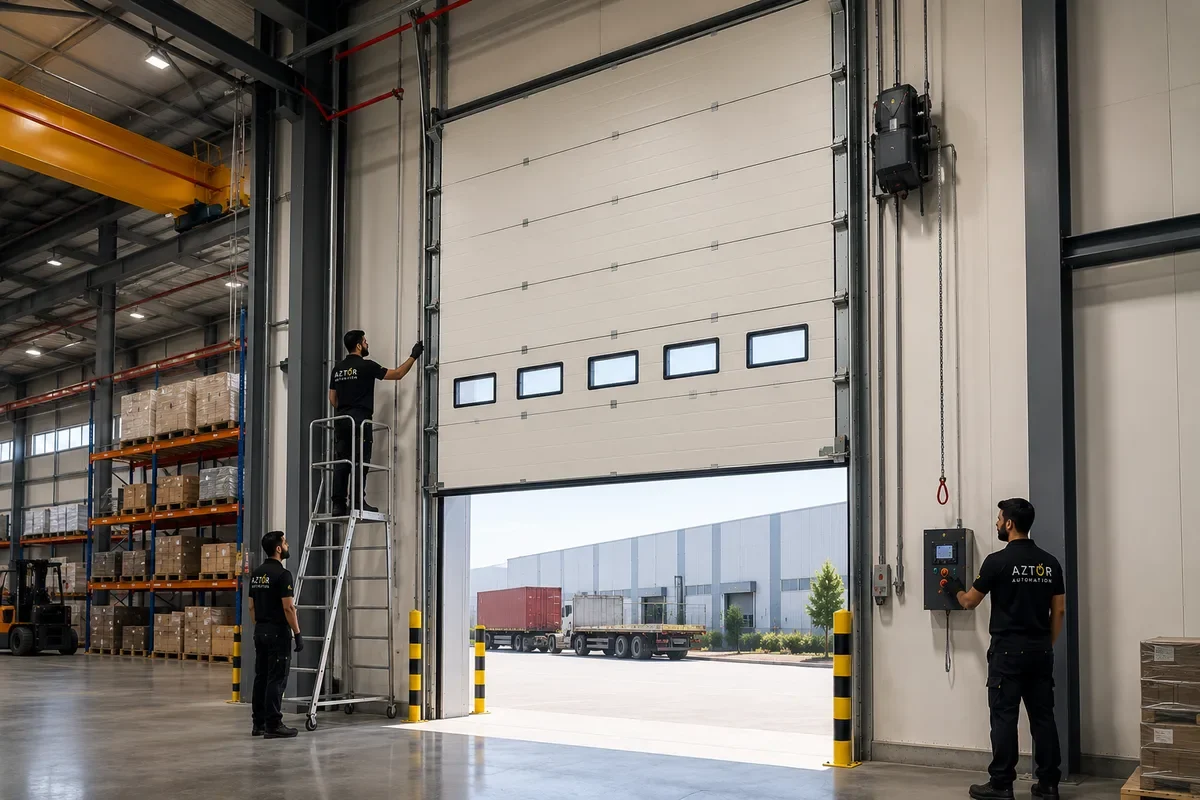
Vertical Lift Doors
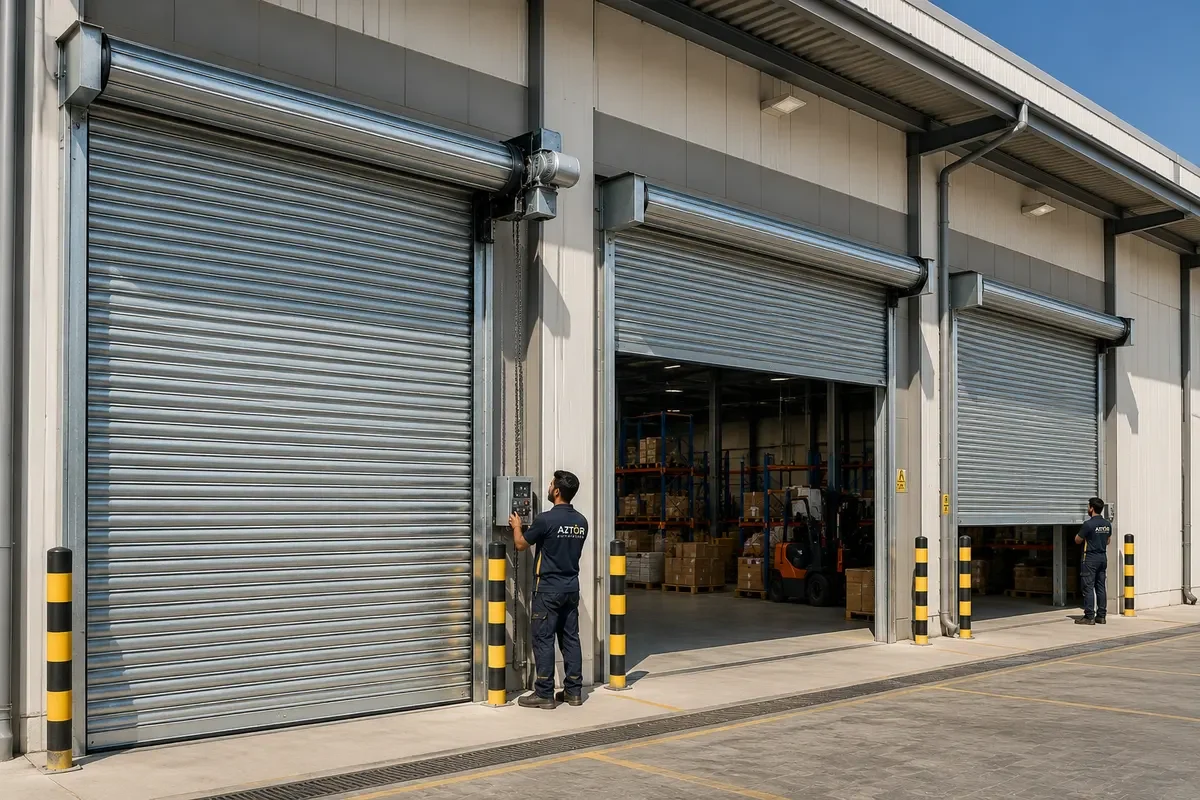
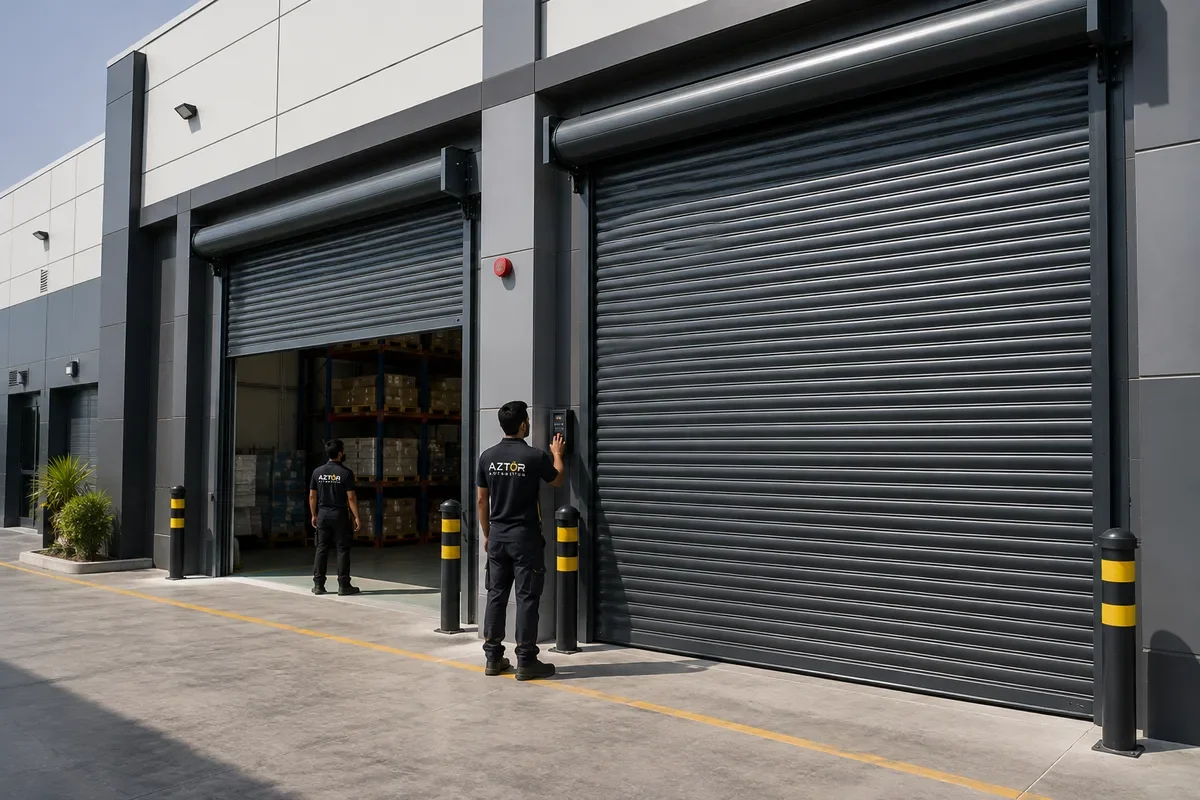
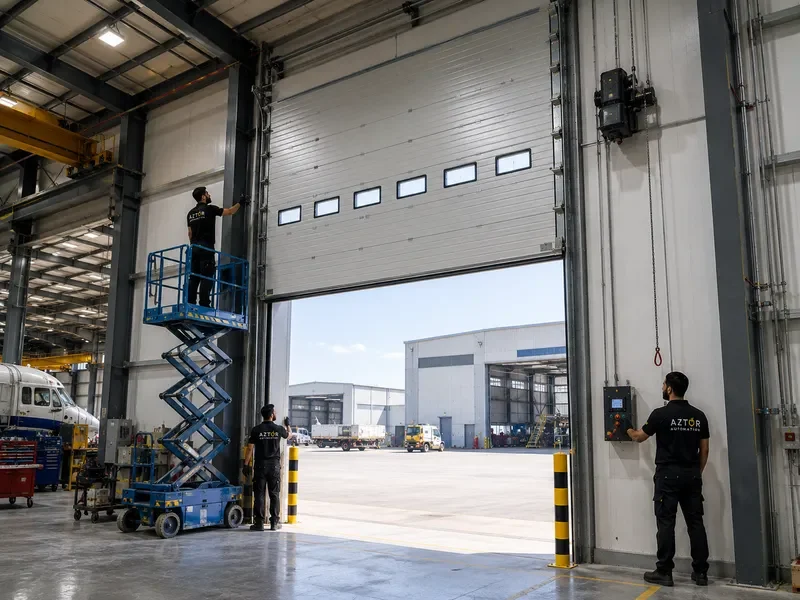
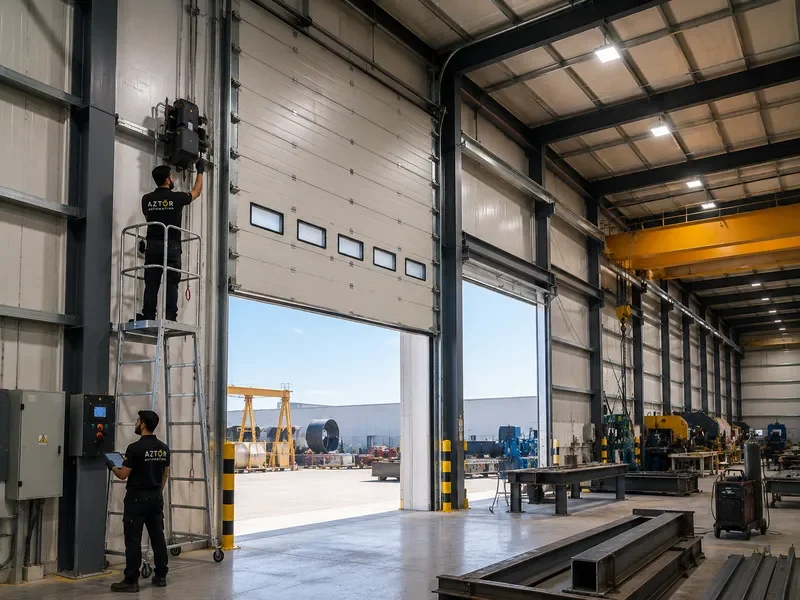
Vertical lift doors are industrial sectional door systems in which the door panels travel vertically upward along tracks above the opening rather than turning horizontally beneath the ceiling. This configuration is particularly useful in tall industrial buildings where sufficient clear wall height is available above the doorway.
AZTÖR supplies, installs, automates and maintains vertical lift door systems for warehouses, factories, logistics facilities, workshops, aircraft-support buildings, vehicle service facilities and other industrial premises across the UAE.
A vertical lift arrangement can make efficient use of tall internal spaces because the opened door remains close to the wall above the entrance. It can help keep ceiling areas clearer for lighting, cranes, building services, racking or other equipment where the building geometry permits.
Vertical lift describes the door's track and movement arrangement rather than one universal door construction. Depending on the selected system, the door can use insulated steel sandwich panels, aluminium sections, glazed sections or other manufacturer-specific sectional panels.
The door requires considerably more clear height above the structural opening than a conventional standard-lift sectional door. For this reason, accurate measurement of the opening, lintel height, roof structure, beams, MEP services and other overhead obstructions is essential before specifying a vertical lift configuration.
AZTÖR provides a free site inspection for applicable vertical lift door projects. We measure the opening width and height, available vertical clearance, side room and fixing surfaces and assess the surrounding structure, operating frequency, traffic and automation requirements.
The track and supporting arrangement are critical because the complete door rises vertically above the opening. Tracks, brackets, rollers, reinforcement and structural fixings must therefore be correctly selected for the door dimensions, weight and building structure.
A counterbalance system helps manage the weight of the door. Depending on the selected manufacturer and configuration, springs, cables, drums, shafts and related components are engineered according to the actual door weight and travel arrangement.
Correct balancing is essential. An improperly balanced door can place excessive load on the motor and lifting components and may become difficult or unsafe to operate. Motors should never be used simply to overcome a defective spring or mechanical system.
Motorised vertical lift doors use industrial sectional-door operators selected according to the door dimensions, weight, balance, required travel and operating frequency. The operator and controls must be compatible with the selected door system.
Control options can include push buttons, key switches, pull cords, remote controls and compatible access-control systems. Where required, vehicle detection or other automatic activation can also be considered for suitable industrial applications.
Depending on the selected system, safety equipment can include photocells, bottom safety edges, cable-break protection, spring-break protection and other manufacturer-specific devices intended to protect the doorway and door mechanism.
Insulated vertical lift doors can be useful for air-conditioned warehouses, workshops and industrial buildings in the UAE. Double-wall insulated panels and suitable perimeter seals can help reduce heat transfer and uncontrolled air movement through the closed opening.
Actual thermal performance depends on the complete door, including panel construction, joints, glazing, perimeter seals and dimensions. Specific U-values should therefore only be published when supported by technical data for the selected door system.
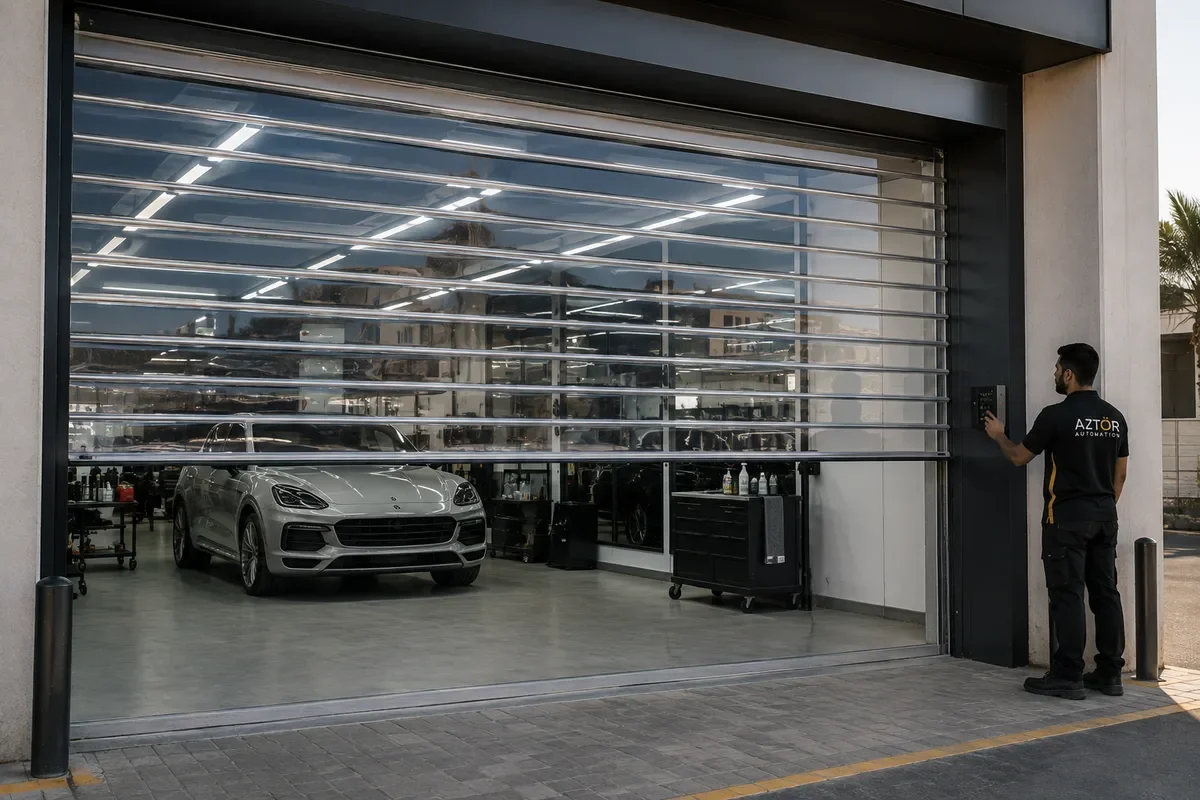
Vision windows or glazed sectional panels can be incorporated into suitable doors where daylight or visibility is required. Industrial facilities can therefore combine vertical-lift operation with insulated solid panels, partial glazing or other project-specific panel arrangements.
External vertical lift doors require appropriate consideration of wind. Because the entire door can form a large exposed surface, panel reinforcement, tracks, rollers, brackets, fixings and supporting structure must be selected for the project's conditions.
Vertical lift doors are particularly useful where ceiling clearance needs to remain available. However, they are not automatically the best arrangement for every industrial opening. Buildings without sufficient clear height above the opening may require high-lift, standard-lift or low-headroom sectional configurations instead.
Vertical lift and high-lift doors should also not be confused. A true vertical lift door continues upward substantially along the wall, whereas a high-lift configuration initially travels vertically and then transitions toward the roof or ceiling using an appropriate track arrangement.
AZTÖR can assess suitable existing sectional doors where a motor, control or component replacement is required. Converting an existing door from another track arrangement to vertical lift requires a proper engineering assessment and should not be treated as a simple track modification.
We also provide troubleshooting and repair for vertical lift doors. Depending on the system, repairs can include panels, tracks, rollers, hinges, springs, cables, drums, shafts, motors, limit systems, control panels, photocells and safety equipment.
Springs and lifting cables can contain substantial stored energy. Adjustment, replacement or dismantling of these components should be carried out by trained personnel using the appropriate equipment and procedures.
For openings operating continuously with forklifts or vehicles throughout the day, traffic frequency should also be considered. Where very rapid cycling is the main requirement, a high speed industrial door may be more appropriate, or the two door types can be combined for different operational and after-hours requirements.
AZTÖR provides vertical lift door supply, installation, automation, repair and preventive maintenance across Dubai, Abu Dhabi, Sharjah, Ajman, Ras Al Khaimah, Fujairah and Umm Al Quwain, with suitable industrial door support available across the wider GCC.
Key Features
- True vertical opening configuration
- Vertical sectional panel travel
- No conventional horizontal ceiling track requirement
- Efficient use of tall industrial spaces
- Keeps suitable ceiling areas clear
- Industrial sectional panel construction
- Insulated sandwich panel options
- Double-skin steel panel options
- Aluminium panel options where applicable
- Glazed sectional options
- Vision window options
- Thermally insulated configurations
- Vertical guide tracks
- Heavy-duty industrial rollers
- Industrial hinges and brackets
- Engineered structural fixing
- Counterbalanced operation
- Torsion spring systems where applicable
- Cable and drum lifting arrangement
- Industrial shaft assembly
- Motorised operation
- Industrial sectional door operators
- Push-button control
- Key-switch control
- Pull-cord activation
- Remote-control options
- Compatible access-control integration
- Vehicle activation options where applicable
- Safety photocells
- Bottom safety edge options
- Spring-break protection on suitable systems
- Cable-break protection on suitable systems
- Anti-drop safety features according to selected system
- Manual emergency operation
- Perimeter weather sealing
- External door configurations
- Wind-resistant configurations according to selected system
- Panel replacement
- Track and roller repair
- Spring and cable servicing
- Motor and control repair
- Preventive maintenance and AMC support
Technical Specification
| Product Type | Industrial vertical lift sectional door |
|---|---|
| Door Movement | Vertically upward above the structural opening |
| Door Construction | Horizontally connected sectional panels |
| Panel Material | Steel, aluminium or manufacturer-specific construction |
| Panel Type | Insulated sandwich, solid or glazed configuration |
| Panel Thickness | Manufacturer and system specific |
| Insulation Core | Manufacturer-specific insulating material |
| Thermal Performance | According to selected complete door system |
| U-Value | Manufacturer and tested-system specific where available |
| Opening Size | Custom manufactured within selected system limits |
| Required Headroom | Determined by door height, hardware and selected system |
| Operation | Manual or motorised according to selected configuration |
| Lift Type | Vertical lift |
| Track Arrangement | Vertical industrial track system |
| Counterbalance | According to selected door system |
| Spring System | Manufacturer and door specific |
| Lifting System | Cable, drum and shaft arrangement according to selected system |
| Motor Type | Industrial sectional door operator |
| Motor Capacity | Selected according to door size, balance and operating duty |
| Duty Cycle | According to selected operator and operating frequency |
| Control | Push button, key switch, pull cord, remote or compatible access control |
| Remote Control | Available where appropriate |
| Vehicle Activation | Compatible sensor or loop system where required |
| Safety Photocells | Available |
| Safety Edge | Available on suitable powered systems |
| Spring-Break Protection | According to selected door system |
| Cable-Break Protection | According to selected door system |
| Manual Override | According to selected operator |
| Vision Panels | Available |
| Perimeter Seals | According to selected door system |
| Power Supply | According to selected operator and project electrical provision |
| Finish | Manufacturer-specific coated panel finish |
| Colour | Standard or project-specific options subject to availability |
| External Application | Subject to selected system and environmental conditions |
| Wind Resistance | Manufacturer, door-size and project specific |
| Fire Rating | Only where supported by documentation for a specifically tested complete system |
| Installation | New installation, replacement or suitable existing-door service |
| Maintenance | Panels, tracks, rollers, springs, cables, motor, controls and safety systems |
A vertical lift door requires sufficient unobstructed height above the opening for the complete door to travel upward. Final panel construction, track arrangement, springs, cables, reinforcement, motor capacity and structural fixings depend on opening dimensions, available vertical clearance, operating frequency, wind exposure and building structure. AZTÖR provides a free site inspection before confirming the configuration. Specific thermal, wind, acoustic or other performance ratings are stated only when supported by technical documentation for the selected system.
Typical Applications
- Warehouses
- High-bay warehouses
- Logistics centres
- Distribution centres
- Factories
- Manufacturing facilities
- Industrial buildings
- Production facilities
- Workshops
- Automotive workshops
- Truck service centres
- Bus maintenance facilities
- Fleet maintenance facilities
- Large vehicle entrances
- Commercial garages
- Loading areas
- Industrial service entrances
- Aircraft support facilities
- Hangar support buildings
- Cargo facilities
- Airport logistics areas
- High-ceiling industrial buildings
- Air-conditioned warehouses
- Temperature-controlled facilities
- Equipment entrances
- Machinery access openings
- Industrial plants
- Utility facilities
- Large commercial openings
- Buildings requiring clear ceiling space