Smart Parking Management
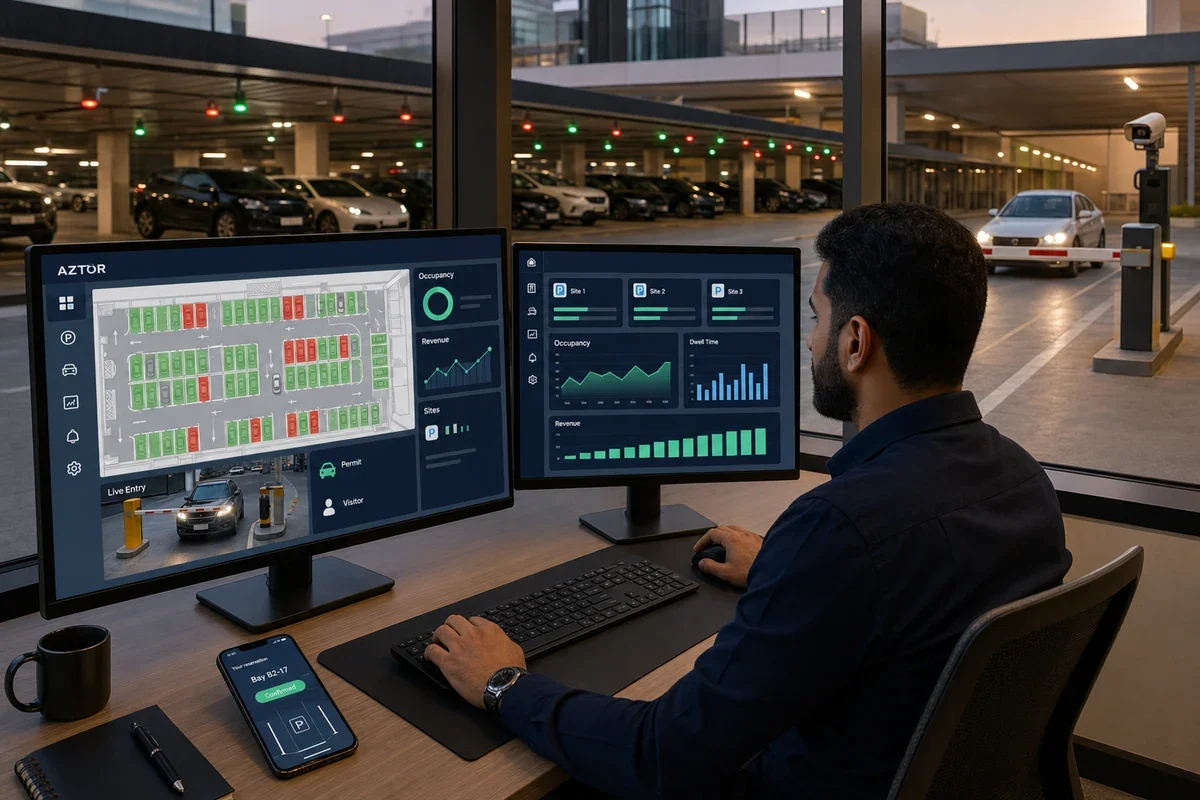
Smart Parking Management brings vehicle access, parking occupancy, visitor handling and parking operations into one connected system. Instead of managing barriers, access credentials, cameras and parking spaces separately, the system provides a central platform for monitoring and controlling the parking facility.
AZTÖR designs, installs, integrates, upgrades and maintains smart parking solutions for residential communities, commercial towers, offices, hotels, hospitals, malls, mixed-use developments, industrial facilities and managed car parks across the UAE.
The correct parking-management solution depends on what the property actually needs to control. A residential community may prioritise resident and visitor access, while a commercial car park may require occupancy monitoring, tenant allocation, ANPR, reporting and integration with a paid parking platform.
AZTÖR provides a free site inspection for applicable smart parking projects. We assess the entry and exit lanes, parking capacity, vehicle flow, existing barriers, network infrastructure, access-control requirements, visitor process and available parking equipment before recommending the system architecture.
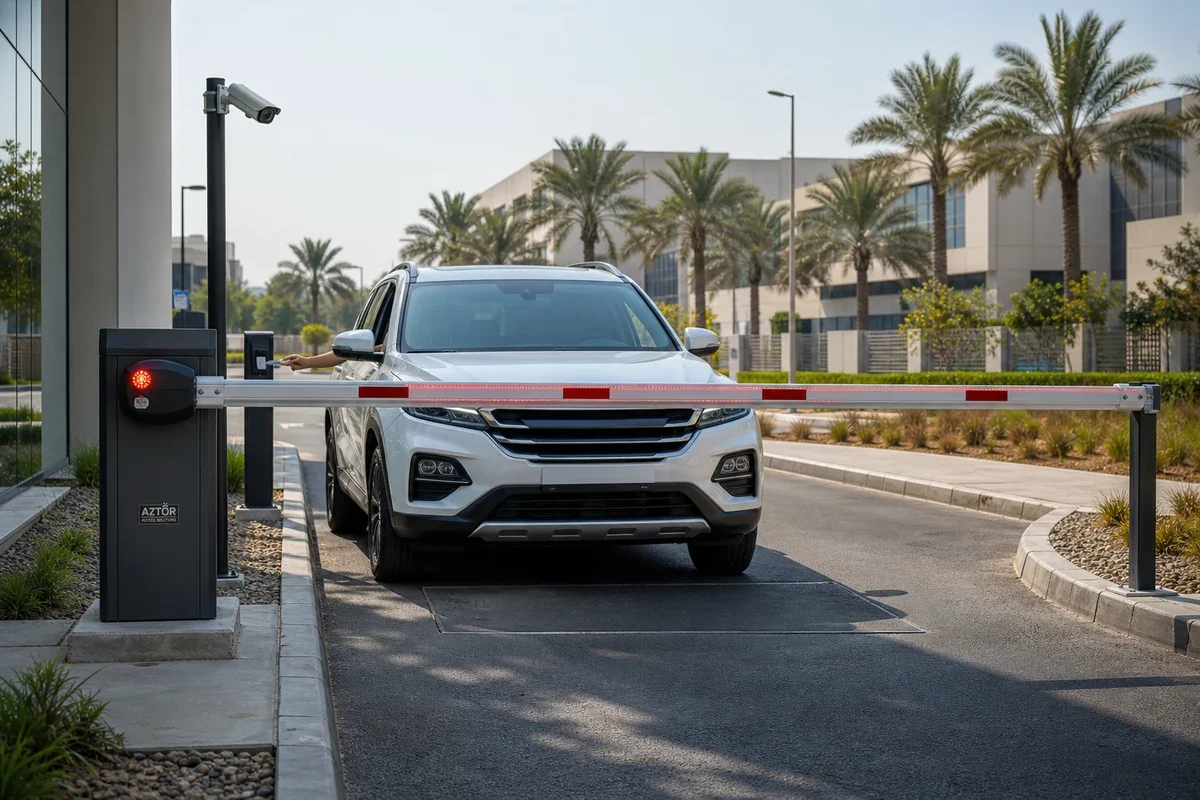
Automatic parking barriers can form the physical entry and exit points of the system. The smart parking platform or connected access-control system determines whether a vehicle is authorised, while the barrier controls physical passage through the lane.
ANPR can provide convenient vehicle identification by reading number plates at entry and exit points. The recognised plate is compared with the permissions or workflow configured in the connected system before an appropriate access decision is made.
ANPR performance depends on much more than installing a general CCTV camera at the gate. Camera selection, mounting position, lane width, vehicle speed, viewing angle, illumination, plate visibility and software configuration all affect recognition performance.
Long-range UHF identification can also be used for registered vehicles. UHF credentials are particularly practical for residential communities, offices, staff parking and other facilities where known vehicles require convenient hands-free access.
ANPR and UHF do not necessarily need to compete with each other. A project can use UHF for regular residents or employees, ANPR for additional verification or selected users, and another visitor process for temporary vehicles.
RFID cards, QR credentials, mobile-based access, intercom authorisation and other compatible methods can also be incorporated depending on the project.
Visitor management is an important part of many UAE residential and commercial parking systems. Visitors can be handled through guard approval, reception, pre-registration, QR credentials, number-plate registration or another compatible workflow.
The objective is to reduce unnecessary manual checking while maintaining a clear record of authorised vehicle access according to the site's requirements.
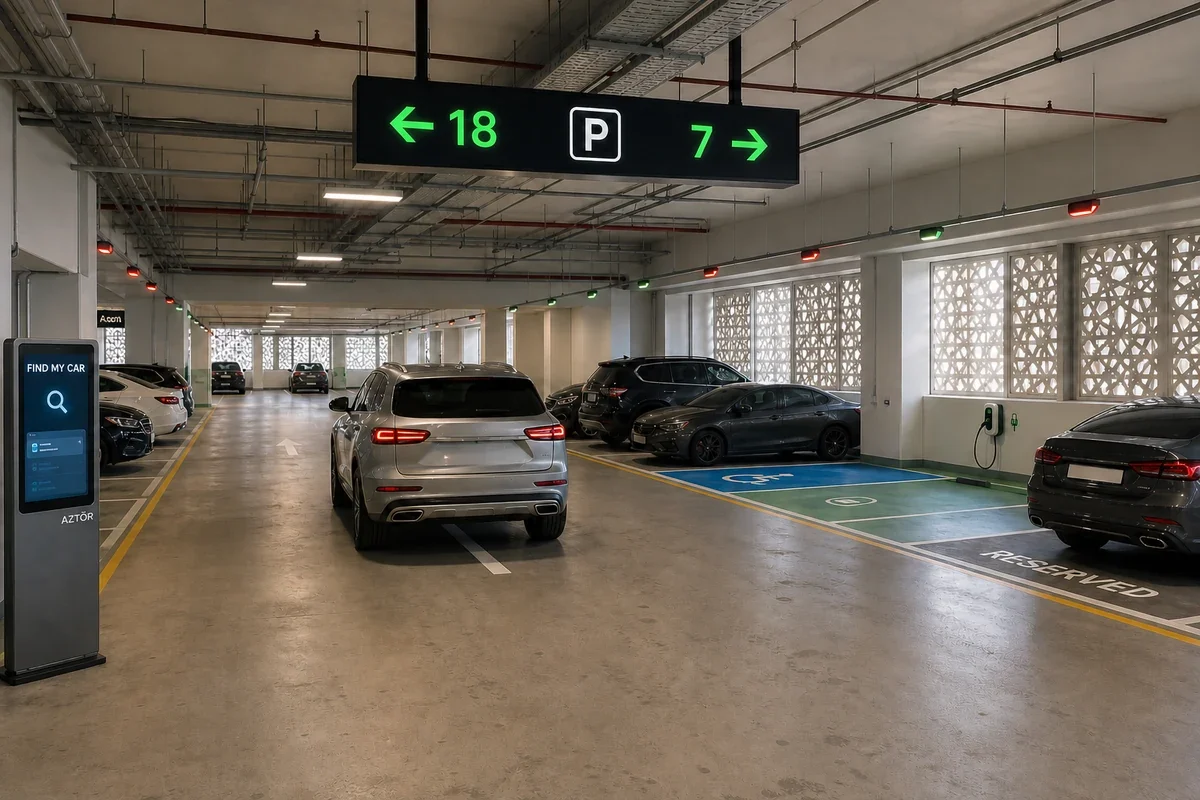
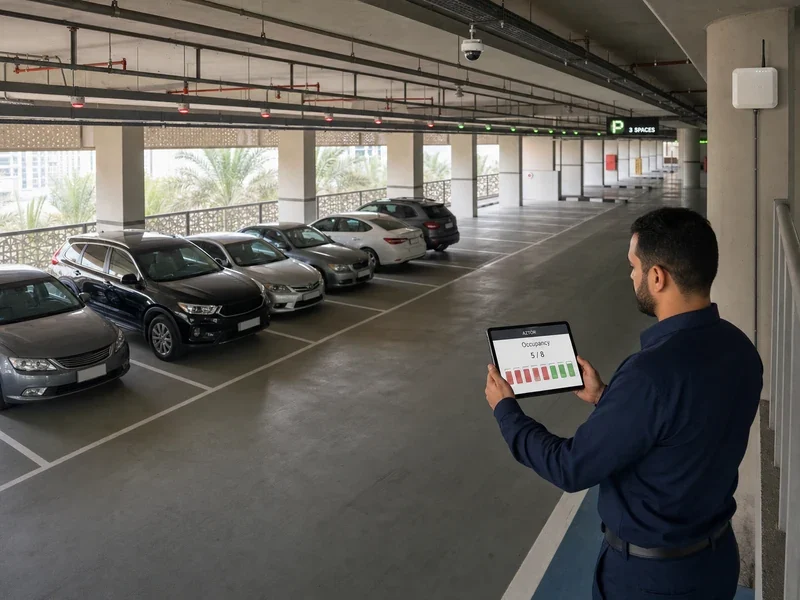
Parking occupancy monitoring can provide information about available and occupied spaces. Depending on the project, this can be achieved using individual parking-space sensors, cameras, zone counting or other suitable technologies.
Individual bay sensors can provide space-by-space status where that level of detail is required. Other facilities may only need to know the total number of vehicles entering and leaving a parking zone.
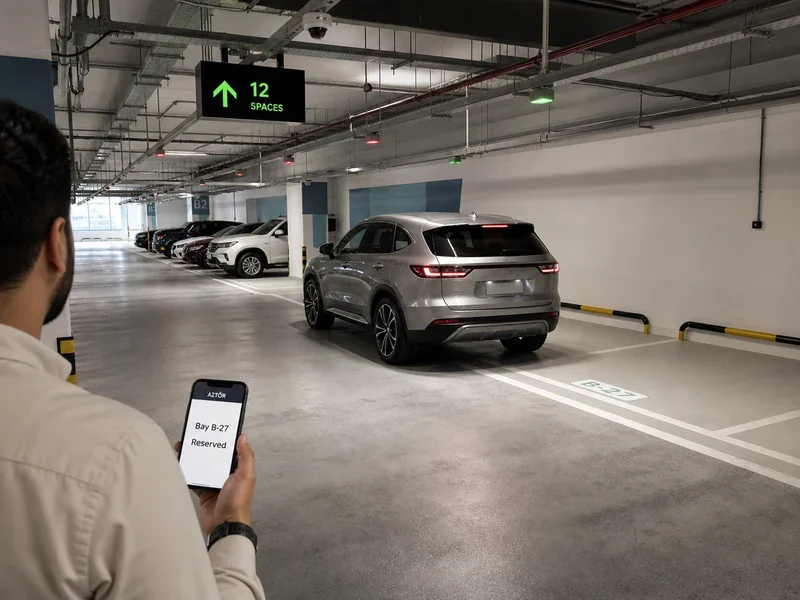
Parking guidance systems can use occupancy information to direct drivers toward areas with available spaces. Suitable installations can include zone signs, directional displays, floor indicators or individual bay indicators.
Digital displays at parking entrances can also show information such as available-space counts, lane status or other approved operational messages depending on the connected system.
For multi-storey car parks, occupancy information can be divided by floor, zone, tenant or another logical parking area. This helps drivers find available parking while giving facility managers a clearer view of utilisation.
Reserved parking can be managed for residents, tenants, employees, VIP users, visitors or other authorised groups. Rules depend on the capabilities of the selected parking-management platform.
For residential communities, the system can manage resident vehicles, multiple vehicles per unit, visitor permissions and entry records according to the community's operating policy.
For commercial buildings, parking rights can be associated with companies, tenants, employees or visitor groups. Parking allocation can be changed centrally instead of relying only on manually distributed remote controls.
Where paid parking is required, compatible ticketing, payment, validation or digital parking platforms can be integrated. Commercial functionality varies substantially between parking-management providers and should be selected around the project's actual business model.
Ticketless parking can also be considered where ANPR or another digital identifier is used to associate vehicle entry and exit with the parking session.
Payment options can include compatible payment kiosks, cashier systems, digital payments, apps or other third-party parking technologies depending on the selected platform and applicable requirements.
Hotels, malls and commercial properties may also require parking validation. A compatible system can apply parking rules or validation according to the facility's configured workflow.
Parking management can provide operational reports such as vehicle entries and exits, occupancy, access events, parking duration, authorised users and other system-specific information.
Reporting capability varies between platforms. Data retention, user permissions, audit requirements and privacy considerations should therefore be established before selecting the software.
Where personal information such as number plates or identifiable access records is processed, the project should consider applicable UAE privacy and data-protection requirements together with the customer's internal data policies.
Centralised management can allow authorised facility personnel to monitor multiple entry and exit lanes from a common interface. Multi-site management may also be available on suitable platforms.
Cloud-connected parking platforms are available, but cloud operation is not automatically the correct choice for every project. Network availability, cybersecurity requirements, customer IT policy, integration and data-hosting requirements should be reviewed.
On-premises solutions can also be appropriate where the customer requires local infrastructure or particular integration and data-control arrangements.
Smart parking systems can integrate with compatible building access control, CCTV, intercom, visitor management, property-management or building-management platforms where technically supported.
At security-sensitive entrances, ANPR information can also be coordinated with CCTV so operators can review the vehicle and access event together. The exact functionality depends on the selected systems and integration method.
Induction loops, photocells and other vehicle-detection devices remain important even in a smart parking installation. Software authorisation does not replace the physical detection and safety requirements of the barrier lane.
The system should distinguish between vehicle identification and vehicle presence. For example, ANPR may identify the approaching vehicle while an induction loop confirms that a vehicle physically occupies a particular lane position.
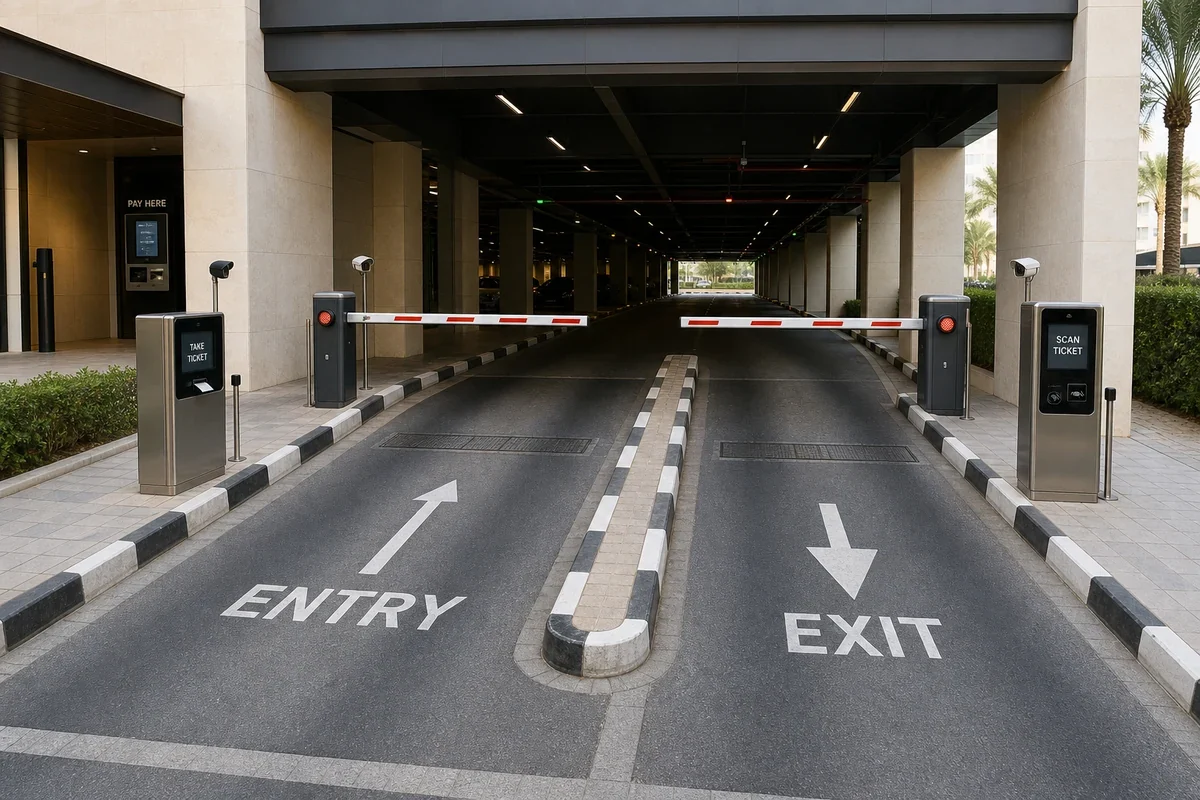
Entry and exit lanes should be designed around actual traffic behaviour. Barrier position, reader location, ANPR camera angle, lane width, islands, kerbs and waiting distance can all influence vehicle throughput.
For busy sites, queue development should be considered during design. A technically advanced access system can still create congestion if vehicles must stop unnecessarily or if the lane geometry does not support the expected traffic volume.
Existing parking facilities can often be upgraded without replacing every component. AZTÖR can inspect existing barriers, loops, readers, cameras, intercoms and network infrastructure to determine what can reasonably be retained.
A legacy remote-control barrier system, for example, may be upgraded with UHF, ANPR or another access-management layer if the existing barrier and controller remain technically suitable.
System availability should also be considered. Local manual controls, authorised override procedures and suitable fallback arrangements can help maintain controlled vehicle movement when a network or connected platform is unavailable.
Battery backup can be considered for compatible barriers and access equipment, while larger facilities may coordinate parking systems with the building's wider UPS or generator strategy where technically appropriate.
AZTÖR also provides troubleshooting for integrated parking systems. A barrier that does not open may have a barrier fault, ANPR issue, UHF reader problem, loop fault, network failure, permission error or integration problem.
Effective diagnosis therefore requires checking the complete access chain rather than immediately replacing the barrier motor or control board.
Preventive maintenance can cover barriers, ANPR cameras, UHF readers, loops, photocells, controllers, intercoms, parking sensors, displays, network devices and associated field equipment according to the installed solution.
AZTÖR provides smart parking management installation, integration, upgrades, repair and maintenance across Dubai, Abu Dhabi, Sharjah, Ajman, Ras Al Khaimah, Fujairah and Umm Al Quwain, with suitable parking and vehicle-access solutions available across the wider GCC.
Key Features
- Centralised smart parking management
- Automatic vehicle entry and exit
- Automatic parking barrier integration
- ANPR vehicle identification
- UHF long-range vehicle access
- RFID access integration
- Access card integration
- QR visitor access options
- Mobile access options where supported
- Intercom integration
- Resident vehicle management
- Tenant vehicle management
- Employee parking management
- Visitor parking management
- Visitor pre-registration
- Temporary vehicle permissions
- Number plate registration
- Vehicle access permissions
- Entry and exit event records
- Parking occupancy monitoring
- Individual parking-space monitoring options
- Zone-based occupancy counting
- Floor-based occupancy monitoring
- Available-space counting
- Parking guidance systems
- Directional parking displays
- Parking availability displays
- Individual bay indicators where applicable
- Reserved parking management
- Tenant parking allocation
- VIP parking management
- Multi-storey parking management
- Multi-zone parking management
- Multi-entry and exit management
- Multi-site management where supported
- Ticketless parking options
- Paid parking integration
- Parking validation integration
- Payment-system integration where supported
- Parking duration monitoring
- Vehicle movement reporting
- Occupancy reporting
- Access-event reporting
- Central management dashboard
- Operator user permissions
- Audit-trail options
- Cloud platform options
- On-premises platform options
- CCTV integration
- Access-control integration
- Visitor-management integration
- Building-system integration where compatible
- Induction loop integration
- Vehicle presence detection
- Safety photocell integration
- Traffic-light integration
- Barrier lane monitoring
- Networked parking controllers
- Existing parking-system upgrades
- Existing barrier integration
- ANPR retrofit
- UHF retrofit
- Parking sensor installation
- Display and signage integration
- System troubleshooting
- Preventive maintenance and AMC support
Technical Specification
| Solution Type | Integrated smart parking management system |
|---|---|
| Primary Function | Vehicle access, parking monitoring and parking operations management |
| Application | Residential, commercial, public and industrial parking facilities |
| Access Barriers | Automatic parking barriers where required |
| Vehicle Identification | ANPR, UHF, RFID or compatible technologies |
| ANPR | Available |
| UHF Access | Available |
| RFID Access | Available |
| QR Access | Available with compatible platform |
| Mobile Access | Available with compatible platform |
| Intercom Integration | Available |
| Visitor Management | Available |
| Resident Management | Available |
| Tenant Management | Available |
| Employee Parking | Available |
| Parking Occupancy | Zone, floor or individual-space monitoring depending on system |
| Parking Sensors | Ultrasonic, camera-based or manufacturer-specific technology |
| Space Indicators | Available on compatible systems |
| Parking Guidance | Available |
| Digital Displays | Available |
| Reserved Parking | Platform specific |
| Ticketless Parking | Available with compatible platform |
| Paid Parking | Available through compatible parking platform |
| Payment Integration | Platform and payment-provider specific |
| Parking Validation | Available on compatible systems |
| Entry and Exit Records | Available |
| Parking Duration | Available on compatible platforms |
| Reporting | Platform specific |
| Dashboard | Web, workstation or manufacturer-specific interface |
| Multi-Site Management | Available on suitable platforms |
| Cloud Management | Available on suitable systems |
| On-Premises Management | Available |
| CCTV Integration | Available where technically compatible |
| Access Control Integration | Available |
| Building System Integration | Interface and platform specific |
| Induction Loops | Available |
| Safety Photocells | Available |
| Traffic Lights | Available |
| Network | Ethernet, wireless or manufacturer-specific architecture |
| Communication Protocol | Manufacturer and integration specific |
| User Permissions | Platform specific |
| Data Retention | Customer, platform and applicable requirement specific |
| Power Backup | Project and equipment specific |
| Installation | New installation or existing parking-system upgrade |
| Maintenance | Barriers, readers, cameras, sensors, controls, network and field equipment |
Smart parking management is a system solution rather than one standard product. Final architecture depends on the number of parking spaces, entry and exit lanes, expected traffic, user groups, visitor workflow, occupancy requirements, existing equipment, network infrastructure and required integrations. ANPR accuracy, sensor performance and software functionality are manufacturer and site specific. AZTÖR provides a free site inspection before finalising the parking-management design.
Typical Applications
- Residential communities
- Gated communities
- Apartment buildings
- Residential towers
- Villa communities
- Commercial towers
- Office buildings
- Business parks
- Corporate campuses
- Shopping malls
- Retail developments
- Hotels
- Resorts
- Hospitals
- Healthcare facilities
- Schools
- Universities
- Government facilities
- Mixed-use developments
- Public parking facilities
- Private car parks
- Paid parking facilities
- Basement parking
- Multi-storey car parks
- Staff parking facilities
- Visitor parking facilities
- Tenant parking facilities
- VIP parking areas
- Warehouses
- Logistics centres
- Factories
- Industrial facilities
- Airports
- Transport facilities
- Large commercial developments
- Existing parking-system upgrades