Cabinet Access
Cabinet Access Control extends electronic security beyond doors by controlling and monitoring access to individual cabinets, racks, lockers, enclosures and other sensitive storage points.
AZTÖR Automation supplies, installs, integrates, upgrades, repairs and maintains electronic cabinet access solutions for data centres, server rooms, offices, warehouses, hospitals, laboratories, industrial facilities and other controlled environments across the UAE.
A conventional cabinet key provides basic physical security, but managing large numbers of keys becomes difficult when many cabinets, users or locations are involved. Electronic cabinet access allows authorised credentials to be assigned, changed or revoked without necessarily replacing the physical locking system every time access permissions change.
Cabinet Access can be used for server racks, network cabinets, telecom enclosures, electrical and control cabinets, document storage, medicine cabinets, tool cabinets, key cabinets, staff lockers and other applications where access to the contents needs to be restricted.
AZTÖR provides a free site inspection for applicable Cabinet Access projects. We assess the cabinet construction, existing handle or lock, number of cabinets, user groups, required credential technology, monitoring requirements, power availability, network architecture and integration with the wider access-control platform.
Cabinet access should be designed around what is being protected and who legitimately needs access.
An IT department securing server racks has different requirements from a hospital controlling medicine storage or an industrial facility restricting access to specialist tools and equipment.
Suitable systems can use RFID cards, key fobs, PIN codes, biometric credentials, mobile credentials or other manufacturer-supported authentication methods.
Where the organisation already operates Door Access Control, the same credential technology may potentially be extended to compatible cabinet locks.
This can allow an authorised employee to use one managed credential for the building entrance, selected rooms and permitted cabinets.
Compatibility must be verified because cabinet locks, readers and door access controllers from different manufacturers are not automatically interoperable.
Electronic cabinet locks are available in different physical formats.
Depending on the cabinet and manufacturer, solutions can include electronic swing handles, electronic cam locks, solenoid locks, motorised locks, latch locks and other purpose-built cabinet locking mechanisms.
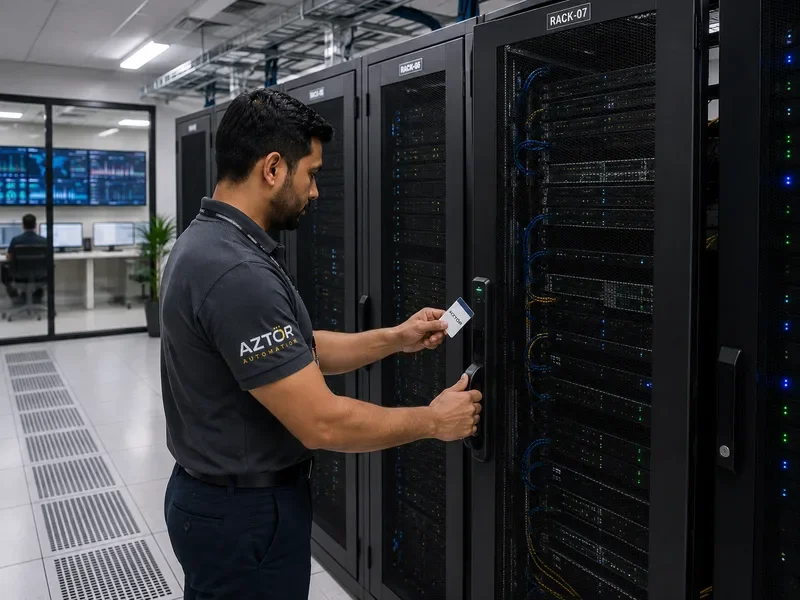
Electronic swing-handle systems are particularly relevant for suitable server and network racks because the locking mechanism can be incorporated into the rack handle.
Electronic cam locks can be useful for suitable lockers, drawers, storage cabinets and equipment enclosures.
The final lock should be selected according to the cabinet construction, door thickness, latch arrangement, available mounting space and required security.
AZTÖR does not recommend replacing a cabinet lock solely on appearance. The physical fit, electrical requirements, operating environment and access-control compatibility must be confirmed.
Standalone Cabinet Access can be suitable where only a small number of storage points need electronic control.
For larger projects, networked cabinet access provides significantly greater management capability.
Centralised systems can allow administrators to manage users, cabinet permissions, schedules and access events from a management platform where supported.
Permissions can be assigned to individual cabinets.
For example, an IT engineer may have access to selected network racks while another employee is authorised only for a particular equipment cabinet.
Permissions can also be assigned according to departments, roles, locations or other authorised groups.
Time schedules can limit access to defined operating periods.
Temporary contractors can receive access to specific cabinets only for the approved maintenance period where the selected platform supports temporary permissions.
When an employee leaves, changes role or no longer requires access, their electronic permission can be removed without collecting and redistributing large numbers of cabinet keys.
This can be especially useful in facilities with many racks or storage cabinets.
Access event logging can provide a record of cabinet activity.
Depending on the selected platform, records can include credential identity, cabinet, date, time and access result.
This creates greater accountability than an ordinary mechanical cabinet key, although access logs should be managed according to the organisation's operational and data-retention requirements.
Cabinet door status monitoring can be incorporated on suitable systems.
A cabinet contact or lock sensor can indicate whether the enclosure is open, closed, locked or unlocked depending on the selected hardware.
Door-held-open alarms can alert authorised personnel when a monitored cabinet remains open beyond an allowed period.
Unauthorised-opening or forced-opening events can also be monitored where the hardware and system architecture support this functionality.
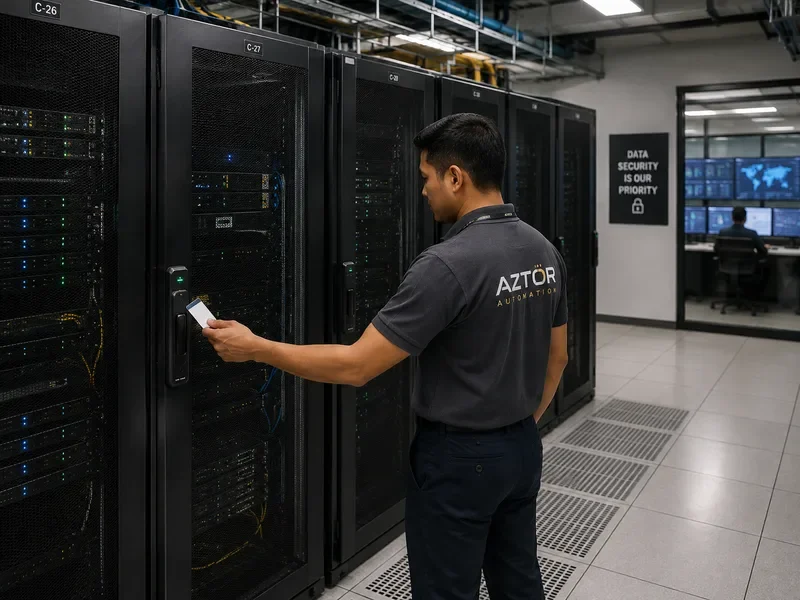
For server racks and data centres, Cabinet Access can provide an additional security layer after building and room access.
An authorised person may first pass the building entrance, then the data hall access-controlled door and finally authenticate at the individual server rack.
This provides more granular control than relying only on the security of the data-centre room.
Rack-level access can be particularly useful where different customers, departments or technical teams share the same data hall but should not access one another's equipment.
Suitable enterprise systems can manage large numbers of rack locks from a central platform.
Integration with CCTV or a Video Management System can provide additional security context.
Where compatible platforms support event integration, a cabinet access or alarm event can be associated with nearby surveillance footage for authorised investigation.
Cabinet Access can also be relevant for telecom and network infrastructure.
Network switches, patch panels, communication equipment and other infrastructure can be secured within controlled racks or cabinets.
Industrial facilities can use electronic cabinet access to restrict electrical control panels, automation cabinets, tools, specialist equipment or sensitive operational storage where appropriate.
Access to electrical or hazardous equipment should still follow the facility's authorised work and safety procedures. Electronic access permission does not replace electrical isolation, lockout/tagout or other required safety controls.
Healthcare facilities can use suitable electronic cabinet systems for controlled equipment, documents or storage applications.
Where medicines or regulated items are involved, the selected system and operating procedure should meet the facility's applicable regulatory and clinical requirements rather than relying only on a generic electronic lock.
Laboratories can use Cabinet Access to restrict equipment, samples, documentation or controlled storage according to their operational requirements.
Offices can use the technology for document cabinets, key storage, IT cabinets and shared equipment.
Warehouses and logistics facilities can restrict tool cabinets, device storage, keys and other operational assets.
Electronic locker systems are another related application.
Individual lockers can be assigned permanently to users or allocated dynamically depending on the selected smart-locker platform.
RFID cards, PINs, mobile credentials or other supported technologies can be used instead of conventional locker keys.
Cabinet Access can also be applied to key-management cabinets.
An electronic key cabinet can control which authorised person is permitted to remove a particular physical key and can provide transaction records where supported.
This can be useful where mechanical keys remain necessary for vehicles, plant rooms, equipment or legacy areas but stronger accountability is required.
Key Cabinet Access should not be confused with replacing every mechanical key with electronic access. It provides controlled custody of physical keys where they are still operationally necessary.
Mobile access can be considered for compatible cabinet-locking platforms.
This can reduce reliance on separate physical credentials, although mobile access depends on the selected manufacturer's technology, application, connectivity and account architecture.
Biometric cabinet access can also be used for suitable higher-control applications.
However, biometric credentials should not automatically be specified simply because they appear more secure.
The sensitivity of the protected asset, number of users, privacy requirements, enrolment process, environmental conditions and availability of alternative access methods should be considered.
PIN access can be practical for suitable cabinets, although shared PINs provide less individual accountability than unique user credentials.
Where auditability matters, each person should ideally use an individually attributable credential supported by the selected system.
Multi-factor authentication can be considered where the cabinet system supports it and the protected asset justifies additional authentication.
Power architecture varies between cabinet access products.
Some electronic locks use wired power from a central or local power supply.
Other systems may use batteries, Power over Ethernet or manufacturer-specific power arrangements.
Battery-operated locks can simplify cabling in suitable applications but require a defined battery-monitoring and replacement procedure.
Low-battery alerts may be available depending on the selected system.
For networked rack-access systems, communication can use Ethernet, RS-485, wireless connectivity or another manufacturer-specific architecture.
Network design should consider controller locations, cable routes, switch capacity, cybersecurity and system resilience.
Cloud-connected cabinet access platforms are available for suitable applications, while other projects may require on-premises management.
The appropriate architecture depends on the customer's IT policy, security requirements, scale and operational preferences.
Role-based software permissions can prevent every system operator from having full administrative control.
For example, an IT administrator may manage server rack permissions while security personnel can view alarms without necessarily changing technical access groups.
Where several sites are involved, suitable enterprise platforms can centralise cabinet-access management across multiple facilities.
Data-centre projects may require integration with existing physical security platforms.
The feasibility of such integration depends on documented APIs, software interfaces, credential compatibility and the selected rack-access system.
Cabinet Access can form part of a wider AZTÖR Automation security architecture incorporating Door Access Control, Elevator Access, CCTV, VMS, Intrusion Detection and other compatible smart-security systems.
For example, an employee credential can be authorised for the main door, a technical floor through Elevator Access, the server room through Door Access Control and only the specific server rack required for that person's work.
This creates layered access permissions from the property perimeter down to the individual protected enclosure.
Emergency and override procedures should also be considered.
If an electronic cabinet lock loses power or communication, authorised personnel may still require a secure method of gaining access.
Mechanical override keys, emergency power connections or manufacturer-specific override procedures may be available depending on the selected lock.
Override methods should themselves be controlled because an unsecured master override can undermine the electronic access system.
Existing cabinets can often be retrofitted with electronic access without replacing the entire enclosure.
Feasibility depends on the existing handle, lock cut-out, latch arrangement, available mounting depth and structural condition of the cabinet.
Server racks with industry-standard handle arrangements may offer compatible retrofit possibilities, while proprietary cabinets can require manufacturer-specific hardware.
AZTÖR assesses existing cabinets before proposing modifications.
Poorly fitted locks can create security problems even when the electronic system works correctly.
Cabinet doors, hinges and latches should align properly so the electronic lock can engage and release without excessive mechanical resistance.
Common Cabinet Access faults include credentials being rejected, locks not releasing, cabinets remaining unlocked, electronic handles going offline, battery warnings, door status reporting incorrectly and software communication failures.
A reader or handle indicating authorised access does not necessarily mean the cabinet latch has mechanically released.
Wiring, power, actuator, lock alignment or mechanical latch faults can still prevent opening.
Similarly, a cabinet showing as open in the software may have a door-contact alignment or sensor problem rather than an actual security incident.
AZTÖR troubleshoots the complete chain from credential and management software through controller, communication, power, electronic lock and physical cabinet mechanism.
Existing Cabinet Access systems can also be expanded or upgraded.
Additional cabinets can be added where the existing platform supports expansion.
Older electronic locks can be assessed for newer credentials, networked management, mobile access or improved event monitoring.
Compatibility, software licensing and spare-parts availability should be confirmed before deciding whether to retain or replace legacy equipment.
Preventive maintenance can include lock operation, electronic handle testing, latch alignment, door contact verification, controller communication, battery condition, power supplies, network connectivity, user permissions and event reporting.
Data-centre and other critical cabinet-access installations can benefit from planned maintenance because a failed electronic lock can either prevent authorised technical access or leave sensitive equipment inadequately secured.
AZTÖR Automation provides Cabinet Access Control, Door Access Control, Elevator Access, security automation and smart-security integration across Dubai, Abu Dhabi, Sharjah, Ajman, Ras Al Khaimah, Fujairah and Umm Al Quwain, with suitable technical support available across the wider GCC.
Key Features
- Electronic Cabinet Access
- Smart Cabinet Access
- Server Rack Access Control
- Network Cabinet Access
- IT Cabinet Security
- Electronic Rack Locks
- Electronic Swing Handles
- Electronic Cam Locks
- Electronic Cabinet Locks
- Motorised Cabinet Locks
- Solenoid Lock Options
- Smart Locker Access
- Key Cabinet Access
- Tool Cabinet Access
- Document Cabinet Access
- Equipment Cabinet Access
- RFID Cabinet Access
- Card Access
- Key Fob Access
- PIN Access
- Biometric Access
- Fingerprint Access Options
- Mobile Credentials
- Multi-Factor Authentication Options
- Individual Cabinet Permissions
- User-Based Permissions
- Department-Based Permissions
- Role-Based Permissions
- Time-Based Access
- Temporary Contractor Access
- Automatic Credential Expiry
- Centralised Management
- Standalone Cabinet Access
- Networked Cabinet Access
- Multi-Cabinet Management
- Multi-Site Management
- Cabinet Door Monitoring
- Lock Status Monitoring
- Open/Closed Status
- Door-Held-Open Alerts
- Unauthorised Opening Alerts
- Access Event Logging
- Denied Access Events
- Audit Trail Options
- Door Access Control Integration
- Elevator Access Integration
- CCTV Integration
- VMS Integration
- Intrusion Detection Integration
- Smart Security Integration
- Data Centre Integration
- Server Room Integration
- Key Management
- Electronic Locker Management
- Wired Power Options
- Battery-Powered Options
- Low-Battery Monitoring Where Supported
- Network Connectivity
- Cloud Management Options
- On-Premises Management
- Role-Based Administration
- Mechanical Override Options
- Existing Cabinet Retrofit
- Existing Rack Retrofit
- Electronic Lock Replacement
- Electronic Handle Replacement
- Controller Replacement
- Battery Replacement
- Door Sensor Replacement
- Access Control Troubleshooting
- Preventive Maintenance
- AMC Support
Technical Specification
| Solution Type | Electronic cabinet and enclosure access control |
|---|---|
| Primary Function | Restrict and monitor access to individual cabinets, racks, lockers or storage |
| Application | Data centres, IT, commercial, industrial, healthcare and controlled storage |
| Cabinet Type | Server rack, network cabinet, locker, key cabinet, storage cabinet or application specific |
| Lock Type | Electronic swing handle, cam lock, motorised lock, solenoid lock or manufacturer specific |
| Credential Type | RFID, PIN, biometric, mobile or manufacturer specific |
| RFID Card | Available |
| Key Fob | Available |
| PIN Access | Available on suitable systems |
| Biometric Access | Available on suitable systems |
| Mobile Credential | Available on compatible platforms |
| Multi-Factor Authentication | Available on suitable platforms |
| Individual Cabinet Permissions | Available |
| User Groups | Available |
| Time Schedules | Available |
| Temporary Access | Available |
| Automatic Credential Expiry | Available on suitable platforms |
| Central Management | Available |
| Standalone Operation | Available on suitable systems |
| Networked Operation | Available |
| Multi-Cabinet Management | Available |
| Multi-Site Management | Available on suitable platforms |
| Cabinet Door Contact | Available |
| Lock Status Monitoring | Manufacturer and model specific |
| Door-Held-Open Monitoring | Available on suitable systems |
| Forced-Opening Monitoring | Available on suitable systems |
| Access Event Logging | Available |
| Audit Trail | Platform specific |
| Door Access Integration | Available where compatible |
| Elevator Access Integration | Available where compatible |
| CCTV/VMS Integration | Available where compatible |
| Intrusion Integration | Available where compatible |
| Power Supply | Wired, battery, PoE or manufacturer specific |
| Battery Monitoring | Available on suitable battery-powered systems |
| Communication | Ethernet, RS-485, wireless or manufacturer specific |
| Cloud Management | Available on suitable platforms |
| On-Premises Management | Available |
| Emergency Override | Manufacturer specific |
| Mechanical Override | Available on suitable locks |
| Installation | New installation, retrofit, expansion or upgrade |
| Maintenance | Locks, handles, sensors, controllers, batteries, power, network and software |
Cabinet Access should be selected according to the cabinet construction, existing handle and latch, protected asset, user population, required auditability, credential technology, power availability, network architecture and wider access-control platform. Server racks, lockers, key cabinets and industrial enclosures can require different locking hardware. Compatibility with existing Door Access Control or other security systems must be verified before integration. AZTÖR Automation provides a free site inspection before finalising the cabinet access solution.
Typical Applications
- Data centres
- Server rooms
- Server racks
- Network racks
- Network cabinets
- Telecommunication cabinets
- IT equipment cabinets
- Patch panel cabinets
- Control cabinets
- Automation cabinets
- Electrical equipment cabinets
- Technical rooms
- Corporate offices
- Document cabinets
- Confidential file storage
- Key cabinets
- Electronic key management
- Staff lockers
- Smart lockers
- Tool cabinets
- Equipment cabinets
- Warehouse storage
- Logistics facilities
- Factories
- Manufacturing facilities
- Industrial facilities
- Hospitals
- Healthcare facilities
- Medicine storage where applicable
- Laboratories
- Research facilities
- Universities
- Government facilities
- Financial institutions
- Security rooms
- CCTV equipment racks
- NVR cabinets
- VMS server racks
- Access control equipment cabinets
- Critical infrastructure facilities
- Multi-tenant data halls
- Co-location data centres
- Restricted technical storage