Hydraulic Barriers
Hydraulic Barriers are powered vehicle access systems designed for entrances where robust operation, controlled movement and demanding traffic conditions require a heavier-duty solution than a typical light-use parking barrier.
AZTÖR Automation supplies, installs, integrates, repairs and maintains hydraulic barrier systems for industrial facilities, logistics centres, commercial compounds, government facilities, staff parking, security checkpoints and other controlled vehicle entrances across the UAE.
The term Hydraulic Barrier can describe different vehicle-control products depending on the application. In parking and access control, it can include hydraulic boom barriers and specialist hydraulic vehicle barriers. Road Blockers and hydraulic bollards are treated separately within the AZTÖR website because their physical operation and security purpose are different.
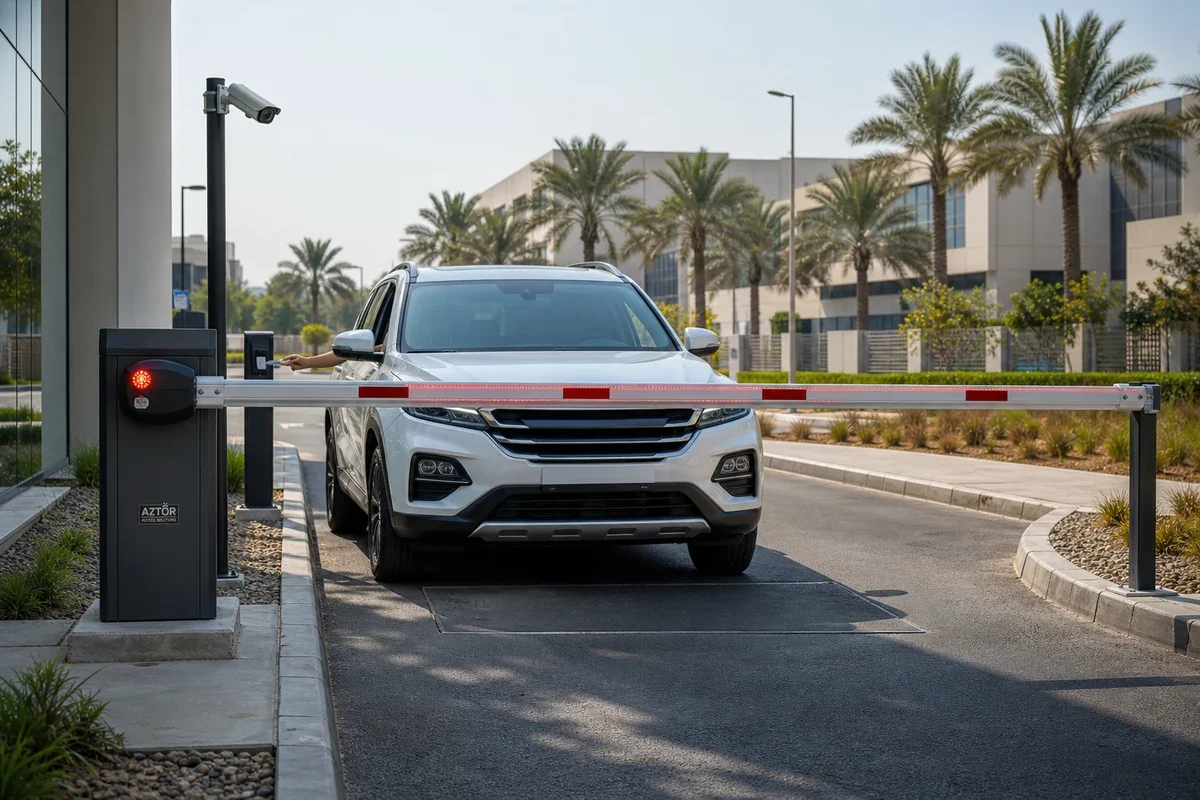
A hydraulic boom barrier uses hydraulic power to control the movement of a barrier arm across a vehicle lane. Suitable systems can be selected for demanding entrances where traffic frequency, reliability and operating duty are important.
The presence of a hydraulic drive does not automatically make a barrier suitable for every high-frequency or high-security application. The complete manufacturer's duty rating, boom configuration, operating speed, environmental limits and intended application must be considered.
AZTÖR provides a free site inspection for applicable hydraulic barrier projects. We assess lane width, traffic frequency, vehicle types, operating hours, required opening speed, access-control method, safety requirements, foundation, electrical supply and surrounding entrance layout before recommending a system.
Lane width is an important starting point. The barrier arm needs to cover the required vehicle passage while remaining within the operating limits of the selected barrier mechanism.
Longer boom arms create different loads on the barrier mechanism and can require different balancing arrangements, operating speeds and accessories.
A longer arm should therefore not simply be fitted to an existing barrier without confirming manufacturer compatibility.
Straight boom arms are suitable for many outdoor entrances where sufficient vertical clearance is available.
Articulated or folding barrier arms can be considered for basement and covered parking entrances with restricted ceiling height where a compatible hydraulic barrier configuration is available.
The barrier arm itself can be supplied in manufacturer-specific aluminium or other suitable constructions.
Reflective strips and high-visibility markings can improve visibility for approaching drivers.
LED boom lighting or illuminated accessories may also be available on suitable systems.
Hydraulic barriers can be operated from a guardhouse using push buttons, key switches or authorised control consoles.
Remote controls can also be incorporated where suitable for the operating environment.
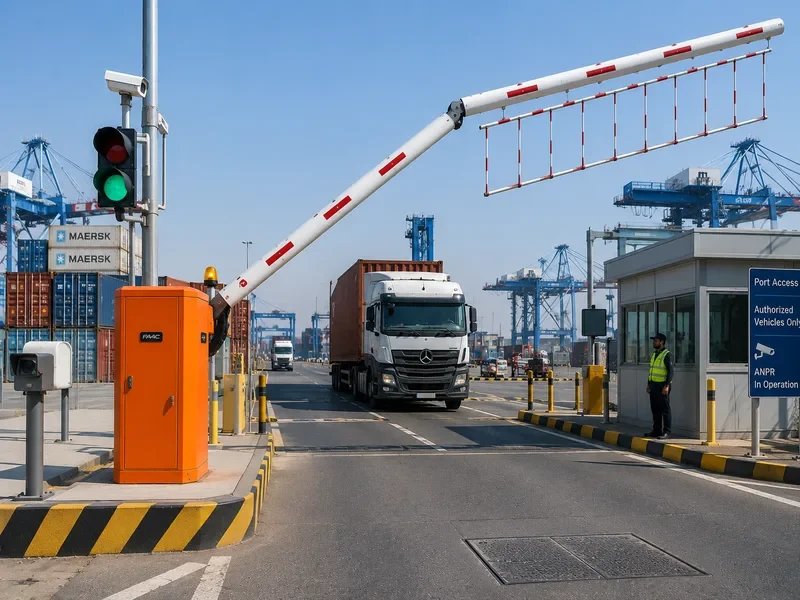
For automated vehicle access, hydraulic barriers can integrate with ANPR. An authorised number plate can be recognised and the access-control system can issue an opening command to the barrier.
UHF Vehicle Access is particularly useful for residents, employees, fleet vehicles and other regular authorised users who require hands-free long-range access.
RFID cards, tags, keypads, biometric access, intercoms and other compatible credentials can also be integrated according to the entrance requirements.
Visitor Vehicle Management can provide temporary access through ANPR pre-registration, QR credentials, intercom approval or another suitable workflow.
The hydraulic barrier performs the physical lane-control function, while the access-control platform determines whether the vehicle is authorised.
These functions should remain logically separate from vehicle safety.
An authorised ANPR, UHF or RFID credential does not confirm that the vehicle has completely passed beneath the barrier arm.
Induction loops can therefore be used to detect vehicle presence and passage.
A safety loop positioned within the appropriate barrier area can help prevent the boom from closing onto a vehicle that remains in the lane.
Additional loops can provide approach detection, opening commands, passage confirmation or other vehicle automation functions depending on the system design.
Safety photocells can also be incorporated where appropriate.
The closing sequence should use suitable vehicle detection and controller logic rather than depending only on an automatic closing timer.
For busy vehicle entrances, barrier opening and closing speed can significantly affect traffic flow.
However, the fastest barrier is not automatically the correct barrier. Arm length, vehicle flow, safety, duty cycle and access verification time all need to work together.
High-frequency entrances require equipment designed for the actual number and pattern of operating cycles.
A barrier that operates intensively during shift changes, residential peak periods or logistics movements may require a different specification from an entrance that opens only occasionally.
Hydraulic technology can be particularly suitable for robust commercial and industrial access, but AZTÖR selects the system according to the complete application rather than specifying hydraulic operation simply as a marketing feature.
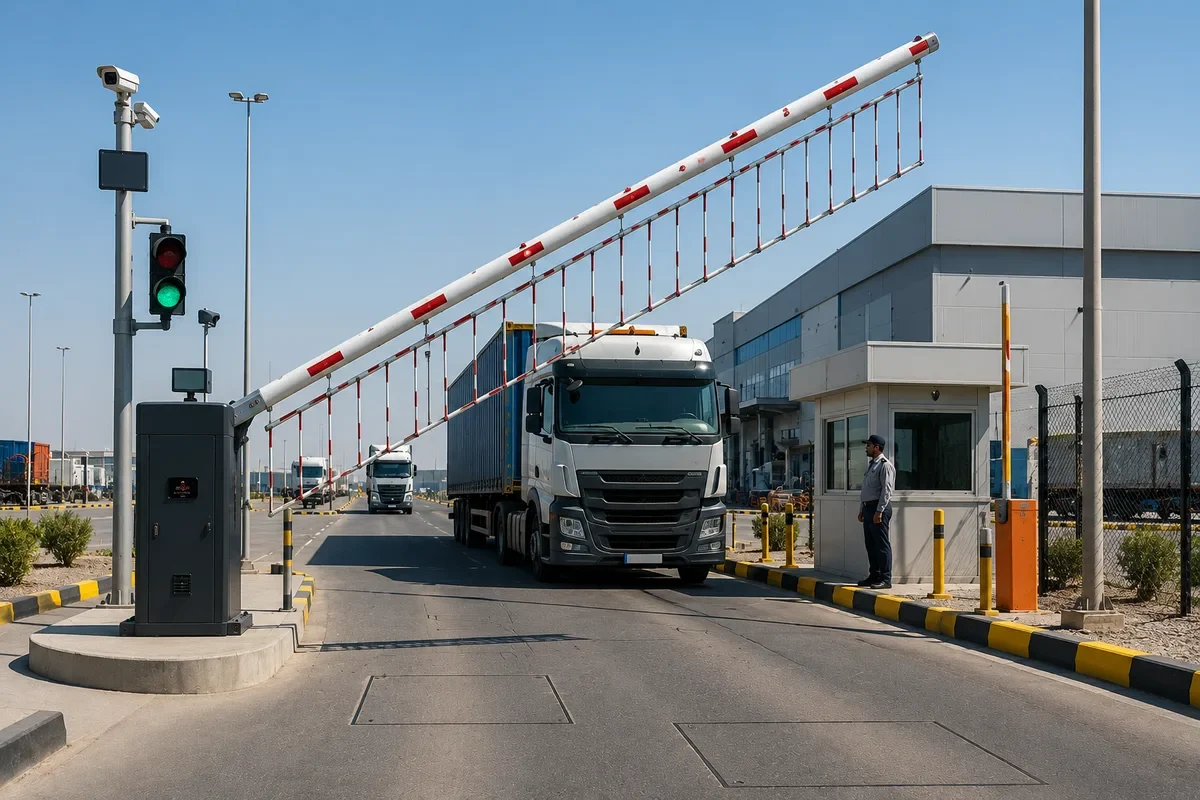
Hydraulic barriers can be used at warehouse and logistics entrances where staff vehicles, contractors, delivery vehicles and fleet movements need controlled access.
Industrial sites can combine the barrier with guardhouse verification, ANPR, UHF and access-control systems.
Commercial properties can use hydraulic barriers for staff, tenant and visitor parking where the traffic profile justifies the selected equipment.
Government and sensitive sites can incorporate hydraulic barriers within a layered vehicle access system.
A hydraulic boom barrier should not be confused with a Road Blocker.
A standard boom barrier controls access and traffic flow but does not normally provide the same substantial physical vehicle-stopping function as a Road Blocker.
Likewise, a heavy-duty hydraulic barrier arm should not automatically be described as crash rated.
Where a project requires hostile-vehicle mitigation or documented vehicle-impact stopping performance, an independently tested Road Blocker, crash-rated bollard, wedge barrier or other suitable certified vehicle barrier should be selected according to the security requirement.
The word hydraulic describes the operating technology; it does not establish an impact rating.
Hydraulic Barriers can operate together with Road Blockers at higher-security entrances.
For example, the hydraulic boom barrier can provide normal traffic control and vehicle identification while the Road Blocker provides a separate physical security layer.
Automatic Bollards can similarly be integrated where the entrance design requires retractable physical vehicle restriction.
Tyre Killers can be incorporated at suitable security entrances where directional vehicle deterrence forms part of the approved access strategy.
Automatic gates can also form part of the entrance, providing perimeter closure when the site is secured.
When several devices are used together, the operating sequence should be carefully coordinated.
Suitable controllers can use interlocking so a Road Blocker, gate or other security device reaches the required position before another stage of vehicle access proceeds.
Traffic lights can be integrated at controlled entrances to provide clear stop and proceed indications.
Red and green signals can be coordinated with the barrier and other security devices according to the configured sequence.
Warning lights or audible alarms can also be incorporated where the application requires them.
For multi-lane entrances, separate hydraulic barriers can control entry, exit or individual user categories.
Central access-control software can manage permissions across several lanes where compatible equipment is selected.
Multi-site vehicle access management can also be provided through suitable platforms.
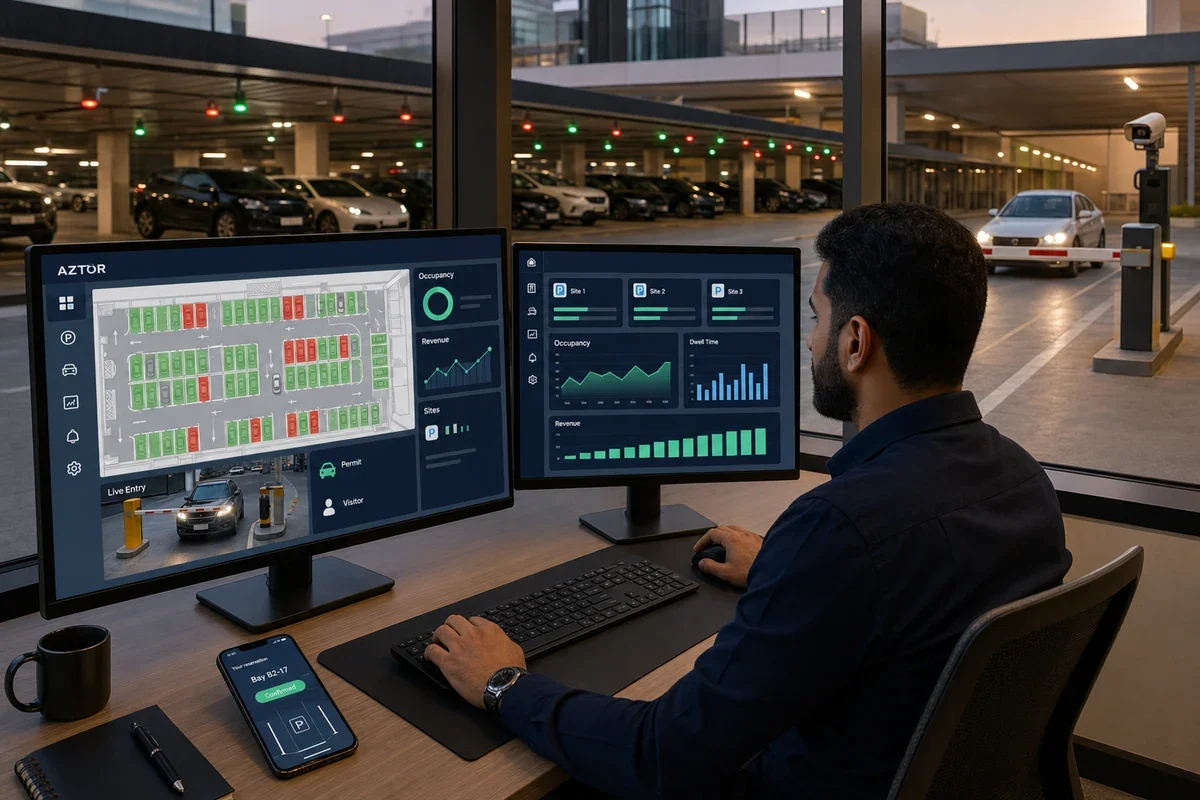
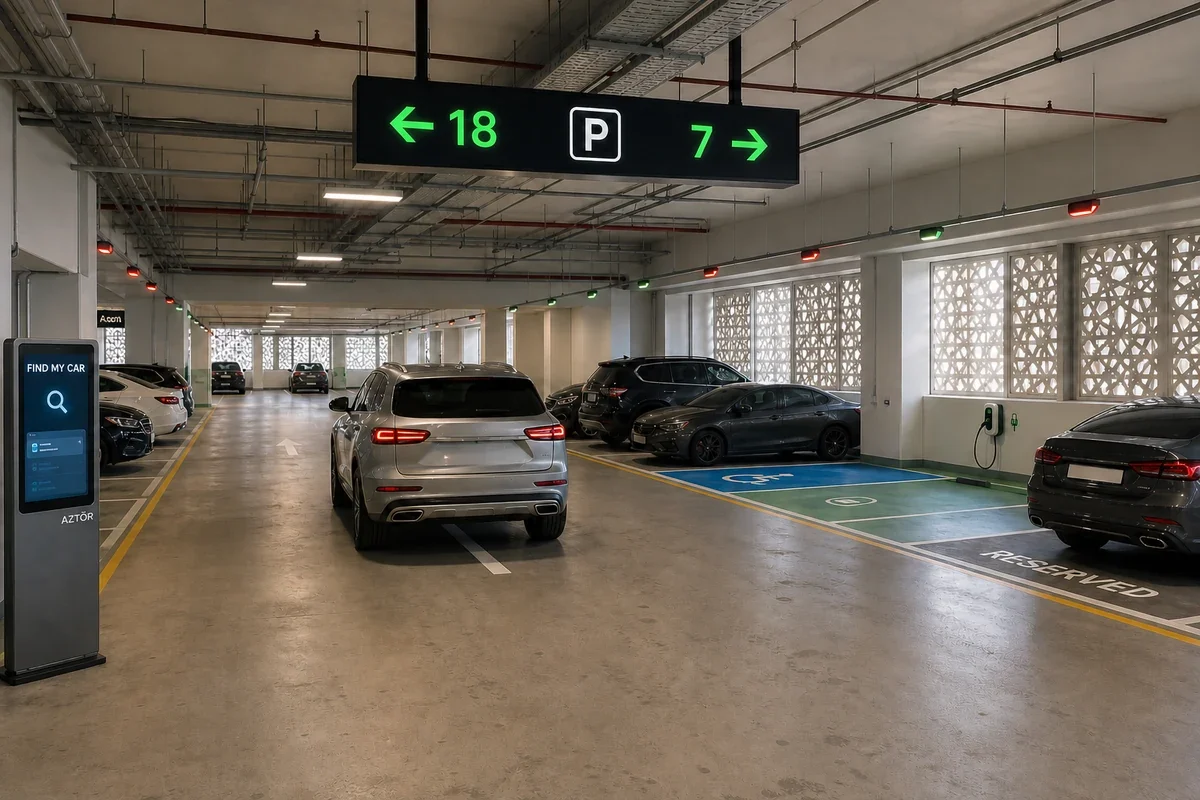
Smart Parking Management can integrate hydraulic barriers into a wider parking automation system.
ANPR, UHF, visitor access, occupancy, parking guidance, ticketing and revenue functions can then operate alongside the physical barrier equipment according to the project's requirements.
Hydraulic barriers can also be incorporated into paid parking environments.
The Parking Ticketing or Parking Revenue System can authorise exit after the required parking transaction or validation, while the hydraulic barrier controls physical passage.
Barrier foundations should be appropriate for the selected equipment, boom length and site conditions.
The cabinet must be securely installed and aligned so the boom operates correctly.
Electrical supply, control cabling, loop wiring, network connections and access-control interfaces should be coordinated during installation.
Outdoor UAE installations require equipment suitable for heat, direct sunlight, dust, sand, humidity and the actual environmental exposure.
Barrier cabinets, hydraulic components, control boards and accessories should be selected and installed according to the manufacturer's environmental requirements.
Coastal sites may require additional attention to corrosion-resistant materials and finishes.
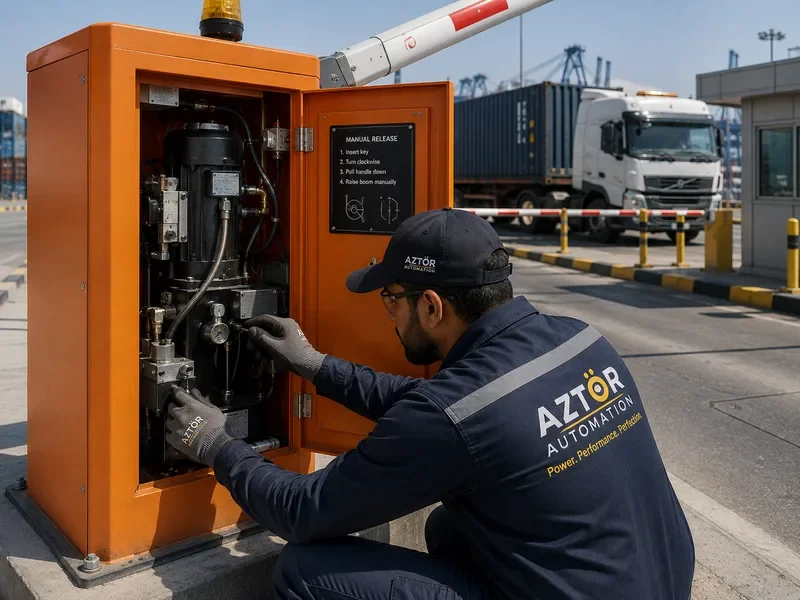
Hydraulic systems require appropriate maintenance. Hydraulic fluid condition, seals, hoses, valves, pumps and other components should be inspected according to the equipment design and manufacturer recommendations.
Visible hydraulic leakage should be investigated rather than repeatedly topping up fluid without identifying the source.
Boom balancing is also important.
Springs, counterbalance mechanisms or manufacturer-specific balancing components reduce the load on the drive and help the arm move correctly.
A barrier arm that drops, rises unevenly or struggles to move may have a balance, hydraulic, mechanical or control problem.
Impact damage is common at vehicle barriers.
If a vehicle strikes the boom, inspection should extend beyond the visible arm.
The boom holder, cabinet, shaft, balancing mechanism, hydraulic drive, foundation, limit or position system and safety devices may also have been affected.
Replacing only the boom arm without checking the barrier mechanism can leave hidden damage unresolved.
Common hydraulic barrier faults include the barrier not opening, not closing, moving slowly, stopping midway, repeatedly reopening, hydraulic leakage, incorrect boom position or failure to respond to access-control commands.
A barrier that opens but refuses to close may have a safety loop, photocell or controller input that remains active.
A barrier that receives an authorised ANPR or UHF command but does not open may have an access-control interface, relay, controller, hydraulic or mechanical fault.
AZTÖR troubleshoots the complete chain from the access credential and vehicle-detection system through the controller and hydraulic barrier mechanism.
Existing hydraulic barriers can often be repaired or upgraded where suitable spare parts and compatible components remain available.
Access systems can also be modernised without automatically replacing a mechanically serviceable hydraulic barrier.
For example, an existing guard-operated barrier may be upgraded with ANPR, UHF Vehicle Access, RFID or Visitor Vehicle Management after technical assessment.
Preventive maintenance can include boom inspection, balancing checks, hydraulic-system inspection, leak checks, cabinet and foundation inspection, control-panel testing, limit or position verification, loop and photocell testing and access-control integration testing.
High-use entrances benefit particularly from planned maintenance because a barrier failure can directly affect vehicle movement and site access.
AZTÖR Automation provides Hydraulic Barrier installation, repair, parking automation and vehicle access automation across Dubai, Abu Dhabi, Sharjah, Ajman, Ras Al Khaimah, Fujairah and Umm Al Quwain, with suitable automation and technical support available across the wider GCC.
Key Features
- Hydraulic barrier systems
- Hydraulic boom barriers
- Heavy-duty vehicle barriers
- Automatic hydraulic barriers
- Commercial vehicle access barriers
- Industrial vehicle access barriers
- Intensive-use barrier options
- High-frequency vehicle access
- Automatic boom operation
- Straight boom options
- Articulated boom options where compatible
- Folding boom options where compatible
- Long boom options
- Reflective boom strips
- LED boom options where available
- Single-lane vehicle access
- Multi-lane vehicle access
- Entry barrier systems
- Exit barrier systems
- Bidirectional access design
- Guardhouse control
- Push-button control
- Key-switch control
- Remote-control integration
- Access-control integration
- ANPR integration
- UHF Vehicle Access integration
- RFID integration
- Visitor Vehicle Management integration
- Intercom integration
- Smart Parking Management integration
- Parking Ticketing integration
- Parking Revenue integration
- Induction loop integration
- Vehicle presence detection
- Vehicle passage detection
- Safety loop integration
- Photocell integration
- Traffic-light integration
- Warning-light integration
- Audible warning integration
- Automatic gate integration
- Road Blocker integration
- Automatic Bollard integration
- Tyre Killer integration where appropriate
- Security interlocking
- Layered vehicle access
- Emergency override options
- Manual release options
- Power-failure management
- Battery or UPS options where compatible
- Hydraulic power system
- Hydraulic pump
- Hydraulic valve system
- Hydraulic seal replacement
- Hydraulic hose replacement
- Boom replacement
- Barrier balancing
- Control-panel repair
- Loop detector repair
- Photocell replacement
- Access-control troubleshooting
- Existing barrier automation upgrades
- ANPR retrofit
- UHF retrofit
- Outdoor UAE installation
- Preventive maintenance
- AMC support
Technical Specification
| Solution Type | Hydraulic automatic vehicle access barrier |
|---|---|
| Primary Function | Controlled entry and exit of authorised vehicles |
| Application | Commercial, industrial, parking and controlled security entrances |
| Drive Technology | Hydraulic or manufacturer-specific hydraulic mechanism |
| Barrier Configuration | Boom barrier or specialist hydraulic vehicle barrier depending on application |
| Boom Type | Straight, articulated, folding or manufacturer specific |
| Boom Length | Manufacturer, model and lane specific |
| Operating Speed | Manufacturer and configuration specific |
| Duty Cycle | Manufacturer and model specific |
| Traffic Frequency | Selected according to actual application |
| Vehicle Type | Passenger, commercial or project-specific vehicles |
| Barrier Cabinet | Manufacturer-specific outdoor enclosure |
| Boom Visibility | Reflective and illuminated options available |
| Control Panel | Available |
| Guardhouse Control | Available |
| Push Button | Available |
| Key Switch | Available |
| Remote Control | Available |
| ANPR Integration | Available |
| UHF Integration | Available |
| RFID Integration | Available |
| Visitor Management Integration | Available |
| Intercom Integration | Available |
| Smart Parking Integration | Available |
| Ticketing Integration | Available |
| Revenue System Integration | Available |
| Induction Loop Integration | Available |
| Vehicle Presence Detection | Available |
| Vehicle Passage Detection | Available |
| Safety Loop | Available |
| Photocell Integration | Available |
| Traffic Lights | Available |
| Warning Light | Available |
| Automatic Gate Integration | Available |
| Road Blocker Integration | Available |
| Automatic Bollard Integration | Available |
| Security Interlocking | Available on suitable control systems |
| Emergency Override | Manufacturer and project specific |
| Manual Release | Manufacturer specific |
| Power Failure Behaviour | Manufacturer and project specific |
| Backup Power | Available on compatible systems |
| Foundation | Manufacturer and site specific |
| Electrical Supply | Manufacturer and model specific |
| Outdoor Application | Available |
| Environmental Rating | Manufacturer and model specific |
| Corrosion Protection | Manufacturer and project specific |
| Crash Rating | Not inherent to hydraulic boom barriers |
| Impact Rating | Only where independently tested and documented for the selected system |
| Installation | New installation, replacement or suitable retrofit |
| Maintenance | Hydraulic, mechanical, electrical, safety and access-control systems |
Hydraulic Barriers should be selected according to lane width, boom length, traffic frequency, required operating speed, vehicle types, duty cycle, safety devices, environmental conditions and access-control requirements. Hydraulic operation does not automatically mean that a barrier is crash rated or suitable for hostile-vehicle mitigation. Where documented vehicle-impact stopping performance is required, a specifically tested security barrier should be selected. AZTÖR Automation provides a free site inspection before finalising the hydraulic barrier and vehicle access automation design.
Typical Applications
- Industrial facilities
- Factories
- Manufacturing plants
- Warehouses
- Logistics centres
- Distribution centres
- Commercial compounds
- Corporate campuses
- Business parks
- Office buildings
- Commercial towers
- Staff parking
- Employee parking
- Tenant parking
- Private parking
- Multi-storey parking
- Basement parking
- Government facilities
- Utility facilities
- Data centres
- Hospitals
- Hotels
- Educational facilities
- Ports
- Marine facilities
- Fleet entrances
- Contractor entrances
- Delivery entrances
- Service entrances
- Vehicle checkpoints
- Security checkpoints
- Guardhouse-controlled entrances
- ANPR-controlled entrances
- UHF-controlled entrances
- RFID-controlled entrances
- Automatic parking entrances
- High-frequency vehicle entrances
- Heavy-duty access points
- Layered security entrances