Parking Guidance
Parking Guidance Systems help drivers find available parking spaces without repeatedly circulating through a car park. Sensors, cameras, indicators, digital signs and management software work together to detect occupancy and guide vehicles toward available bays, zones or floors.
AZTÖR designs, supplies, installs, integrates and maintains parking guidance solutions for shopping malls, commercial towers, residential developments, hospitals, hotels, airports, universities, mixed-use developments and multi-storey car parks across the UAE.
The right parking guidance system depends on the size and layout of the facility. A small basement may only require zone-based availability displays, while a large multi-storey car park can benefit from individual bay detection, colour indicators, floor counting, directional signs and centralised monitoring.
AZTÖR provides a free site inspection for applicable parking guidance projects. We assess parking capacity, floor layout, entry and exit points, driving routes, ceiling heights, lighting, network infrastructure, electrical availability and the level of occupancy information required.
Individual-space parking guidance uses a sensor or suitable camera-based technology to determine whether each parking bay is occupied or available.
Ultrasonic parking sensors are commonly installed above individual parking spaces or in suitable overhead positions. The sensor measures the presence of a vehicle and communicates the occupancy status to the parking guidance system.
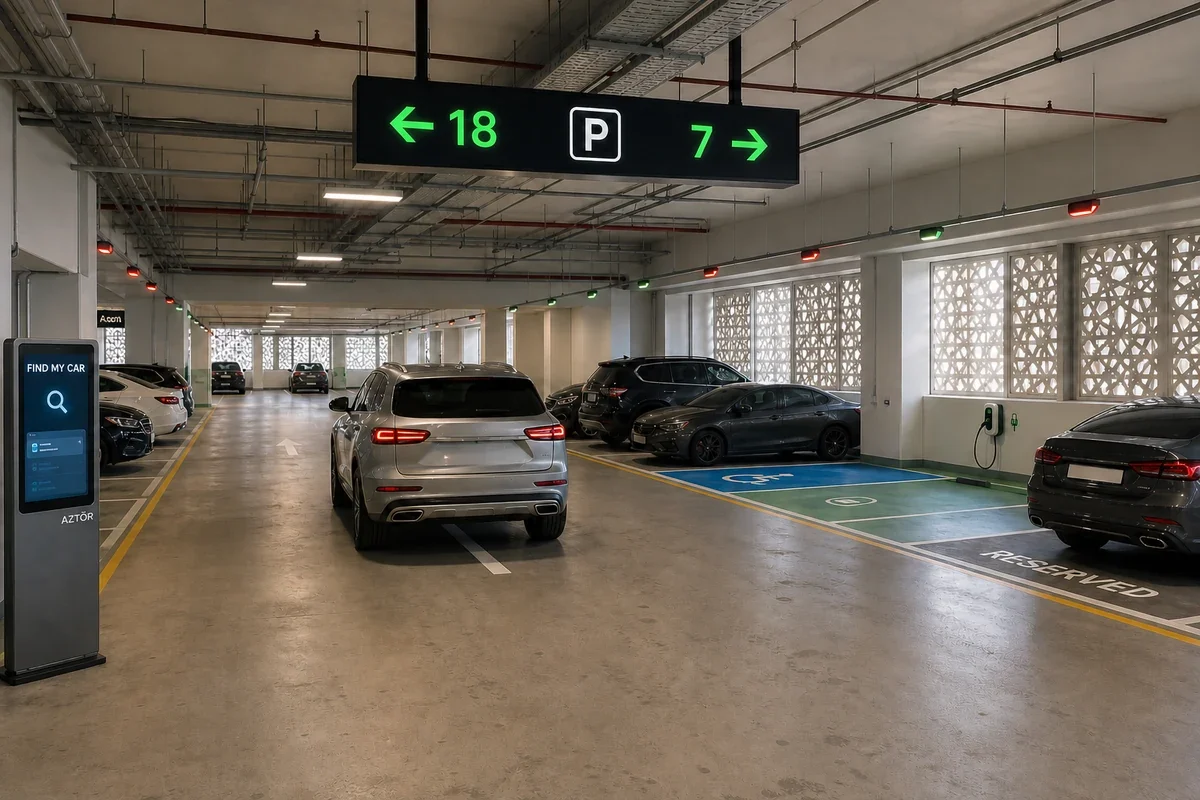
Depending on the selected system, the sensor and indicator can be separate devices or combined into one unit. Indicator lights positioned where drivers can see them from the driving aisle make available spaces easier to identify.
Green commonly represents an available bay while red commonly represents an occupied bay, although colour logic can be configured differently on suitable systems. Additional colours may be used for reserved, accessible, VIP, EV or other designated parking categories where supported.
Camera-based parking guidance is another option. Suitable smart parking cameras can monitor multiple spaces while software analyses occupancy and, on selected platforms, can provide additional parking information.
The number of spaces monitored by one camera, recognition capabilities and accuracy depend on the selected manufacturer, camera position, parking geometry, lighting and software. These values should therefore be confirmed from the specific system rather than treated as universal specifications.
Zone-based parking guidance can be used where individual bay monitoring is unnecessary. Vehicle counts can be maintained for a floor, section or parking zone and displayed to drivers at decision points.
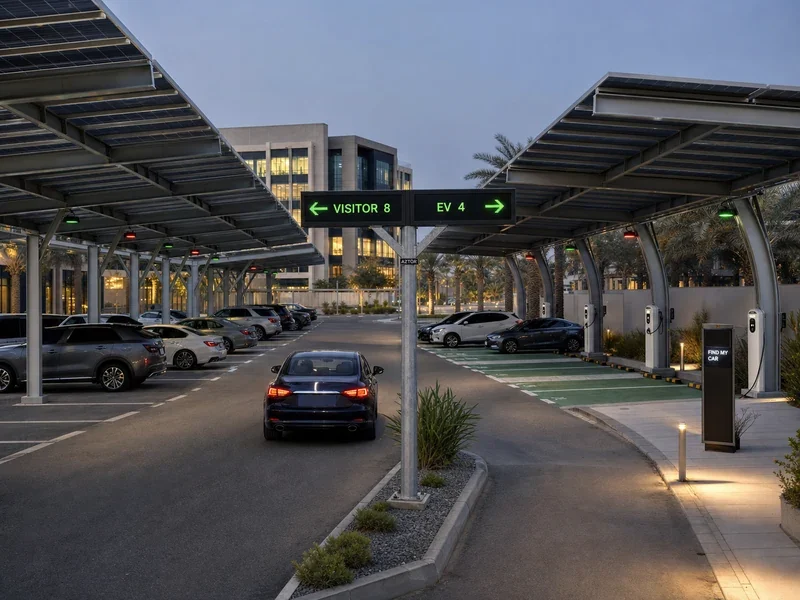
Digital parking displays can show the number of available spaces on each floor or in different directions. Positioning these displays before a driver reaches a junction allows the information to support an actual route decision.
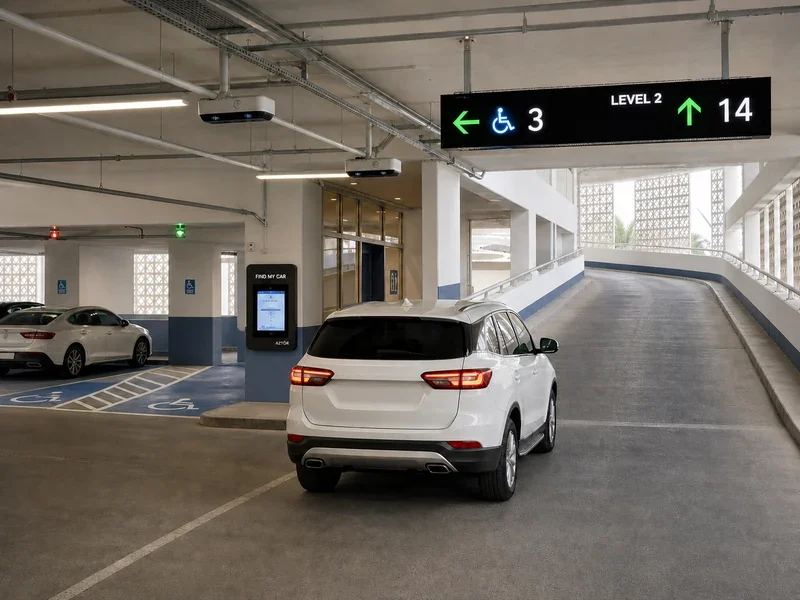
For multi-storey car parks, floor-level displays can show available capacity before vehicles enter a ramp. Additional directional signs can then guide drivers toward available sections after they reach the selected floor.
Entrance displays can provide an overall parking availability count before a vehicle enters the facility. Depending on the system, information can be separated into general, reserved or other parking categories.
Parking guidance should be designed around the natural driving path. Showing accurate information after a driver has already passed the relevant turn provides little operational value, so display locations are just as important as the detection technology.
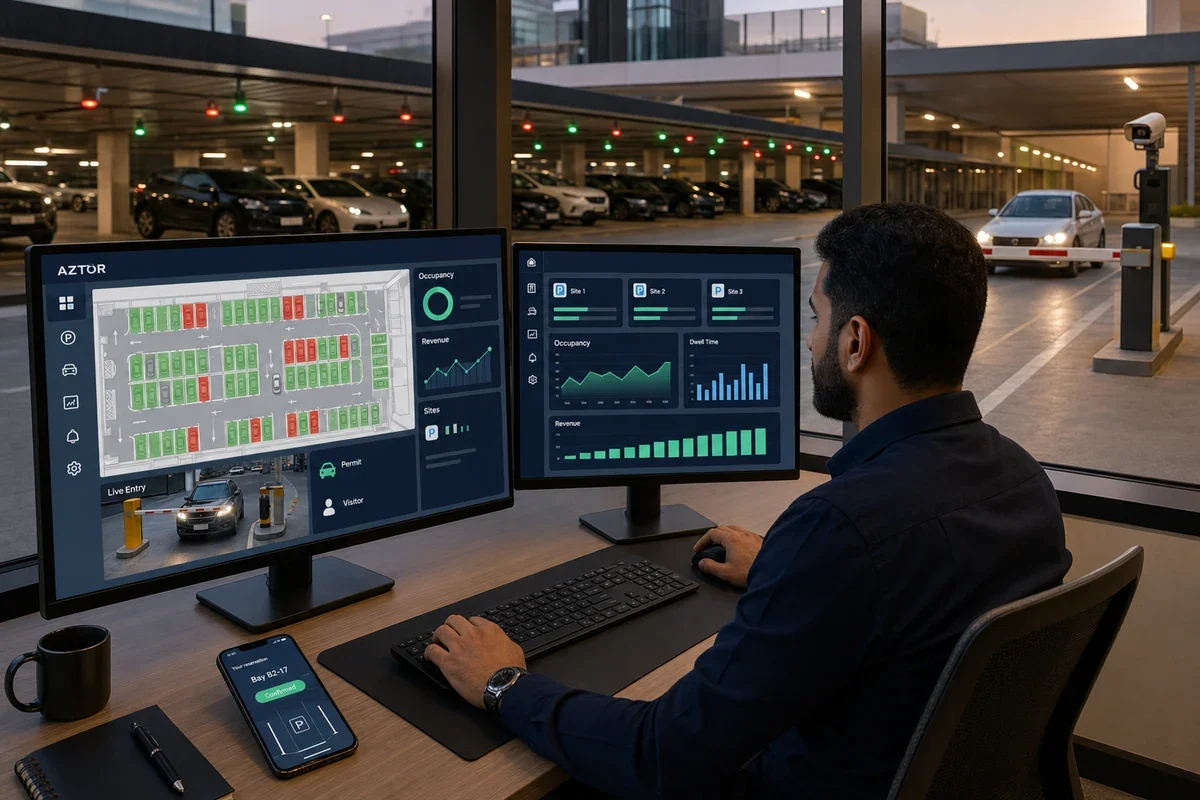
Central parking guidance software collects information from field devices and provides authorised operators with an overview of occupancy and system status.
Depending on the selected platform, facility teams can view total capacity, occupied spaces, available spaces, floor utilisation, zone utilisation, device status and historical parking information.
Parking utilisation data can help facility managers understand which floors or zones are heavily used and which remain underutilised. This information can support operational planning and parking allocation decisions.
Reserved parking spaces can be represented differently where supported by the selected platform. Parking for tenants, visitors, VIP users, people of determination, EV charging or other designated groups can be incorporated into the guidance strategy.
The system should not simply show a reserved but empty space as generally available if the parking policy does not allow other drivers to use it. Parking status and user permissions therefore need to be coordinated.
Parking guidance can be integrated with Smart Parking Management so occupancy information becomes part of a broader vehicle-access and parking platform.
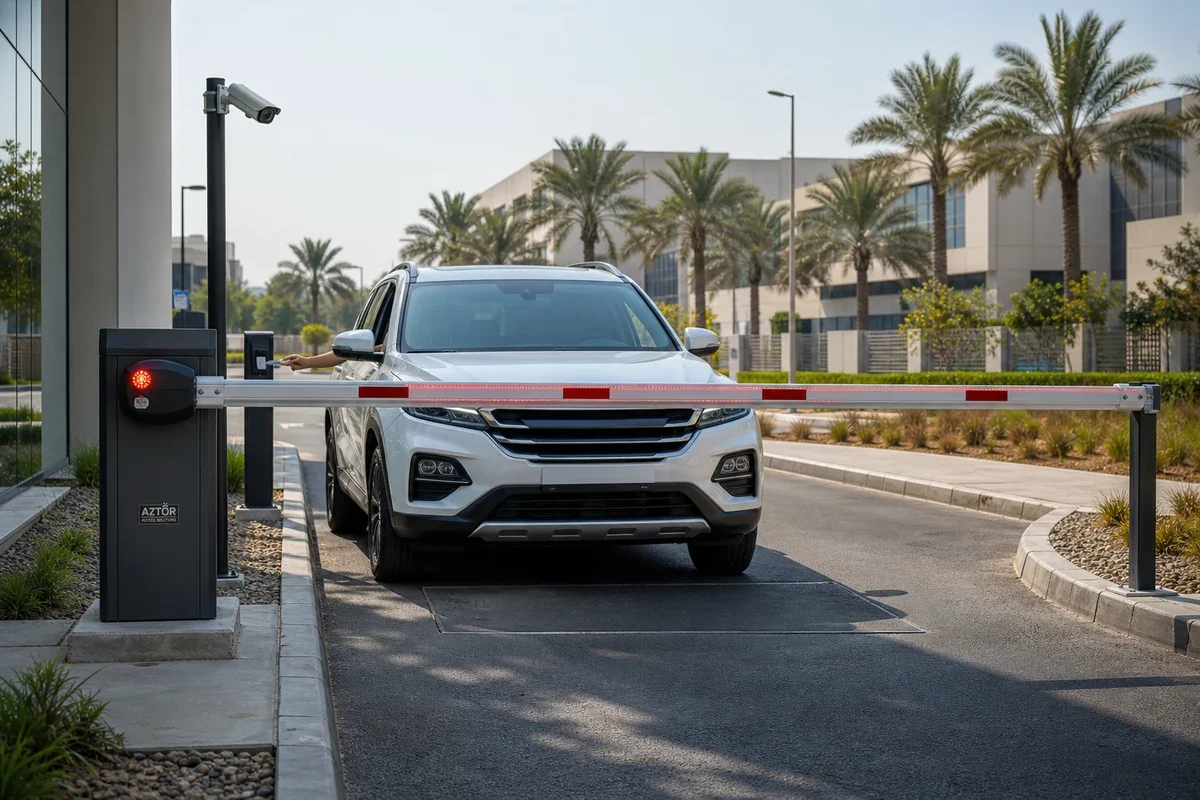
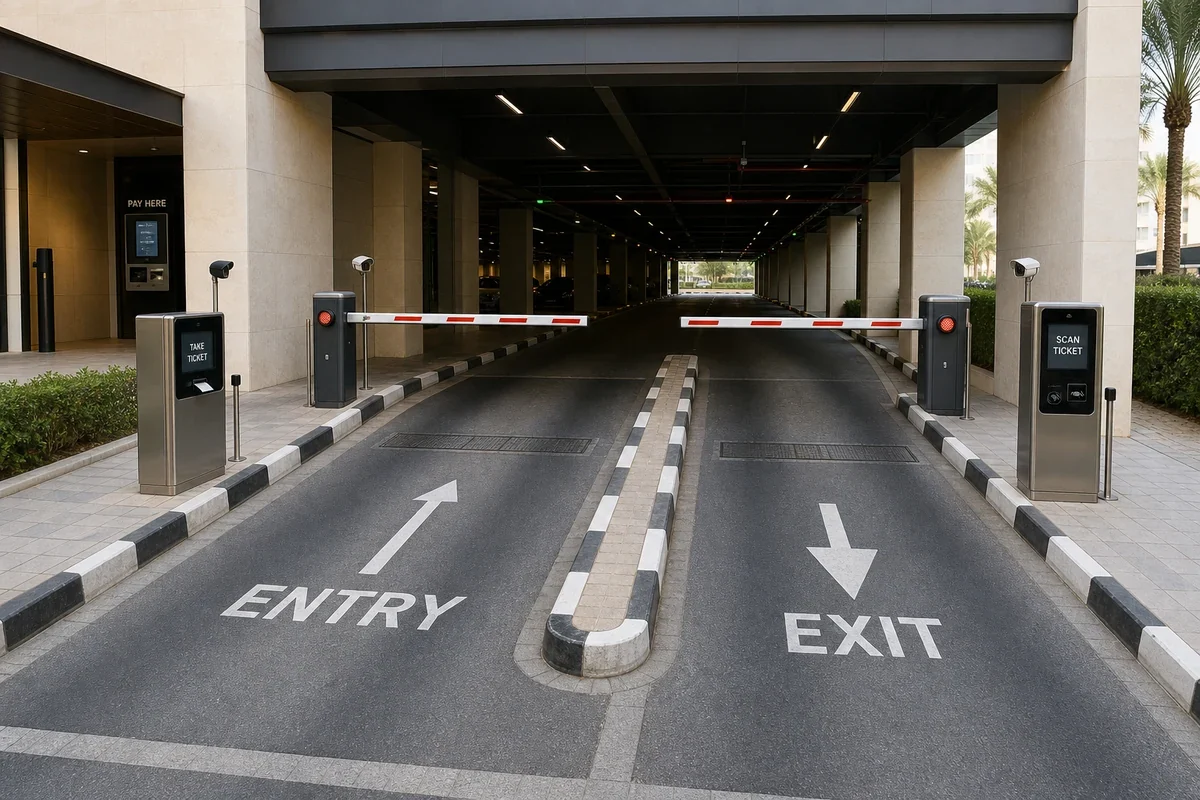
Automatic parking barriers, ANPR, UHF vehicle access and visitor management can control who enters the car park, while the guidance system helps authorised vehicles find appropriate parking after entry.
Where entry and exit counting is used to determine occupancy, the counting logic needs to account for the actual vehicle routes. Multiple entrances, exits, internal ramps or uncontrolled movements can affect the accuracy of simple count-based systems.
Individual-space detection provides more granular information because the status is determined at the parking bay itself. The additional infrastructure required should be considered against the operational value required by the property.
For basement and covered parking areas, installation planning needs to consider ceiling services such as sprinklers, lighting, ventilation ducts, signage, cable trays and other MEP systems.
Sensor positioning should not obstruct required building services or place equipment where it can easily be damaged by tall vehicles.
Network architecture depends on the selected parking technology. Field devices may communicate through wired networks, dedicated controllers, gateways, wireless technologies or manufacturer-specific communication methods.
Power and communication cabling should be planned systematically, particularly in large multi-storey facilities. Controller and gateway locations should remain accessible for future testing and maintenance.
Parking guidance equipment installed in exposed or semi-open UAE car parks should be selected with consideration for heat, dust, humidity and the actual environmental conditions.
Clear visual communication is equally important. Displays should be readable from the intended driver distance and viewing angle without creating unnecessary visual clutter.
Parking guidance can improve the driver experience and reduce unnecessary searching, but it should not be presented as guaranteeing a fixed reduction in parking time or congestion. Actual results depend on car-park size, occupancy, traffic patterns and driver behaviour.
Existing car parks can often be retrofitted with parking guidance without replacing their existing parking barriers. AZTÖR can assess whether current barriers, ANPR, access control and network infrastructure can be retained and integrated.
The system can also be introduced in phases. For example, a facility may initially implement floor or zone counting and later expand to individual-space detection where the selected architecture supports it.
Common faults include incorrect bay status, offline sensors, failed indicators, inaccurate counts, communication faults and displays showing information that does not match actual parking availability.
An incorrectly displayed space does not always mean the sensor itself has failed. Device alignment, communication, controller configuration, software mapping or network connectivity can also be responsible.
AZTÖR can troubleshoot suitable parking sensors, indicators, controllers, gateways, digital signs, networks and management software interfaces to identify the source of parking guidance faults.
Preventive maintenance should include sensor inspection, indicator testing, display checks, controller status, communication health, equipment cleaning and verification that software mapping still corresponds with the physical parking layout.
AZTÖR provides parking guidance system installation, integration, upgrades and maintenance across Dubai, Abu Dhabi, Sharjah, Ajman, Ras Al Khaimah, Fujairah and Umm Al Quwain, with suitable smart parking solutions available across the wider GCC.
Key Features
- Smart parking guidance systems
- Parking space availability detection
- Individual parking bay monitoring
- Zone-based parking monitoring
- Floor-based parking monitoring
- Multi-storey parking guidance
- Ultrasonic parking sensors
- Camera-based parking detection
- Overhead parking sensors
- Parking bay indicators
- Red and green bay indicators
- Multi-colour indicator options
- Available-space identification
- Occupied-space identification
- Reserved-space indication
- Accessible parking indication options
- VIP parking indication options
- EV parking indication options
- Parking availability counters
- Floor availability displays
- Zone availability displays
- Entrance parking displays
- Directional parking signs
- LED parking guidance displays
- Digital parking signage
- Real-time occupancy monitoring
- Central parking guidance software
- Parking occupancy dashboard
- Floor utilisation monitoring
- Zone utilisation monitoring
- Historical occupancy information
- Parking-space mapping
- Reserved parking management integration
- Smart Parking Management integration
- Automatic barrier integration
- ANPR integration
- UHF vehicle access integration
- Visitor management integration
- Multi-entry parking support
- Multi-exit parking support
- Parking entry and exit counting
- Parking controller integration
- Network gateway integration
- Wired communication options
- Wireless communication options where supported
- Existing car park retrofit
- Multi-storey car park retrofit
- System expansion options
- Sensor replacement
- Indicator replacement
- Parking display repair
- Controller troubleshooting
- Network fault diagnosis
- Preventive maintenance and AMC support
Technical Specification
| Solution Type | Smart parking guidance system |
|---|---|
| Primary Function | Detect parking occupancy and guide drivers toward available spaces |
| Application | Indoor, covered and suitable outdoor parking facilities |
| Detection Method | Ultrasonic, camera-based, counting or manufacturer-specific technology |
| Individual Bay Detection | Available |
| Zone Monitoring | Available |
| Floor Monitoring | Available |
| Parking Sensor | Manufacturer and technology specific |
| Camera Detection | Available on suitable systems |
| Bay Indicator | Available |
| Indicator Colours | System and configuration specific |
| Availability Display | LED, digital or manufacturer-specific display |
| Directional Signage | Available |
| Entrance Display | Available |
| Floor Display | Available |
| Zone Display | Available |
| Parking Capacity | Project specific |
| Number of Spaces | Scalable according to selected system |
| Occupancy Status | Available or occupied, with additional categories where supported |
| Reserved Bay Status | Available on compatible systems |
| EV Bay Status | Available on compatible systems |
| Accessible Bay Status | Available on compatible systems |
| Central Software | Available |
| Parking Dashboard | Available |
| Parking Map | Available on suitable platforms |
| Historical Reporting | Platform specific |
| Utilisation Reporting | Platform specific |
| Entry/Exit Counting | Available |
| ANPR Integration | Available |
| Automatic Barrier Integration | Available |
| UHF Integration | Available |
| Smart Parking Integration | Available |
| Visitor Management Integration | Available where compatible |
| Communication | Wired, wireless or manufacturer-specific |
| Network Architecture | Project and manufacturer specific |
| Controllers | According to selected system |
| Gateways | According to selected system |
| Power Supply | Equipment and manufacturer specific |
| Data Storage | Platform and project specific |
| Cloud Connectivity | Available on suitable platforms |
| On-Premises Operation | Available on suitable platforms |
| Environmental Suitability | Selected according to installation location |
| Installation | New installation or existing car park retrofit |
| Maintenance | Sensors, indicators, displays, controllers, gateways, network and software interfaces |
Parking guidance should be designed around the actual parking layout, number of spaces, vehicle routes, decision points and required level of occupancy information. Individual-space sensors, camera-based detection and zone counting each have different advantages and infrastructure requirements. Detection accuracy, camera coverage, indicator functionality and software features are manufacturer and site specific. AZTÖR provides a free site inspection before finalising the parking guidance architecture.
Typical Applications
- Shopping malls
- Retail developments
- Commercial towers
- Office buildings
- Business parks
- Residential towers
- Residential communities
- Mixed-use developments
- Hotels
- Resorts
- Hospitals
- Healthcare facilities
- Airports
- Airport parking
- Universities
- Schools
- Government facilities
- Public car parks
- Private car parks
- Paid parking facilities
- Multi-storey car parks
- Basement parking
- Underground parking
- Covered parking facilities
- Corporate campuses
- Staff parking facilities
- Visitor parking facilities
- Tenant parking facilities
- VIP parking areas
- EV parking zones
- Large residential developments
- Entertainment venues
- Exhibition centres
- Transport facilities
- Existing car park upgrades