Hangar Doors
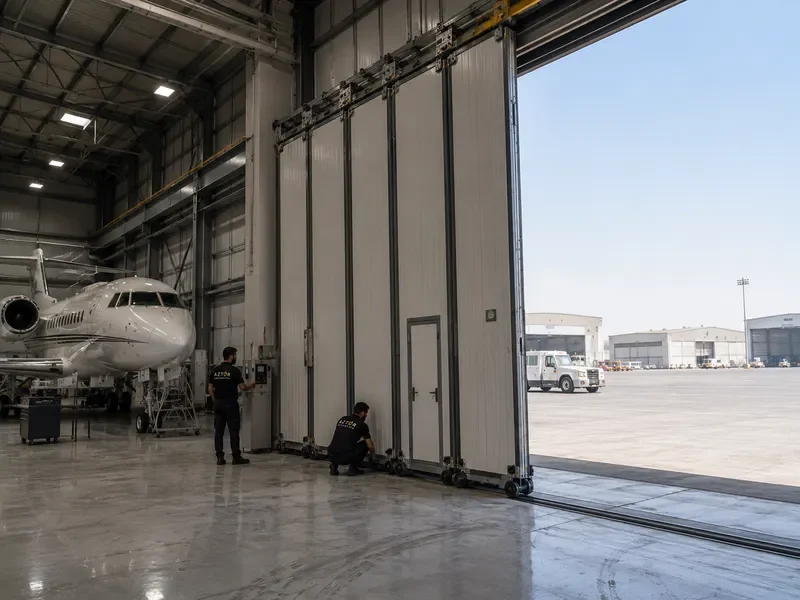
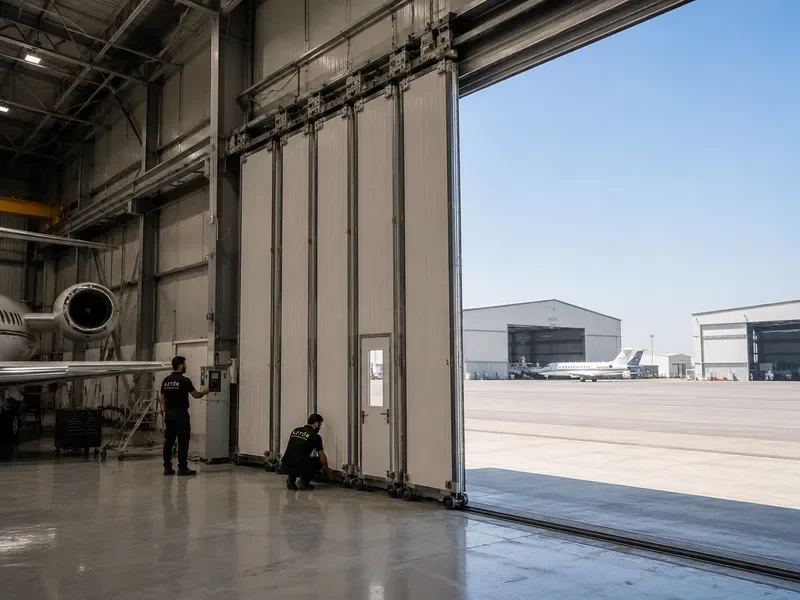
Hangar doors are large-format engineered door systems designed for exceptionally wide and tall openings used by aircraft, aviation maintenance facilities and specialist industrial buildings. Unlike standard industrial doors, hangar entrances require careful coordination between the door system, building structure, operating mechanism and site-specific environmental loads.
AZTÖR supplies, installs, automates and maintains hangar door solutions for aviation facilities, aircraft maintenance buildings, private hangars, helicopter facilities and suitable large industrial openings across the UAE.
There is no single hangar door configuration suitable for every building. Depending on the opening dimensions, available side and overhead space, structural design and operational requirements, solutions can include sliding hangar doors, bi-parting sliding systems, telescopic sliding doors, folding or bi-folding systems, vertical lifting doors, fabric lifting doors and other specialist configurations.
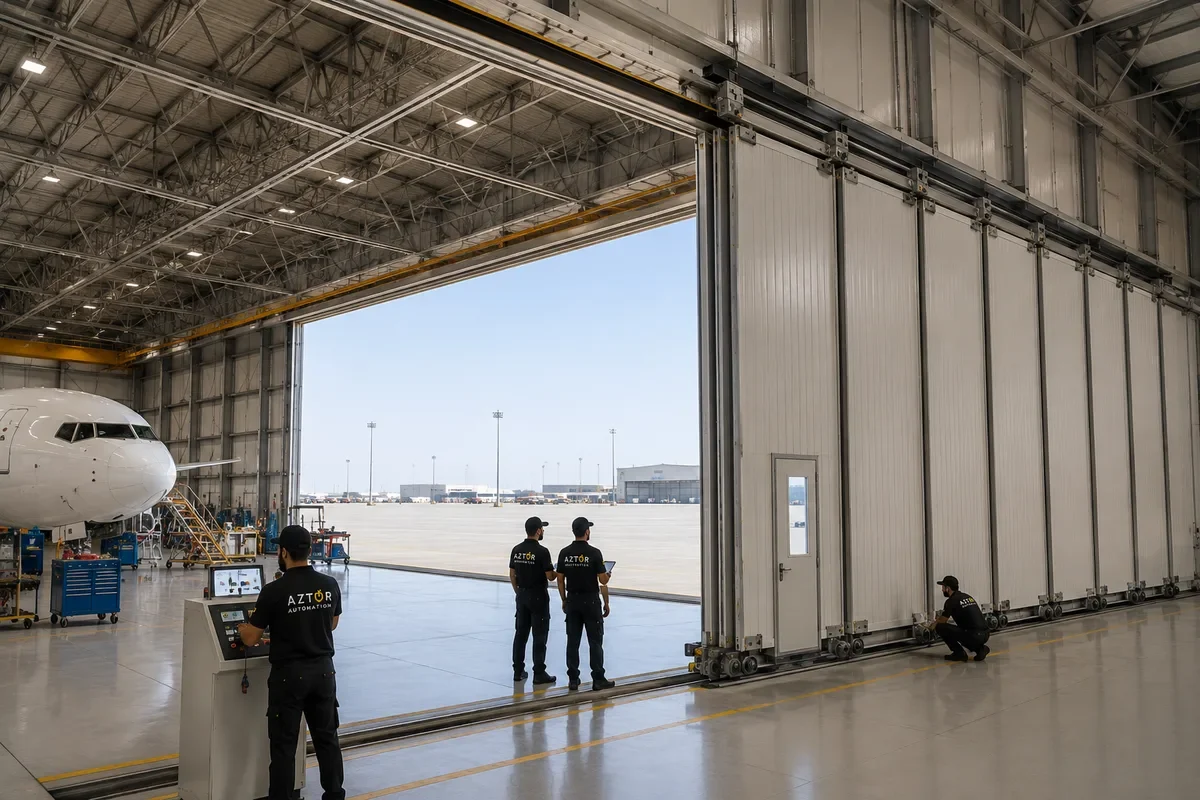
Sliding hangar doors are commonly considered where sufficient stacking or run-back space is available beside the opening. Large door leaves travel horizontally on an engineered track or manufacturer-specific support arrangement, allowing very wide openings to be divided into manageable moving sections.
Bi-parting and multi-leaf sliding arrangements can reduce the distance individual leaves need to travel. Telescopic configurations can also be considered where several panels need to stack progressively, subject to the selected system and building geometry.
Folding and bi-folding hangar doors provide another solution where the door leaves can fold into sections as the entrance opens. Their suitability depends on panel dimensions, structural loading, available clearances and the selected operating mechanism.
Vertical lifting and fabric lifting systems can be considered where lateral stacking space is limited but sufficient structure and height are available above the opening. These systems require specialist engineering appropriate to the door dimensions and building design.
AZTÖR provides a free site inspection for applicable hangar door projects. The assessment includes clear opening width and height, side and head clearances, floor conditions, structural fixing areas, aircraft or equipment dimensions, required opening sequence, expected operating frequency and environmental exposure.
For aircraft applications, the required clear opening should be established from the aircraft types and operational movement planned for the facility. Wing span, tail height, towing arrangements, ground-support equipment and required manoeuvring clearance can all influence the practical door opening.
Wind is one of the most important considerations for large hangar doors in the UAE. Because of their substantial surface area, door leaves can experience significant pressure and suction. The selected system, panels, framing, tracks, guides, supports, fixings and building structure must therefore be engineered for the project's required wind conditions.
A large door should never be specified from motor power alone. Door weight, friction, panel dimensions, wind conditions, operating speed, travel distance, duty cycle and emergency operating requirements all affect the automation design.
Motorised hangar doors can use one or multiple coordinated drive units depending on the system. Where several leaves or door sections move together, the controls may require sequencing, synchronisation, position monitoring and appropriate interlocks.
Control options can include hold-to-run or automatic push buttons, key switches, remote controls and compatible access-control interfaces. For controlled aviation or industrial facilities, operation can also be integrated with authorised access systems where appropriate.
Depending on the selected door and project requirements, safety systems can include photocells, safety edges, light curtains, obstacle detection, warning lights, audible warnings, emergency-stop stations and other manufacturer-specific protective devices.
Large automated doors require particular attention to the movement area. Personnel, vehicles, aircraft and ground-support equipment may all be present near the opening, so the safety arrangement should be based on the actual operating environment rather than relying on a single sensor.
Hangar door systems can incorporate insulated panels where environmental control is important. This can be useful for air-conditioned aircraft maintenance or specialist industrial facilities, although actual thermal performance depends on the selected panels, joints, perimeter sealing and complete installed system.
Glazed or translucent sections can also be considered on suitable door systems where natural light is required. The glazing arrangement must remain compatible with the structural and wind requirements of the complete door.
Bottom tracks, where used, require appropriate design and maintenance. Dust, sand, debris and floor movement can affect large sliding doors, particularly in UAE conditions. Track drainage, alignment, cleaning access and protection should therefore be considered during design.
Where trackless or top-supported specialist systems are proposed, the building structure must be suitable for the loads transferred by the door. Structural requirements should be coordinated with the project consultant or structural engineer.
Hangar doors can also be used for non-aviation applications requiring exceptionally large clear openings, including large equipment buildings, industrial assembly facilities, vehicle depots and specialist maintenance workshops.
Fire performance is a separate requirement. A conventional hangar door should not automatically be described as fire rated. Where the approved fire and life-safety strategy requires a rated closure, the applicable opening and selected system must be addressed using appropriate tested and documented solutions.
Likewise, terms such as hurricane rated, blast resistant, security rated or a specific wind class should only be used where the selected complete door system has appropriate engineering or test documentation supporting that performance.
AZTÖR can inspect existing hangar doors for operational problems, automation upgrades and component repairs. Depending on the system, work can include tracks, rollers, wheels, guides, hinges, panels, cables, motors, gearboxes, limit systems, control panels and safety devices.
Preventive maintenance is particularly important because relatively small alignment, track or drive problems can become significant when applied to very large and heavy moving doors. Mechanical condition, fasteners, tracks, drives, controls and safety devices should therefore be inspected according to the system and operating frequency.
AZTÖR provides hangar door project support, installation, automation, repair and preventive maintenance across Dubai, Abu Dhabi, Sharjah, Ajman, Ras Al Khaimah, Fujairah and Umm Al Quwain, with suitable specialist industrial door support available across the wider GCC.
Key Features
- Large-format engineered door systems
- Aircraft hangar applications
- Wide and tall clear-opening solutions
- Sliding hangar door options
- Bi-parting sliding configurations
- Multi-leaf sliding systems
- Telescopic sliding configurations where suitable
- Folding hangar door options
- Bi-folding hangar door options
- Vertical lifting configurations
- Fabric lifting door options
- Specialist project-specific configurations
- Manual and motorised options according to system
- Multiple coordinated drive options
- Industrial-duty motors and gearboxes
- Door sequencing
- Drive synchronisation where required
- Position monitoring
- Engineered structural framing
- Heavy-duty tracks and guides
- Heavy-duty rollers and wheels
- Trackless or top-supported options on suitable systems
- Insulated panel options
- Glazed or translucent panel options
- Perimeter sealing options
- External UAE applications
- Project-specific wind engineering
- Push-button control
- Key-switch control
- Remote-control options
- Compatible access-control integration
- Safety photocells
- Safety edges
- Safety light curtain options
- Obstacle detection where supported
- Warning lights
- Audible warning options
- Emergency-stop stations
- Manual emergency operation according to selected system
- Control-panel integration
- Existing hangar door automation upgrades
- Track and roller repairs
- Motor and gearbox servicing
- Control-system troubleshooting
- Safety-device replacement
- Preventive maintenance and AMC support
Technical Specification
| Product Type | Large-format hangar door system |
|---|---|
| Primary Application | Aircraft hangars and specialist large industrial openings |
| Door Configuration | Sliding, bi-parting, telescopic, folding, bi-folding, vertical lifting or specialist system |
| Door Material | Steel, aluminium, fabric or manufacturer-specific construction |
| Panel Construction | Solid, insulated, glazed or project-specific configuration |
| Opening Size | Engineered according to project and selected system |
| Clear Width | Project specific |
| Clear Height | Project specific |
| Operation | Manual or motorised according to selected system |
| Drive System | Single or multiple industrial drive units |
| Motor Capacity | Engineered according to door weight, travel, wind and operating duty |
| Drive Synchronisation | Available where required by multi-drive systems |
| Operating Speed | Manufacturer, system and project specific |
| Duty Cycle | Selected according to required operating frequency |
| Track System | Floor, overhead or manufacturer-specific arrangement |
| Rollers / Wheels | Heavy-duty system-specific components |
| Structural Support | Project and door-system specific |
| Wind Requirement | Project specific and subject to engineering |
| Panel Reinforcement | According to door dimensions and structural requirements |
| Insulation | Available with suitable insulated door systems |
| Thermal Performance | According to selected complete system |
| Vision / Glazing | Available on suitable configurations |
| Control | Push button, key switch, remote or compatible access control |
| Safety Photocells | Available where applicable |
| Safety Edge | Available on suitable systems |
| Light Curtain | Available where appropriate |
| Warning Light | Available |
| Audible Warning | Available where required |
| Emergency Stop | Available on suitable automated systems |
| Manual Override | According to selected drive system |
| Position Monitoring | Available according to selected controls |
| Power Supply | According to selected drive and project electrical design |
| Finish | Manufacturer and project specific |
| Colour | Subject to selected panel and coating system |
| External Application | Available with suitable engineered system |
| Fire Rating | Only where supported by documentation for a specifically tested complete system |
| Installation | New installation, replacement or suitable existing-door automation |
| Maintenance | Structure, panels, tracks, rollers, drives, controls and safety systems |
Hangar doors are project-engineered systems rather than standard catalogue doors. Final configuration depends on clear opening dimensions, aircraft or equipment clearance, available stacking space, building structure, wind requirements, operating frequency and required automation. AZTÖR provides a free site inspection and coordinates the door requirements with the project team before final system selection. Structural, wind, thermal, fire, security or other performance values are stated only where supported by engineering or technical documentation for the selected system.
Typical Applications
- Aircraft hangars
- Private aircraft hangars
- Business aviation facilities
- Helicopter hangars
- Helicopter maintenance facilities
- Aircraft maintenance facilities
- MRO facilities
- Aviation workshops
- Airport maintenance buildings
- Airport support facilities
- Aircraft storage buildings
- Fixed-base operator facilities
- Aviation training facilities
- Government aviation facilities
- Military support facilities where applicable
- Cargo maintenance buildings
- Ground-support equipment facilities
- Large industrial buildings
- Industrial assembly facilities
- Heavy equipment workshops
- Large vehicle maintenance facilities
- Bus depots
- Fleet maintenance facilities
- Rail maintenance facilities
- Manufacturing plants
- Large machinery entrances
- Marine maintenance buildings
- Specialist storage buildings
- Large equipment storage facilities
- Wide industrial openings