Elevator Access
Elevator Access Control extends building security beyond entrance doors by controlling which lift floors an authorised user is permitted to select.
AZTÖR Automation supplies, installs, integrates, upgrades, repairs and maintains elevator access control solutions for residential towers, commercial buildings, hotels, offices, mixed-use developments and other controlled properties across the UAE.
In a conventional lift, passengers may be able to select any floor available from the elevator car. With access control integration, selected floors can remain restricted until the passenger presents an authorised credential or receives an approved visitor permission.
A resident can, for example, be authorised for the building entrance, parking area, common facilities and the floor associated with their apartment while remaining restricted from unrelated residential floors.
An office employee can be permitted to access their company's floors during authorised hours while management, facilities or security personnel can receive different permissions according to their responsibilities.
AZTÖR provides a free site inspection for applicable Elevator Access projects. We review the existing access-control platform, elevator arrangement, number of lifts, number of floors, lift control interface, user groups, visitor process, required credentials and integration possibilities before proposing a solution.
Elevator Access Control should not be treated as a standalone modification to the lift's safety or motion-control system.
The access-control system normally provides permission-related signals through an interface agreed with the elevator system, while the elevator controller continues to manage lift movement, doors, safety functions and other core elevator operations.
Any connection to the elevator system should therefore be coordinated with the elevator manufacturer, authorised lift maintenance company or relevant project specialist where required.
AZTÖR's role is to design and integrate the access-control side without bypassing or interfering with the lift's safety circuits.
A typical solution can include access readers, elevator access controllers, floor-control relay modules, power supplies, management software and the required interface with the lift control system.
The exact architecture depends on the lift manufacturer, access-control platform and required functionality.
Card access is one of the most common methods for elevator security.
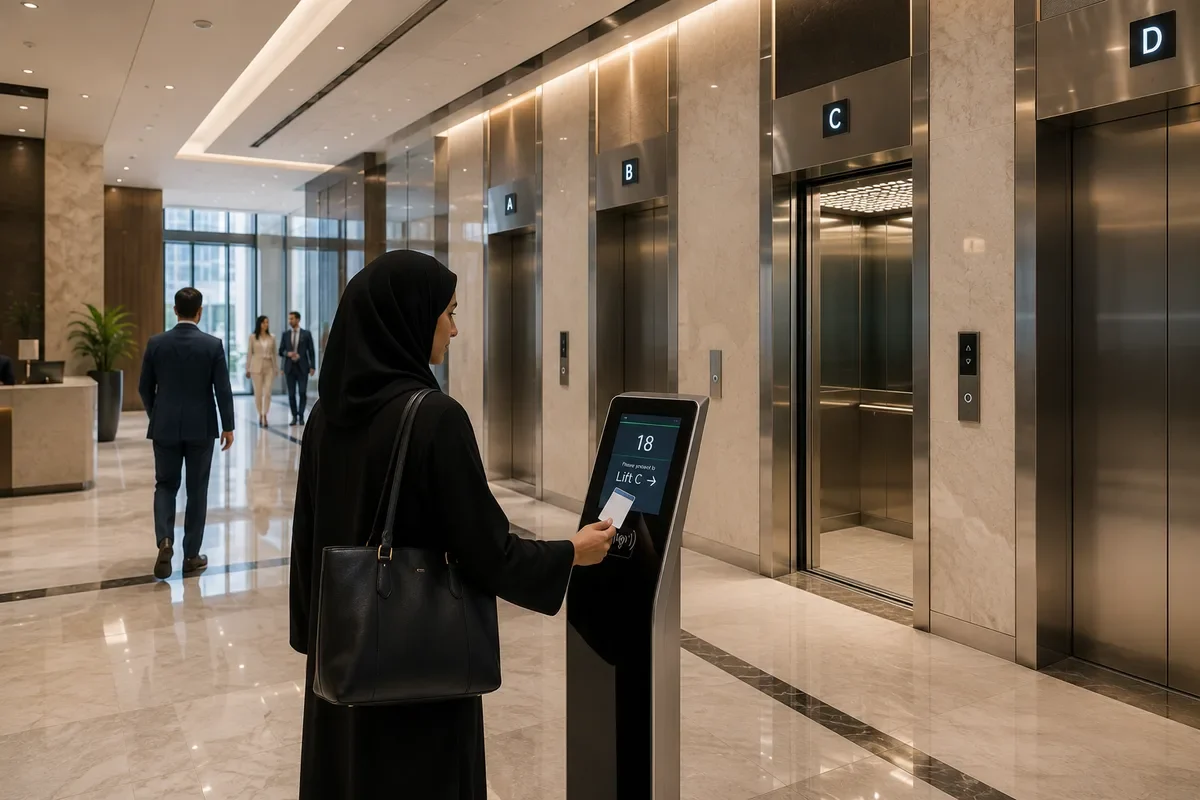
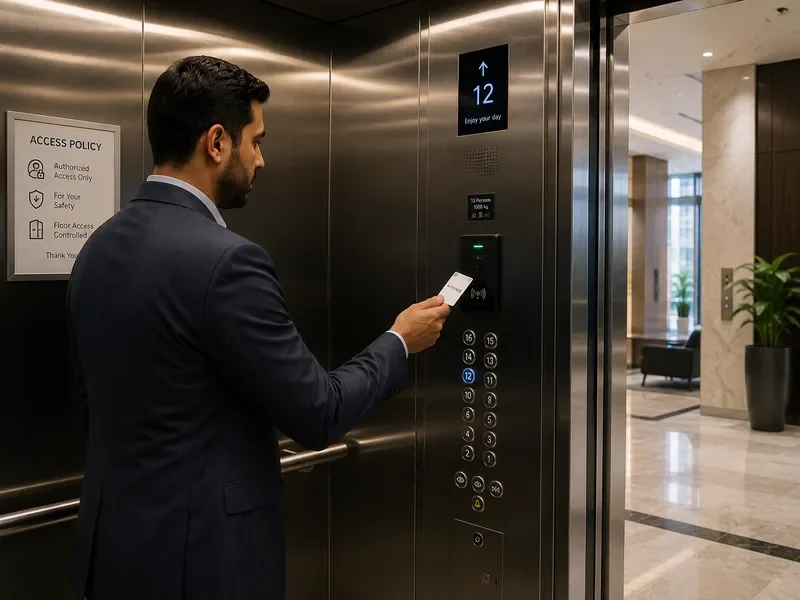
An authorised user presents an RFID card or compatible credential inside the lift car or at another designated reader position.
After successful authentication, the system can enable only the floor buttons associated with that user's permissions.
For example, an employee authorised for Floors 5 and 6 can be permitted to select those floors while other restricted floors remain unavailable.
In residential buildings, permissions can be configured around apartments, residential floors, amenities, parking levels and common areas according to the property's access policy.
Key fobs can provide similar functionality where compatible with the selected credential system.
PIN credentials can also be used on suitable elevator access systems.
Biometric authentication such as fingerprint or facial recognition can be considered where appropriate and supported by the selected system.
Biometric access should be selected with appropriate consideration of privacy, user enrolment, environmental conditions, operational continuity and alternative access procedures.
Mobile credentials can allow compatible smartphones to be used for elevator access where supported by the selected access-control platform.
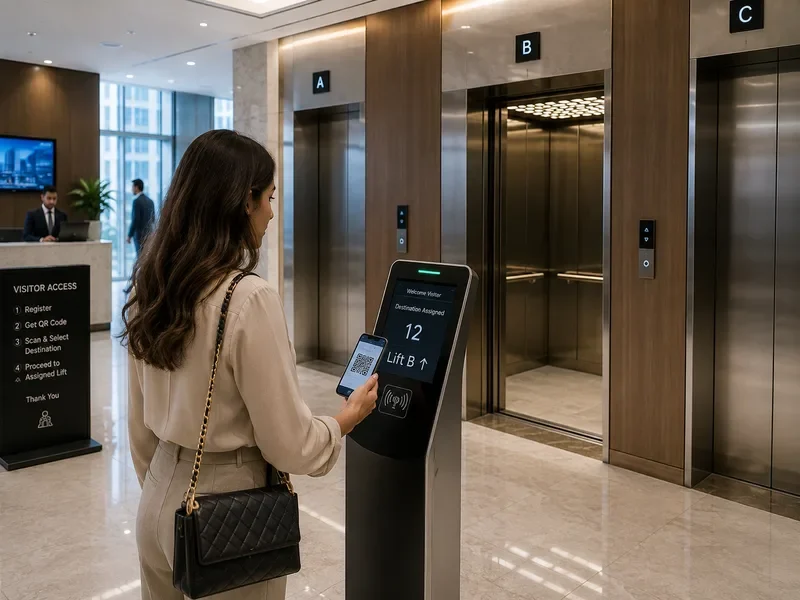
QR credentials can be particularly useful for temporary visitor access.
A visitor can receive a credential valid only for a defined destination or time period where the selected Visitor Management and elevator access platforms support this functionality.
The visitor therefore does not necessarily need unrestricted access to every floor in the building.
Elevator Access Control can be integrated with Door Access Control so the same authorised credential operates both pedestrian doors and permitted elevator floors.
This provides a more consistent security experience than managing unrelated cards for the building entrance, office door and lift.
Where technically compatible, parking access can also form part of the same wider credential environment.
A resident or employee could potentially use one credential for the parking entrance, building entrance and authorised lift floors.
The exact functionality depends on the credential technology and compatibility between the parking, door and elevator access systems.
Floor permissions can be assigned by individual user, department, tenant, resident group or another authorised category.
Time schedules can further restrict when those permissions are valid.
An employee may be authorised for an office floor during working hours while a facilities engineer has extended access for maintenance requirements.
Temporary contractors can receive access to only the floors required for their work and only for the approved period.
Credentials can be disabled when employees leave, tenants move out or contractor access expires.
This provides more flexible security administration than relying only on physical keys or unrestricted elevator floor buttons.
Multi-tenant commercial buildings can use Elevator Access Control to separate access between companies occupying different floors.
Suitable systems can allow a central building administrator to maintain overall control while individual tenant access requirements are configured according to the agreed management structure.
Residential towers can use floor restriction to reduce unnecessary movement between private residential levels.
The system should still preserve required access to common, refuge, emergency or other areas according to the building's approved operational and life-safety requirements.
Hotels can use elevator access as part of a guest credential system where technically compatible with the hotel access platform.
A guest credential may be configured for the appropriate accommodation floor and authorised hotel facilities according to the selected system.
Hotel integrations are manufacturer and property-management-platform specific and should be assessed before committing to a particular workflow.
Visitor Management is particularly valuable in buildings with restricted elevator floors.
Visitors can be pre-registered by a resident, tenant, reception desk or authorised employee.
Depending on the platform, a temporary card, QR code, mobile credential or other approved credential can then provide limited building and elevator access.
Permissions can expire automatically after the approved visit period where supported.
Reception and security personnel can also issue or revoke temporary access from the management platform.
Video intercom can form part of the visitor workflow.
A visitor can communicate with reception or the host before being granted access to the building and appropriate lift destination.
In more advanced destination-control elevator environments, access credentials may interact with the destination-dispatch workflow where the elevator manufacturer and access-control system provide a supported integration.
The system may identify the user's permitted destination and coordinate access with the elevator's destination-control interface.
This is different from simply enabling conventional floor-selection buttons through relay outputs.
Destination-control integration is highly manufacturer specific and should not be promised without confirming the actual lift system and supported interface.
Traditional elevator access control often uses relay modules to enable or disable individual floor-selection inputs.
The number of floors, lifts and required controlled outputs affects the quantity and type of elevator control modules required.
The relay interface must be designed so that access control does not interfere with elevator safety operation.
AZTÖR does not modify elevator safety circuits simply to achieve access-control functionality.
Emergency and fire operation must always take priority over ordinary access restrictions according to the approved building and elevator strategy.
During a fire or other emergency condition, elevator operation can be governed by specialised lift and fire-life-safety logic.
The access-control system must not prevent the elevator from carrying out its required emergency functions.
The exact emergency behaviour depends on the building, lift system, fire strategy and applicable requirements and should be coordinated with the relevant elevator and life-safety specialists.
Similarly, access control must not prevent authorised rescue, fire service or maintenance operation.
Security override procedures should be established for authorised building personnel.
Suitable systems can provide administrator or security credentials with broader floor permissions according to the property's security policy.
Access permissions should follow the principle that users receive only the areas necessary for their role or legitimate access requirement.
Elevator Access Control can also integrate with CCTV and Video Management Systems where compatible.
Elevator access events can potentially be associated with relevant surveillance footage to support authorised security investigation.
For example, a denied elevator access event can be reviewed together with nearby lobby or elevator surveillance footage where the integrated platforms support event association.
Access logs can record information such as credential identity, elevator, floor permission, date, time and access result depending on the selected platform.
These records can support security administration and investigation but should be handled according to the organisation's legitimate operational requirements and applicable UAE data-protection obligations.
Biometric credentials require additional care because biometric information is sensitive personal information and cannot simply be replaced like a lost card.
Where biometrics are proposed, the customer's privacy, enrolment, retention and access-control procedures should be considered alongside the technical design.
Elevator Access can also integrate with Building Management or wider smart-building platforms where suitable interfaces exist.
Integration should be based on documented interfaces or APIs rather than assuming that every lift, access controller and BMS can communicate directly.
Existing buildings can often be retrofitted with Elevator Access Control, but feasibility depends heavily on the installed elevator system.
AZTÖR first reviews the lift make, controller, floor-selection arrangement, existing access-control equipment and available integration points.
Some existing elevators may support straightforward dry-contact or relay integration, while others require a manufacturer-specific interface, gateway or software integration.
Where the elevator manufacturer requires its authorised service provider to make connections within the lift controller, that work should be coordinated accordingly.
For new developments, elevator access should ideally be planned before final commissioning.
Early coordination allows the elevator supplier, access-control contractor, electrical contractor, IT team, security consultant and building management requirements to be aligned before installation is complete.
Cable routes, reader locations, controller positions, relay quantities, network requirements and interface responsibilities can then be clearly established.
For existing Door Access Control customers, Elevator Access can often be added as an extension of the wider access platform if the installed system supports the required elevator modules.
However, software licences, controller capacity, credential compatibility and manufacturer interfaces must be checked first.
Different access-control brands are not automatically interchangeable.
Reader protocols, credentials, encryption, controller architecture, relay modules, software licensing and lift integration interfaces can all affect compatibility.
For larger developments, centralised management can provide one authorised interface for doors, elevators and other access-controlled areas.
Role-based administration can restrict what different operators are allowed to manage.
For example, reception personnel may issue visitor access without being allowed to change high-security floor permissions.
Audit trails can record administrative changes where the selected platform provides that capability.
System resilience should also be considered.
The required behaviour during controller, server or network failure should be established according to the building's operational and security requirements.
Local controller intelligence can allow suitable systems to continue making configured access decisions even when communication with the central management server is temporarily unavailable.
The actual offline behaviour depends on the selected platform.
Backup power can be provided for suitable access-control controllers and readers.
Backup duration depends on connected equipment, power consumption and battery capacity and should therefore be calculated for the selected installation rather than advertised as one universal duration.
Elevator Access Control faults can originate from either the access-control side or the elevator interface.
A card may read correctly but the required floor button may remain disabled because of a relay, wiring, controller, interface or lift-side issue.
A user who can access every floor despite having restricted permissions may indicate incorrect relay logic, software configuration or an interface problem.
A reader that does not respond may have a power, communication, credential or hardware fault.
AZTÖR troubleshoots the access-control components and coordinates with the elevator service provider where the fault involves lift equipment outside the access-control scope.
Existing elevator access systems can also be upgraded.
Older card systems can be assessed for migration to newer credential technologies, centralised management, mobile access, Visitor Management or biometric authentication where suitable.
An upgrade does not automatically require replacing every existing component. AZTÖR reviews which readers, controllers, credentials, relay modules and software components remain technically suitable.
Preventive maintenance can include reader testing, controller communication, floor relay testing, power-supply inspection, backup battery checks, credential verification, access-permission testing and confirmation of the access-control interface with the elevator system.
Elevator Access should also be tested whenever significant changes are made to the elevator controller, access-control software or building security configuration.
AZTÖR Automation provides Elevator Access Control, Door Access Control, security automation and smart-building integration across Dubai, Abu Dhabi, Sharjah, Ajman, Ras Al Khaimah, Fujairah and Umm Al Quwain, with suitable technical support available across the wider GCC.
Key Features
- Elevator Access Control
- Lift access control
- Floor access restriction
- RFID elevator access
- Card-based elevator access
- Key fob access
- PIN access options
- Biometric elevator access
- Fingerprint access options
- Facial recognition options
- Mobile credentials
- QR visitor credentials
- Multi-factor authentication options
- Individual floor permissions
- Multiple floor permissions
- User-based floor access
- Tenant-based floor access
- Department-based access
- Resident floor access
- Staff floor access
- Contractor floor access
- Visitor floor access
- Temporary floor permissions
- Time-based floor permissions
- Automatic credential expiry
- Centralised access management
- Multi-elevator management
- Multi-building management
- Multi-site access management
- Elevator access controllers
- Floor-control modules
- Relay interface modules
- Door Access Control integration
- Visitor Management integration
- Video intercom integration
- CCTV integration
- VMS integration
- Parking access integration
- Smart building integration
- BMS integration where compatible
- Destination-control integration where supported
- Conventional lift button control
- Destination dispatch integration where supported
- Role-based administration
- Access event records
- Denied access records
- Audit trail options
- Security override permissions
- Emergency operation coordination
- Fire and life-safety coordination
- Local controller operation where supported
- Backup power options
- Existing elevator retrofit
- Existing access-control expansion
- New building integration
- Reader upgrades
- Controller upgrades
- Credential migration
- Mobile access upgrades
- Elevator access troubleshooting
- Floor relay troubleshooting
- Reader replacement
- Controller replacement
- Power supply replacement
- Preventive maintenance
- AMC support
Technical Specification
| Solution Type | Electronic elevator and floor access control |
|---|---|
| Primary Function | Restriction of elevator floor access according to authorised credentials |
| Application | Residential, commercial, hospitality and controlled buildings |
| Credential Type | RFID, PIN, biometric, mobile, QR or manufacturer specific |
| RFID Card | Available |
| Key Fob | Available |
| PIN Access | Available on suitable systems |
| Fingerprint | Available on suitable systems |
| Facial Recognition | Available on suitable systems |
| Mobile Credential | Available on compatible platforms |
| QR Credential | Available on suitable platforms |
| Multi-Factor Authentication | Available on suitable systems |
| Floor Permissions | User, group, tenant, department or role specific |
| Time Schedules | Available |
| Temporary Access | Available |
| Visitor Access | Available |
| Automatic Credential Expiry | Available on suitable platforms |
| Elevator Controller Interface | Project and elevator specific |
| Floor Control | Relay, gateway, API or manufacturer-specific interface |
| Relay Modules | Available |
| Floors per Module | Manufacturer and model specific |
| Number of Elevators | Project and platform specific |
| User Capacity | Controller and platform specific |
| Credential Capacity | Platform specific |
| Door Access Integration | Available |
| Visitor Management Integration | Available |
| Intercom Integration | Available |
| CCTV/VMS Integration | Available where compatible |
| Parking Access Integration | Available where compatible |
| BMS Integration | Available where compatible |
| Destination Control Integration | Elevator manufacturer and interface specific |
| Emergency Operation | Elevator and life-safety strategy specific |
| Fire Alarm Coordination | Project and elevator system specific |
| Security Override | Available according to authorised permissions |
| Role-Based Administration | Available |
| Event Reporting | Available |
| Audit Trail | Platform specific |
| Network | Ethernet or manufacturer-specific architecture |
| Cloud Management | Available on suitable platforms |
| On-Premises Management | Available |
| Offline Controller Operation | Platform specific |
| Backup Power | Available for suitable access-control equipment |
| Installation | New installation, retrofit, expansion or upgrade |
| Elevator Safety Circuits | Remain under elevator system control |
| Maintenance | Readers, controllers, relay modules, power supplies, software and interfaces |
Elevator Access Control must be designed around the installed elevator system and should never interfere with lift safety, emergency or motion-control functions. The final solution depends on the elevator manufacturer, controller interface, number of lifts and floors, credential technology, existing access-control platform and required visitor or destination-control integration. Connections to elevator equipment may require coordination with the authorised elevator contractor. AZTÖR Automation provides a free site inspection before finalising the access-control architecture and integration scope.
Typical Applications
- Residential towers
- Apartment buildings
- Residential communities
- Luxury residences
- Commercial towers
- Office buildings
- Corporate headquarters
- Business parks
- Multi-tenant offices
- Mixed-use developments
- Hotels
- Resorts
- Serviced apartments
- Hospitals
- Healthcare facilities
- Government buildings
- Educational facilities
- Universities
- Data centres
- Technology facilities
- Financial institutions
- Corporate campuses
- Staff-only floors
- Executive floors
- Management floors
- Residential floors
- Tenant floors
- Hotel guest floors
- VIP floors
- Technical floors
- Server floors
- Restricted floors
- Parking-to-lobby access
- Visitor-controlled floors
- High-security areas
- Multi-elevator buildings
- Destination-control elevators
- Smart buildings