Wheel Guides
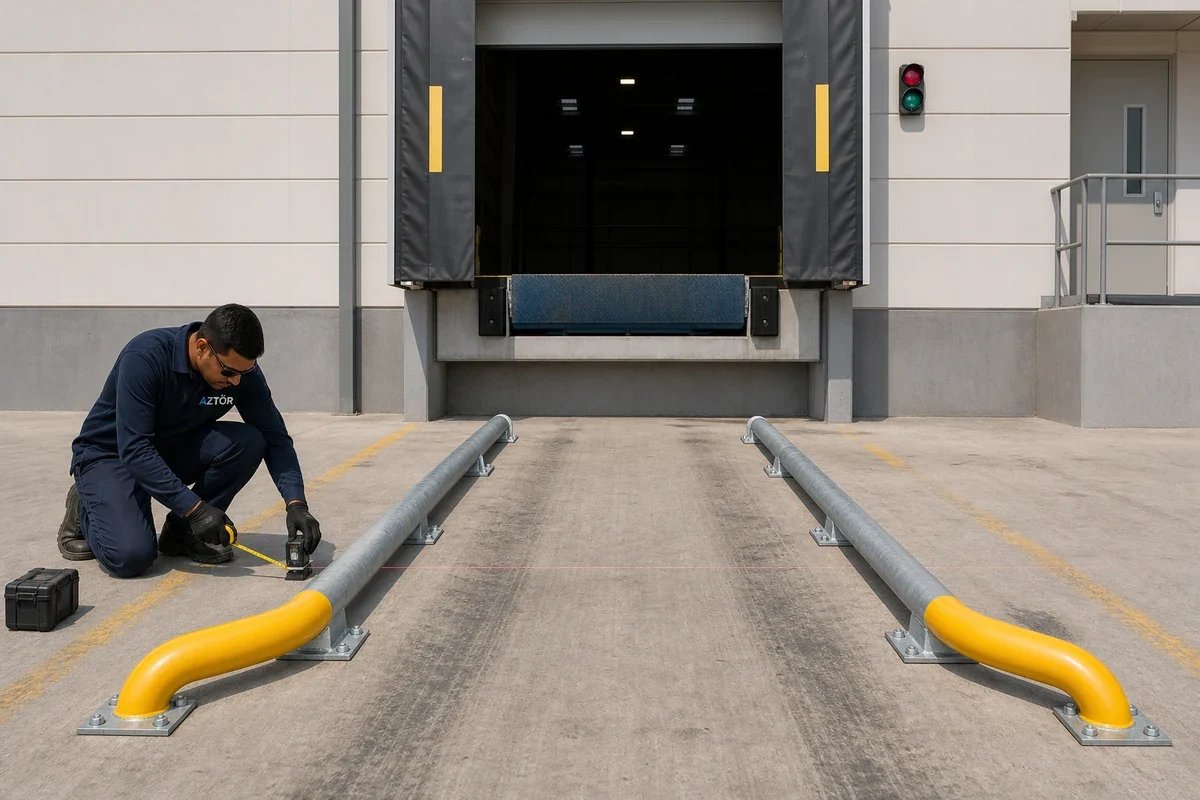
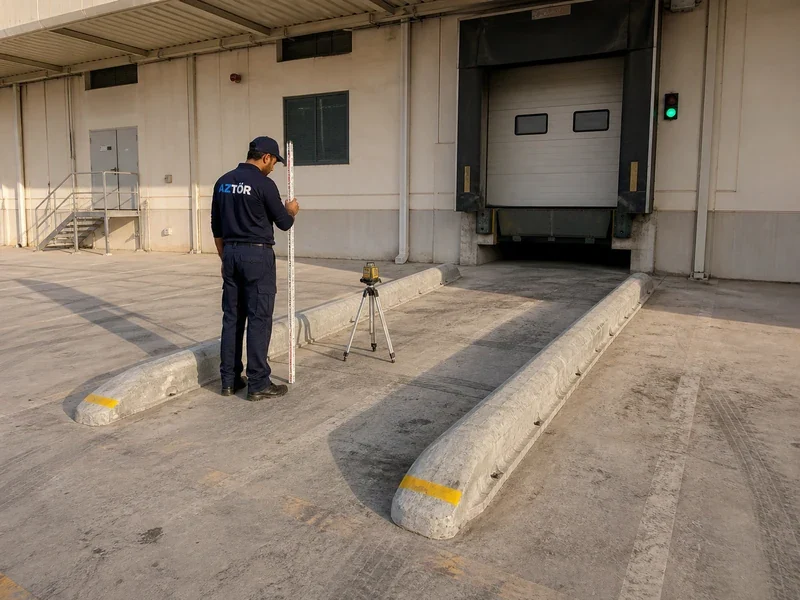
Loading bay wheel guides are heavy-duty vehicle-guidance barriers installed on the approach to a loading dock. They help drivers position trucks and trailers centrally and consistently as they reverse toward the loading bay.
AZTÖR supplies, installs, replaces and maintains wheel guides for warehouses, logistics centres, distribution facilities, factories, cold stores and industrial loading bays across the UAE.
Accurate vehicle positioning is important because several loading-bay systems depend on the truck arriving in the correct position. Dock levellers, dock shelters, dock seals, bumpers and vehicle restraints all work more effectively when the vehicle is properly aligned with the bay.
Wheel guides are normally installed as a pair, one on each side of the vehicle approach. Their position creates a guided path that assists the driver in bringing the vehicle toward the centreline of the loading bay.
As the vehicle reverses, the tyres can make controlled contact with the guide if the approach begins to move away from the intended alignment. The guide helps redirect the vehicle toward the correct docking position.
Wheel guides should assist positioning rather than create an unnecessarily narrow or aggressive approach. The spacing, length, height, profile and position need to suit the expected vehicle fleet and loading-yard geometry.
AZTÖR provides a free site inspection for applicable wheel-guide installations. We assess the loading-bay centreline, approach angle, vehicle types, tyre positions, trailer widths, dock spacing, yard dimensions, kerbs, drainage and existing loading-bay equipment before confirming the layout.
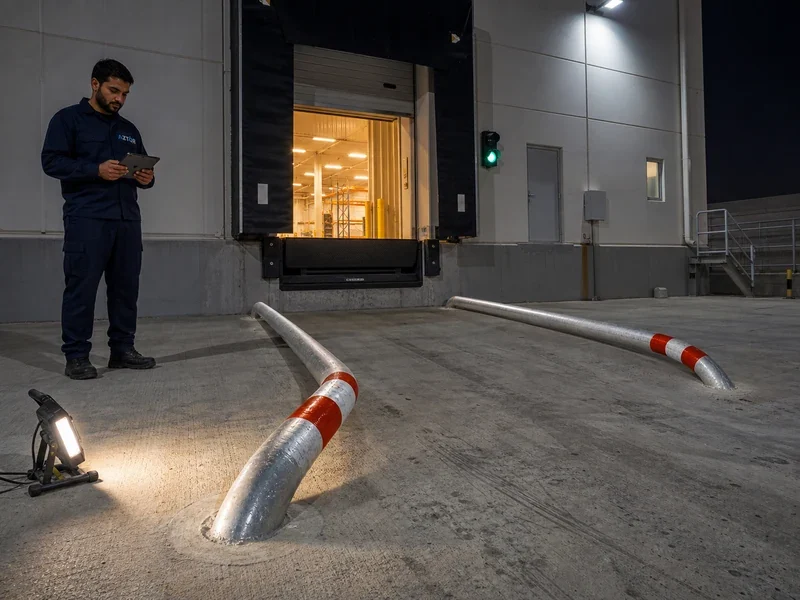
Straight tubular steel wheel guides are widely used for conventional loading bays. Depending on the project, flared or angled entry sections can make it easier for drivers to enter the guided approach before the vehicle reaches the narrower docking position.
Different wheel-guide profiles and configurations are available. The appropriate design depends on vehicle dimensions, expected impact, site layout and the selected manufacturer's or project engineer's requirements.
Wheel guides are commonly manufactured from heavy-duty steel tube or other engineered steel sections. Surface protection can include galvanising, painted finishes or other manufacturer-specific corrosion-protection systems.
For UAE installations, outdoor equipment should be selected with consideration for heat, dust, sand, humidity, irrigation exposure and, where relevant, coastal conditions.
High-visibility finishes or markings can help drivers identify the guides during manoeuvring. Visibility should also be considered together with loading-yard lighting, dock markings and traffic-management arrangements.
Wheel guides should be positioned relative to the actual vehicle wheel path rather than simply centred visually beneath the dock door. Trucks and trailers can have different tyre tracks and body widths, so the expected fleet should be reviewed.
Vehicle approach geometry is particularly important where the yard has limited manoeuvring space. If trucks cannot approach the bay sufficiently straight, wheel guides alone will not correct an unsuitable loading-yard layout.
Foundation design and anchoring are critical because wheel guides can experience repeated lateral contact from heavy commercial vehicle tyres. The guide itself may be strong, but poor concrete or inadequate anchoring can still cause movement or failure.
Depending on the system and site, wheel guides may be surface-mounted using suitable anchors or installed using embedded foundations. Final fixing requirements depend on the selected guide, substrate and engineering requirements.
Wheel guides should not be treated as vehicle restraints. Their purpose is to assist lateral alignment during reversing; they do not secure the truck against forward movement once loading begins.
They also do not replace dock bumpers. Dock bumpers establish and protect the final stopping interface at the dock face, whereas wheel guides help control the vehicle's lateral approach.
At loading bays fitted with dock seals, accurate alignment is especially useful. A poorly centred trailer can compress one side of the seal excessively while leaving a larger gap on the opposite side.
Correct positioning is also important for dock shelters. Keeping the vehicle within the intended shelter operating range helps improve the interface and can reduce abnormal contact with shelter curtains or frames.
For dock levellers, vehicle alignment helps place the trailer correctly in front of the platform and lip. Final leveller operation and lip engagement must still follow the equipment manufacturer's operating requirements.
Wheel guides can also support loading bays equipped with vehicle restraints by helping the vehicle approach the intended restraint position. Compatibility depends on the restraint type and vehicle configuration.
The wider loading-bay system can include sectional overhead doors, dock levellers, dock shelters or seals, bumpers, wheel guides, vehicle restraints, traffic lights and dock lights.
At facilities with several adjacent loading bays, consistent wheel-guide layouts can help drivers identify individual docking lanes and maintain separation between neighbouring vehicle approaches.
Wheel guides can suffer damage from repeated heavy impacts, incorrectly aligned vehicles or unsuitable installation. Bent sections, loose anchors, cracked concrete and corrosion should be inspected rather than ignored.
Where existing guides repeatedly become loose, simply tightening the same anchors may not provide a lasting solution. The concrete condition, anchor design, guide position and pattern of vehicle impact should also be assessed.
AZTÖR can replace damaged wheel guides, repair suitable steel components, renew fixings and assess the positioning of existing guides as part of a loading-bay upgrade.
Existing loading bays without wheel guides can also be assessed for retrofit installation, subject to yard geometry, concrete condition, drainage and vehicle-clearance requirements.
AZTÖR provides loading bay wheel-guide installation, replacement and maintenance across Dubai, Abu Dhabi, Sharjah, Ajman, Ras Al Khaimah, Fujairah and Umm Al Quwain, with suitable loading-bay support available across the wider GCC.
Key Features
- Loading bay vehicle wheel guides
- Truck alignment guides
- Trailer alignment guides
- Heavy-duty steel construction
- Tubular steel configurations
- Engineered steel profiles
- Straight wheel-guide options
- Flared entry options
- Angled approach configurations
- Pair installation
- Vehicle centreline guidance
- Improved truck positioning
- Controlled lateral vehicle guidance
- Dock door alignment support
- Dock leveller alignment support
- Dock shelter alignment support
- Dock seal alignment support
- Dock bumper coordination
- Vehicle-restraint coordination
- Multi-bay warehouse applications
- Logistics yard applications
- Cold storage loading bays
- High-visibility finish options
- Galvanised finish options
- Painted finish options
- Corrosion-protection options
- Surface-mounted configurations
- Embedded installation options
- Heavy-duty anchoring
- Concrete foundation assessment
- Project-specific guide spacing
- Vehicle-fleet assessment
- Truck tyre-path assessment
- Loading-yard geometry assessment
- Existing loading-bay retrofit
- Damaged wheel-guide replacement
- Anchor replacement
- Steel repair where appropriate
- Preventive inspection and maintenance
Technical Specification
| Product Type | Loading bay wheel guide |
|---|---|
| Primary Function | Assist truck and trailer alignment during reversing |
| Application | Warehouse, logistics and industrial loading bays |
| Installation | Normally installed as a pair |
| Material | Heavy-duty steel or manufacturer-specific engineered construction |
| Profile | Tubular, formed or manufacturer-specific steel profile |
| Configuration | Straight, flared, angled or project-specific |
| Guide Length | Project and vehicle-fleet specific |
| Guide Height | Manufacturer and project specific |
| Guide Diameter | Manufacturer and design specific |
| Guide Spacing | Selected according to vehicle tyre path and loading-bay geometry |
| Vehicle Type | Trucks, trailers and suitable commercial vehicles |
| Surface Finish | Galvanised, painted or manufacturer-specific protective finish |
| High Visibility | Available through suitable finish or markings |
| Corrosion Protection | Selected according to site environment |
| Mounting | Surface mounted, embedded or engineered fixing arrangement |
| Anchoring | Heavy-duty mechanical, chemical or project-specific anchoring |
| Foundation | Existing or new concrete subject to structural suitability |
| Approach Layout | Selected according to yard and vehicle manoeuvring geometry |
| Dock Centreline | Coordinated with loading-bay position |
| Dock Leveller Coordination | Compatible |
| Dock Shelter Coordination | Compatible |
| Dock Seal Coordination | Compatible |
| Dock Bumper Coordination | Required as part of overall bay geometry |
| Vehicle Restraint Coordination | Compatible where applicable |
| Traffic Management | Can form part of wider loading-yard layout |
| External Application | Suitable with appropriate material and finish |
| Installation Environment | UAE industrial and logistics facilities |
| Maintenance | Guides, welds, fixings, anchors and surrounding concrete |
Wheel-guide spacing and position should be determined from the actual vehicle fleet, tyre paths, loading-bay centreline and yard approach rather than using one standard dimension for every site. Foundation condition and anchoring are equally important because the guides can receive repeated lateral contact from heavy vehicles. Wheel guides assist alignment but do not replace dock bumpers or vehicle restraints. AZTÖR provides a free site inspection before finalising the layout.
Typical Applications
- Warehouses
- Logistics centres
- Distribution centres
- Fulfilment centres
- Loading bays
- Loading docks
- Cold storage warehouses
- Temperature-controlled warehouses
- Refrigerated logistics facilities
- Factories
- Manufacturing facilities
- Food distribution centres
- FMCG warehouses
- Pharmaceutical warehouses
- Retail distribution centres
- Supermarket distribution centres
- E-commerce fulfilment centres
- Third-party logistics facilities
- Cargo facilities
- Freight terminals
- Airport logistics facilities
- Transport depots
- Automotive warehouses
- Industrial facilities
- Commercial storage facilities
- Multi-bay warehouses
- High-traffic loading yards
- Existing loading-bay upgrades
- Dock leveller installations
- Dock shelter installations
- Dock seal installations
- Vehicle-restraint loading bays