Dock Levellers
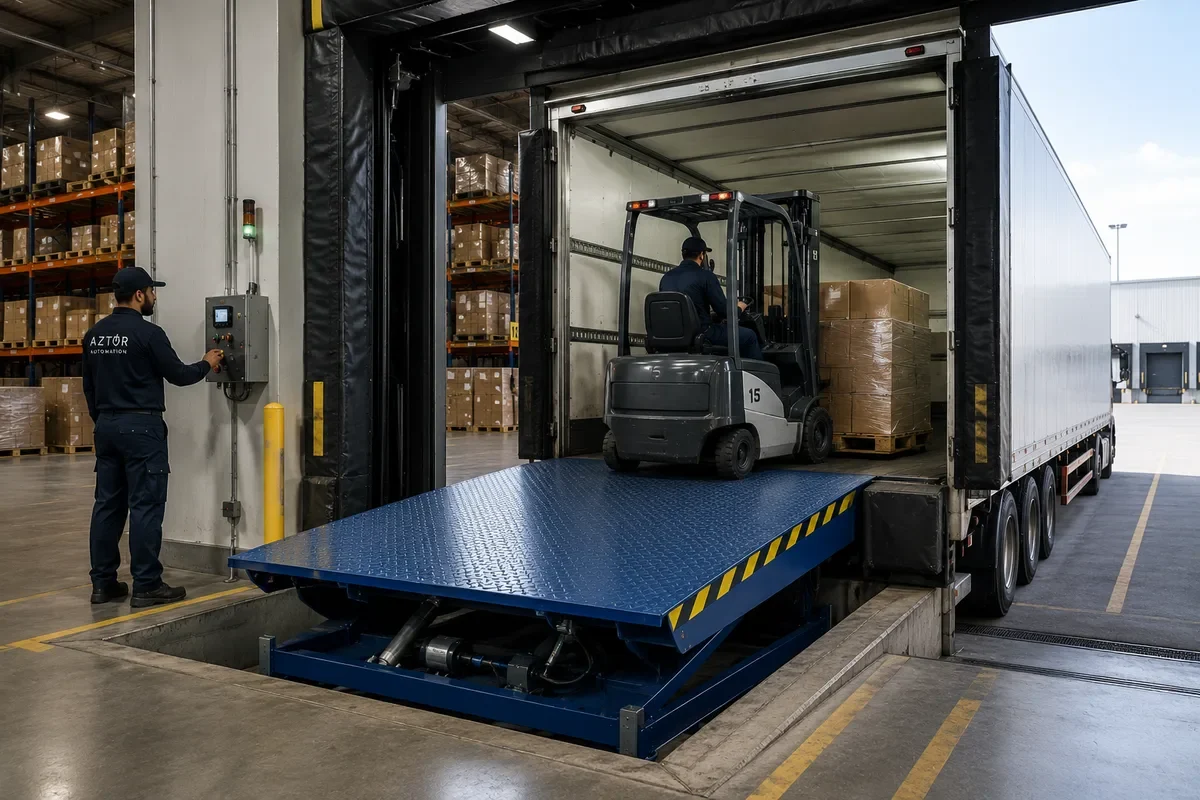
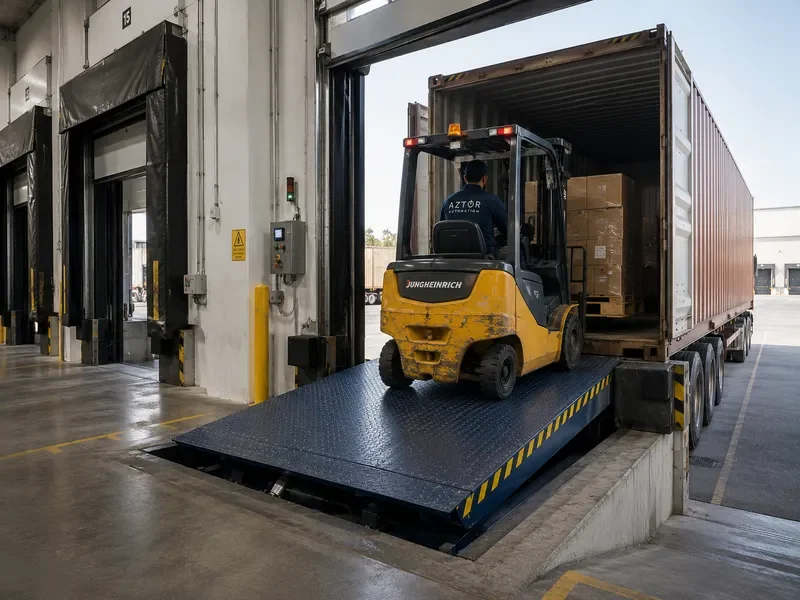
Dock levellers are loading-bay systems designed to bridge the height and distance difference between a warehouse dock and the floor of a truck or trailer. They create a controlled transition for forklifts, pallet trucks and other material-handling equipment during loading and unloading.
AZTÖR supplies, installs, repairs and maintains dock levellers for warehouses, logistics centres, distribution facilities, factories, cold stores and other commercial and industrial loading bays across the UAE.
A dock leveller should not be selected simply by platform dimensions or quoted load capacity. Vehicle types, dock height, trailer-bed range, forklift weight, transferred goods, traffic frequency, pit construction and loading procedure all influence the correct equipment selection.
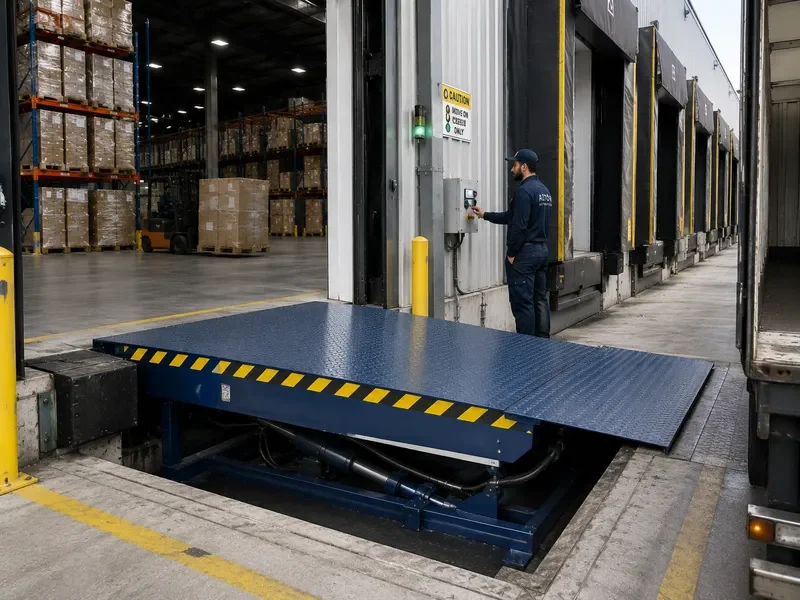
Hydraulic dock levellers are widely used in modern logistics facilities because the platform and lip can be operated through a hydraulic system using a suitable control station. They provide convenient operation for loading bays with frequent vehicle movements.
Depending on the application, hydraulic dock levellers can use hinged-lip or telescopic-lip configurations. Each has different operating characteristics and should be selected according to the vehicles, loading process and required positioning accuracy.
A hinged-lip dock leveller uses a lip attached to the front of the platform. During operation, the platform rises and the lip extends outward before the assembly lowers onto the vehicle bed, creating the bridge between dock and trailer.
Telescopic-lip dock levellers use a lip that extends horizontally from the platform. The controllable lip extension can provide more precise positioning onto the vehicle bed and can be particularly useful where loading conditions vary or where accurate lip placement is required.
Mechanical dock levellers can also be considered for suitable applications. Their operation and maintenance requirements differ from hydraulic equipment, and the appropriate choice depends on usage, budget and loading-bay requirements.
AZTÖR provides a free site inspection for applicable dock leveller projects. We assess the dock height, pit dimensions, vehicle types, trailer-bed heights, loading equipment, operating frequency, electrical provision and surrounding loading-bay equipment before recommending a configuration.
For new warehouses, dock leveller requirements should ideally be coordinated before the loading-bay pits and structural works are finalised. Pit dimensions, embedded steel, electrical conduits and surrounding construction need to match the selected equipment.
For existing loading bays, AZTÖR can inspect the current pit and structural arrangement to determine whether a replacement leveller can be installed within the existing opening or whether civil modifications are required.
Rated capacity must be selected from the actual loading operation. The combined weight of the forklift or pallet truck, operator where applicable and transferred load needs to be considered together with the dynamic forces created as equipment moves across the platform.
A higher published capacity does not by itself make one dock leveller more suitable than another. Platform construction, lip design, hydraulic system, structural support, duty cycle and the manufacturer's operating limitations must all be considered.
The vehicle must be correctly positioned and secured before loading operations begin. Depending on the loading-bay design, wheel chocks, vehicle restraints, traffic lights or other vehicle-control measures can be incorporated into the operating procedure.
Dock levellers can be coordinated with sectional overhead doors, dock shelters, dock seals, inflatable shelters, bumpers, vehicle restraints, traffic lights and other loading-bay equipment to create a complete dock solution.
Control interlocking can also be considered. For example, suitable systems can be configured so that certain dock equipment operates only when the required door, restraint or other loading-bay condition has been achieved. The exact sequence depends on the equipment and approved operating procedure.
Dock bumpers are important because they help protect the building and loading-bay equipment from normal vehicle contact during positioning. Damaged or incorrectly positioned bumpers can allow trucks to approach too close to the dock structure or leveller.
The lip must achieve adequate support on the vehicle bed according to the selected manufacturer's requirements. Insufficient lip engagement can create an unsafe transition and should not be corrected by improvised operation.
The dock leveller also needs to accommodate normal changes in trailer-bed height during loading and unloading. As weight is added or removed, vehicle suspension can move, and the leveller must operate within its intended working range.
Forklift speed and driver behaviour affect loading-bay safety. Operators should approach and cross the leveller in accordance with site procedures and the equipment manufacturer's instructions rather than treating the platform as an ordinary warehouse floor.
Safety features vary by manufacturer and model but can include emergency-stop functions, hydraulic safety devices, toe guards, maintenance supports, warning markings and other protective arrangements.
A maintenance support or similar manufacturer-specific device is particularly important when authorised technicians need to work beneath a raised platform. The leveller should never be serviced underneath without the required mechanical support and safe isolation procedure.
For cold stores and temperature-controlled warehouses, the dock leveller forms part of a larger environmental interface. Suitable dock shelters or inflatable seals, insulated sectional doors and appropriate loading procedures can help reduce exposure while vehicles are being loaded.
AZTÖR also provides dock leveller troubleshooting and repair. Common service requirements can involve hydraulic cylinders, hoses, pumps, valves, motors, control panels, switches, sensors, hinges, lip mechanisms, platform components and electrical connections.
Oil leakage, unusual movement, failure to raise, failure of the lip to extend or deploy, uneven platform movement and abnormal noise should be investigated before the equipment is returned to normal loading operations.
Structural damage or deformation should not be addressed only by repairing the hydraulic system. The platform, lip, hinges, frame, pit supports and surrounding structure should also be inspected where impact or overloading may have occurred.
Preventive maintenance is important for busy loading bays because dock levellers are repeatedly exposed to dynamic forklift loads, vehicle movement, dust and demanding daily operation. Mechanical, hydraulic, electrical and safety components should be inspected at appropriate intervals.
AZTÖR provides dock leveller supply, installation, replacement, repair and preventive maintenance across Dubai, Abu Dhabi, Sharjah, Ajman, Ras Al Khaimah, Fujairah and Umm Al Quwain, with suitable loading-bay support available across the wider GCC.
Key Features
- Industrial loading-bay dock levellers
- Hydraulic dock leveller options
- Hinged-lip dock levellers
- Telescopic-lip dock levellers
- Mechanical dock leveller options where suitable
- Forklift loading applications
- Pallet truck loading applications
- Warehouse loading bays
- Logistics and distribution applications
- Heavy-duty steel platform construction
- Project-specific platform dimensions
- Project-specific rated capacity
- Vehicle-bed height compensation
- Controlled platform movement
- Hydraulic power-pack operation
- Hydraulic cylinder systems
- Automatic lip deployment according to selected system
- Controlled telescopic lip extension
- Suitable lip support on vehicle bed
- Dynamic load considerations
- Side toe-guard options according to selected system
- Emergency-stop functions where provided
- Hydraulic safety systems according to selected model
- Maintenance support arrangements
- Control-panel operation
- Loading-bay interlock options
- Sectional door integration
- Dock shelter coordination
- Dock seal coordination
- Inflatable shelter coordination
- Vehicle-restraint integration
- Traffic-light integration
- Dock bumper coordination
- Existing dock leveller replacement
- Existing pit assessment
- Hydraulic-system repair
- Cylinder repair and replacement
- Hydraulic hose replacement
- Pump and motor servicing
- Valve troubleshooting
- Control-panel repair
- Limit and sensor troubleshooting
- Lip mechanism repair
- Hinge and platform inspection
- Preventive maintenance and AMC support
Technical Specification
| Product Type | Industrial dock leveller |
|---|---|
| Primary Function | Bridge between loading dock and vehicle bed |
| Application | Warehouse, logistics and industrial loading bays |
| Leveller Type | Hydraulic, mechanical or manufacturer-specific system |
| Lip Type | Hinged lip or telescopic lip |
| Platform Material | Heavy-duty steel construction |
| Platform Size | Selected according to loading bay and vehicle requirements |
| Rated Capacity | Manufacturer, model and application specific |
| Working Range | Manufacturer and model specific |
| Lip Length | Manufacturer, model and loading requirement specific |
| Lip Engagement | According to manufacturer operating requirements |
| Operation | Hydraulic, mechanical or system specific |
| Hydraulic Power Unit | According to selected hydraulic model |
| Hydraulic Cylinders | Manufacturer-specific configuration |
| Control Panel | Industrial dock leveller controller |
| Control Method | Push-button or manufacturer-specific control |
| Emergency Stop | According to selected system |
| Safety Valve | Manufacturer-specific hydraulic safety arrangement |
| Toe Protection | According to selected system |
| Maintenance Support | Manufacturer-specific mechanical maintenance support |
| Vehicle Movement Compensation | Within selected leveller operating range |
| Vehicle Restraint Integration | Available where compatible |
| Traffic Light Integration | Available where compatible |
| Door Interlocking | Available with suitable control systems |
| Dock Shelter Integration | Compatible as part of complete loading-bay solution |
| Dock Bumpers | Recommended according to loading-bay design |
| Pit Installation | According to manufacturer pit requirements |
| Existing Pit Installation | Subject to dimensional and structural assessment |
| Electrical Supply | According to selected hydraulic power unit and controls |
| Surface Finish | Manufacturer-specific protective coating |
| Environment | Indoor, covered or project-specific loading-bay conditions |
| Installation | New installation or replacement |
| Maintenance | Hydraulic, mechanical, electrical and safety-component servicing |
Dock leveller capacity, platform dimensions, lip type and working range must be selected from the actual loading operation, including vehicle-bed heights, forklift or pallet-truck weight, carried load, traffic frequency and pit construction. Published capacity should not be selected in isolation. AZTÖR provides a free site inspection to assess the loading bay and confirm the appropriate equipment configuration before installation or replacement.
Typical Applications
- Warehouses
- Logistics centres
- Distribution centres
- Fulfilment centres
- Loading bays
- Loading docks
- Factories
- Manufacturing facilities
- Industrial buildings
- Cold storage warehouses
- Temperature-controlled warehouses
- Food distribution facilities
- FMCG warehouses
- Retail distribution centres
- E-commerce fulfilment facilities
- Pharmaceutical warehouses
- Automotive facilities
- Spare-parts warehouses
- Cargo facilities
- Airport logistics facilities
- Freight terminals
- Transport depots
- Commercial storage facilities
- Large retail warehouses
- Supermarket distribution centres
- Production facilities
- Packaging facilities
- Third-party logistics facilities
- Refrigerated logistics centres
- Existing loading-bay upgrades